H.R. 2196 explained · 119th Congress · Became law
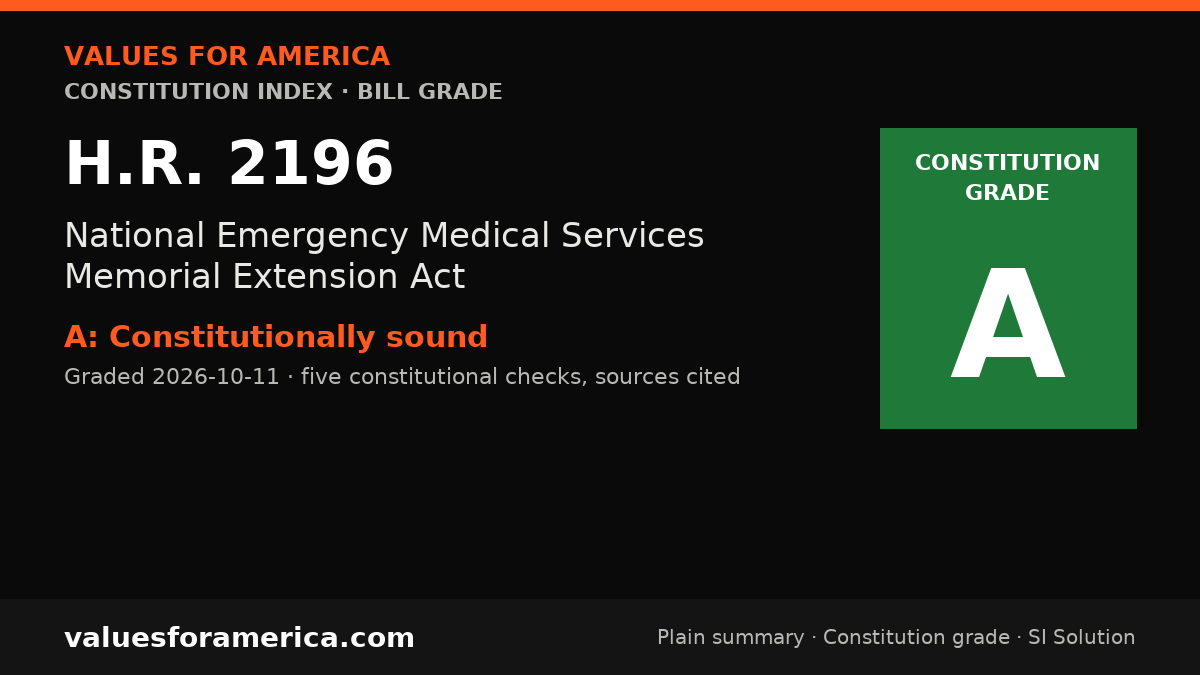
National Emergency Medical Services Memorial Extension Act
Cosponsors: 6 (5 D, 1 R) · per Congress.gov, 2026-10-14
Introduced: 2025-03-18
Latest action (2026-09-11): Became Public Law No: 119-107.
What H.R. 2196 does, in plain terms
National Emergency Medical Services Memorial Extension Act This bill reauthorizes the National Emergency Medical Services Memorial Foundation to establish in Washington, DC, a monument to commemorate the commitment and service represented by emergency medical services. This authorization expires seven years after enactment of the bill.
Official summary by the Congressional Research Service, via Congress.gov.
Constitution Index
“VFA Constitution grade”
Constitutionally sound
Graded 2026-10-11
SI-generated grade · five published checks · not individually reviewed by a person · methodology
This bill is a narrow, time-limited reauthorization of a memorial foundation for emergency medical services in Washington, DC. It involves no exercise of coercive federal power, no restriction on individual rights, and no consolidation of authority beyond the federal government's established role in managing the District of Columbia and maintaining national memorials. It passes all constitutional checks with no significant issues.
-
✓ Passes · Enumerated powers
The federal government has explicit authority to exercise exclusive legislation over the District of Columbia under Article I, Section 8, Clause 17. Establishing a memorial in Washington, DC falls squarely within this enumerated power. Additionally, the federal government has long-standing authority to manage public lands and maintain national memorials under the Property Clause (Article IV, Secti… -
✓ Passes · Bill of Rights
The bill imposes no restrictions on speech, religion, assembly, press, petition, arms, quartering, search and seizure, self-incrimination, due process, takings, trial rights, or cruel and unusual punishment. It merely authorizes a foundation to establish a monument. No provision of the Bill of Rights is implicated. -
✓ Passes · Individual sovereignty
The bill does not restrict any individual's use of their person, property, speech, labor, or belief. It creates no mandates, prohibitions, or obligations on private citizens. The foundation's establishment is voluntary and does not burden individual sovereignty. -
✓ Passes · Decentralization
The bill passes all four questions. (1) An individual or family could not establish a national memorial in Washington, DC on their own, as this requires federal authorization and management of federal land. (2) A local community or county could not handle this without federal involvement, as the memorial is to be located in the federal district. (3) A state could not handle this without federal in… -
✓ Passes · Due process and takings
The bill does not deprive any person of life, liberty, or property, nor does it take private property for public use. It involves no adjudicative or administrative proceedings that could implicate procedural due process. There is no arbitrary government action; the bill is a straightforward authorization for a memorial.
Sources: Congress.gov: HR 2196 summary
Report an error in this grade
The Framers
“Founders’ Verdict”
Confidence 0.75
Archived SI output (machine-generated)No editorial review recorded. This historical SI verdict was machine-generated by software and predates the review desk; check it against the official bill text.
Synthesis
The bill is constitutional because Congress has exclusive legislative authority over the District of Columbia under Article I, Section 8, Clause 17, and the authorization of a memorial to honor emergency medical services is a proper exercise of that power, further supported by the General Welfare Clause and the Necessary and Proper Clause. The temporary seven-year authorization ensures legislative oversight and does not exceed enumerated powers.
The Constitution grants Congress the power to provide for the general welfare and to exercise exclusive legislation over the District of Columbia (Article I, Section 8, Clause 1 and Clause 17). Authorizing a memorial to honor emergency medical services falls within the scope of promoting the general welfare and regulating affairs within the federal district. The bill does not infringe upon any enumerated powers reserved to the states, nor does it violate the separation of powers. The seven-year expiration ensures that the authorization is temporary and subject to renewal, consistent with prude…
The Constitution grants Congress only those powers enumerated in Article I, Section 8. Nowhere does it authorize the establishment of monuments or memorials, even within the District of Columbia. The Tenth Amendment reserves all powers not delegated to the United States to the States or the people. While Congress may legislate for the District under Article I, Section 8, Clause 17, this power is limited to governing the seat of government—not to erecting commemorative structures that serve no necessary federal function. Such an act exceeds the strict bounds of federal authority and encroaches …
This bill falls squarely within the enumerated powers of Congress. The Constitution grants Congress exclusive legislative authority over the District of Columbia, which includes the power to authorize the establishment of monuments on federal lands within the District. Furthermore, the authorization of a memorial to commemorate emergency medical services serves the general welfare, a purpose for which Congress may appropriate funds under its spending power. The bill does not exceed any constitutional limitation; it is a proper exercise of federal authority over the seat of government and a per…
The Congress possesses the exclusive power to legislate for the District of Columbia under Article I, Section 8, Clause 17. The establishment of a monument within the District to honor emergency medical services is a proper exercise of that power, as it serves to commemorate public service and falls within the scope of permissible federal action. Furthermore, the Necessary and Proper Clause (Article I, Section 8, Clause 18) authorizes Congress to enact laws that are appropriate and plainly adapted to the exercise of its enumerated powers. Reauthorizing a foundation to erect such a monument is …
Report an error in this Founders' Verdict
What should pass
“VFA SI Solution”
Archived SI output (machine-generated) · No editorial review recorded
This historical draft has no editorial review time on record. Check its claims against the original bill and current law.
National Emergency Medical Services Memorial Authorization and Oversight Act of 2025
Generated by VFA SI Solutions
Extend the authorization for the establishment of a national memorial honoring emergency medical services personnel on federal land in the District of Columbia.
Bipartisan rationale: Honors Democratic priorities of recognizing public service and supporting federal workers, and Republican priorities of fiscal restraint (no federal funding) and limited government (sunset provision, private funding).
Article I, Section 8, Clause 17 Article I, Section 8, Clause 1
Report an error in this Solution
Citizen Consensus
“Do you support this VFA SI Solution?”
One vote per verified account; you can change it any time. Only verified accounts count, results publish once 30 verified people have voted, and state and district results count only people who attested a home ZIP code. How this works.
Email verification is not switched on yet, so no vote counts toward results yet. Votes cast now are saved and count once the voter verifies their email address.
Sign in or create a free account to vote.
Add a short reason (optional)
/280 · no links or contact details · reasons are reviewed before anyone sees them, and many never are shown.
Your vote is saved but held out of published results by an automated integrity check (for example, several accounts voting from one browser).
Your vote is saved. It will count once you verify your email address. Verify on your account page.
Your vote counts nationally. Add your home ZIP code to count in your state and district too.
Your vote counts nationally and in .
Reason saved privately; it is shown only if it passes review.
Verified participants nationwide · n =
Self-selected participants, not a random sample; ± is the 95% sampling margin.
Not enough verified votes yet. Results publish at verified votes.
A sudden surge of votes on this item was flagged and is under review; votes from new accounts in that surge are held out until it is resolved.
Related on VFA

For journalists and bloggers
“Embed this grade”
Free to use with the link back. The badge and card update when the grade changes. Embed terms →
