H.R. 2180 explained · 119th Congress · Pending in Congress
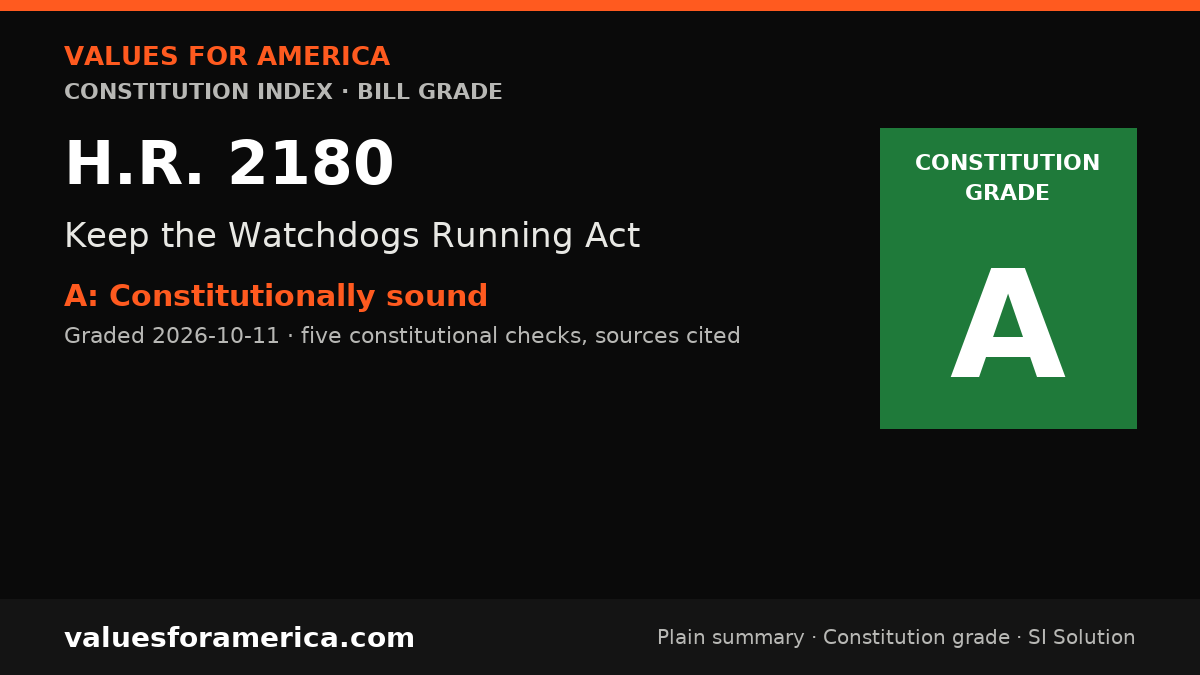
Keep the Watchdogs Running Act
Cosponsors: 16 (16 D, 0 R) · per Congress.gov, 2026-10-10
Introduced: 2025-03-18
Latest action (2025-11-20): ASSUMING FIRST SPONSORSHIP - Mr. Walkinshaw asked unanimous consent that he may hereafter be considered as the first sponsor of H.R. 2180, a bill originally introduced by Representative Connolly, for the purpose of adding cosponsors and requesting reprintings pursuant to clause 7 of rule XII. Agreed to without objection.
What H.R. 2180 does, in plain terms
Keep the Watchdogs Running Act This bill authorizes a federal office of inspector general (OIG) to continue performing its duties during a lapse in appropriations (i.e., government shutdown). During a lapse in appropriations, the OIG may obligate funds (1) at the rate of operations and under the authority and conditions provided in the most recently enacted appropriations act, and (2) to perform its duties with respect to any program that continues during the lapse in appropriations.
Official summary by the Congressional Research Service, via Congress.gov.
Constitution Index
“VFA Constitution grade”
Constitutionally sound
Graded 2026-10-11
SI-generated grade · five published checks · not individually reviewed by a person · methodology
The bill is a narrow, constitutionally sound measure that ensures federal inspectors general can continue their oversight duties during a government shutdown. It does not expand federal power, infringe on rights, or centralize authority; it merely maintains the status quo of existing offices during a lapse in appropriations.
-
✓ Passes · Enumerated powers
Congress has the power to appropriate funds and to organize the executive branch under Article I, Section 8, Clause 18 (the Necessary and Proper Clause) and Article I, Section 9, Clause 7 (Appropriations Clause). Authorizing an existing office to continue operations during a lapse in appropriations is a valid exercise of Congress's spending and oversight powers. -
✓ Passes · Bill of Rights
The bill does not implicate any of the first ten amendments. It does not restrict speech, religion, assembly, press, petition, arms, quartering, search and seizure, self-incrimination, due process, takings, trial rights, or cruel and unusual punishment. It is purely administrative. -
✓ Passes · Individual sovereignty
The bill does not restrict individual liberty or property. It only allows federal inspectors general to continue their existing oversight functions during a shutdown, which does not impose new burdens on individuals. Any oversight is already authorized by law and subject to due process. -
✓ Passes · Decentralization
The bill does not consolidate power upward. It merely allows existing federal oversight offices to continue functioning during a lapse in appropriations. The functions are already federal, and the bill does not expand their jurisdiction or create new federal authority. It does not affect the ability of individuals, localities, or states to handle their own affairs. -
✓ Passes · Due process and takings
The bill does not deprive anyone of life, liberty, or property without due process, nor does it take private property for public use without just compensation. It is a routine appropriations-related measure that does not affect individual rights.
Sources: Congress.gov: HR 2180 summary
Report an error in this grade
What should pass
“VFA SI Solution”
No solution yet
A sourced SI draft appears here once it passes automated checks (Constitution citation, source verification, independent SI critic). How publication works.
Related on VFA

For journalists and bloggers
“Embed this grade”
Free to use with the link back. The badge and card update when the grade changes. Embed terms →
