H.R. 21 explained · 119th Congress · Pending in Congress
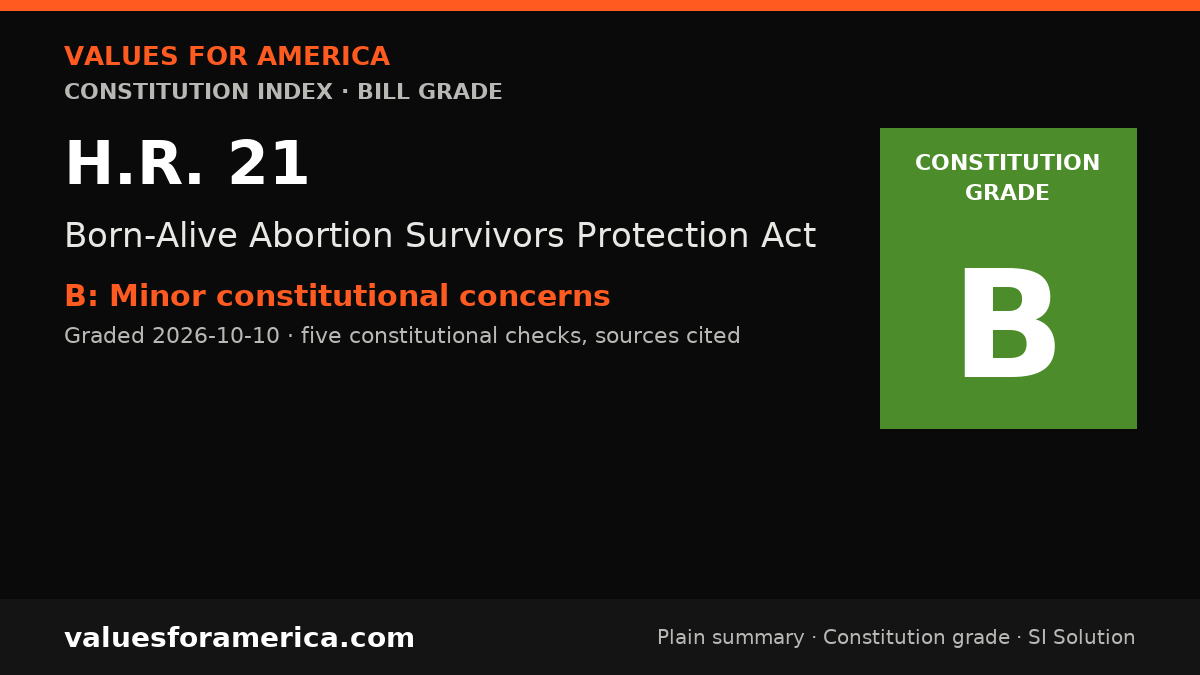
Born-Alive Abortion Survivors Protection Act
Cosponsors: 163 (0 D, 163 R) · per Congress.gov, 2026-10-12
Introduced: 2025-01-03
Latest action (2025-01-24): Received in the Senate and Read twice and referred to the Committee on the Judiciary.
What H.R. 21 does, in plain terms
Born-Alive Abortion Survivors Protection Act This bill establishes requirements for the degree of care a health care practitioner must provide in the case of a child born alive following an abortion or attempted abortion. Specifically, a health care practitioner who is present must (1) exercise the same degree of care as would reasonably be provided to any other child born alive at the same gestational age, and (2) ensure the child is immediately admitted to a hospital. Additionally, a health care practitioner or other employee who has knowledge of a failure to comply with the degree-of-care requirements must immediately report such failure to law enforcement. A health care practitioner who fails to provide the required degree of care, or a health care practitioner or other employee who fails to report such failure, is subject to criminal penalties—a fine, up to five years in prison, or both. An individual who intentionally kills or attempts to kill a child born alive is subject to prosecution for murder. The bill bars the criminal prosecution of a mother of a child born alive under this bill and allows her to bring a civil action against a health care practitioner or other employee for violations.
Official summary by the Congressional Research Service, via Congress.gov.
Constitution Index
“VFA Constitution grade”
Minor constitutional concerns
Graded 2026-10-10
SI-generated grade · five published checks · not individually reviewed by a person · methodology
The bill is mostly sound but has minor constitutional tensions. It falls within Congress's enumerated powers under the Commerce Clause and the Fourteenth Amendment's enforcement authority, does not directly infringe the Bill of Rights, and respects individual sovereignty by exempting the mother from prosecution. However, the criminal penalties for failing to report may raise minor due process concerns regarding vagueness and the compelled reporting requirement.
-
✓ Passes · Enumerated powers
Congress has authority under Article I, Section 8, Clause 3 (Commerce Clause) to regulate medical procedures and facilities involved in interstate commerce, and under Section 5 of the Fourteenth Amendment to enforce the right to life for persons born alive. The bill targets conduct in healthcare settings that affect interstate commerce and protects constitutional rights. -
✓ Passes · Bill of Rights
The bill does not restrict speech, religion, assembly, press, petition, arms, quartering, or jury trial. It does not authorize unreasonable searches or seizures (Fourth Amendment) and does not impose cruel and unusual punishment (Eighth Amendment). The criminal penalties are proportionate and apply only to intentional failures to provide care or to report. No First or Second Amendment rights are i… -
✓ Passes · Individual sovereignty
The bill does not restrict what a person may do with their own body, property, speech, labor, or belief. It imposes duties on healthcare practitioners in a professional context, which is a legitimate exercise of the state's police power to protect the life of a born child. The mother is explicitly exempt from prosecution, preserving her individual sovereignty. -
✗ Concern · Decentralization
The bill fails the decentralization test because it imposes federal criminal penalties for conduct that could be handled by states under their traditional police powers. While the protection of born-alive infants is a compelling interest, the federalization of medical malpractice and reporting requirements consolidates decision-making upward unnecessarily. States already have laws addressing this … -
✗ Concern · Due process and takings
The bill raises minor due process concerns. The requirement to report failures to law enforcement is clear, but the term 'failure to provide the required degree of care' could be vague in emergency situations, potentially violating the Fifth Amendment's Due Process Clause by not providing fair notice. However, the bill does not take property without just compensation and preserves procedural prote…
Sources: Congress.gov: HR 21 summary
Report an error in this grade
What should pass
“VFA SI Solution”
No solution yet
A sourced SI draft appears here once it passes automated checks (Constitution citation, source verification, independent SI critic). How publication works.
Related on VFA

For journalists and bloggers
“Embed this grade”
Free to use with the link back. The badge and card update when the grade changes. Embed terms →
