H.R. 2096 explained · 119th Congress · Pending in Congress
Protecting Our Nation’s Capital Emergency Act
Cosponsors: 3 (0 D, 3 R) · per Congress.gov, 2026-10-11
Introduced: 2025-03-14
Latest action (2025-06-11): Received in the Senate and Read twice and referred to the Committee on Homeland Security and Governmental Affairs.
What H.R. 2096 does, in plain terms
Protecting Our Nation's Capital Emergency Act of 2025 This bill rescinds certain changes that were made in 2023 to District of Columbia (DC) law governing discipline of Metropolitan Police Department (MPD) officers. First, the bill reinstates a 90-day statute of limitations (i.e., time limit) for initiating a corrective or adverse action against any MPD officer or civilian employee. The bill also allows officer disciplinary matters to be negotiated as part of a collective bargaining agreement. Next, the bill eliminates the MPD police chief's authority to increase the police trial board's recommended penalty for officer misconduct. Finally, the bill eliminates a requirement that MPD publish a schedule online of disciplinary hearings for which the proposed action is termination, including the date, time, and underlying allegations.
Official summary by the Congressional Research Service, via Congress.gov.
Constitution Index
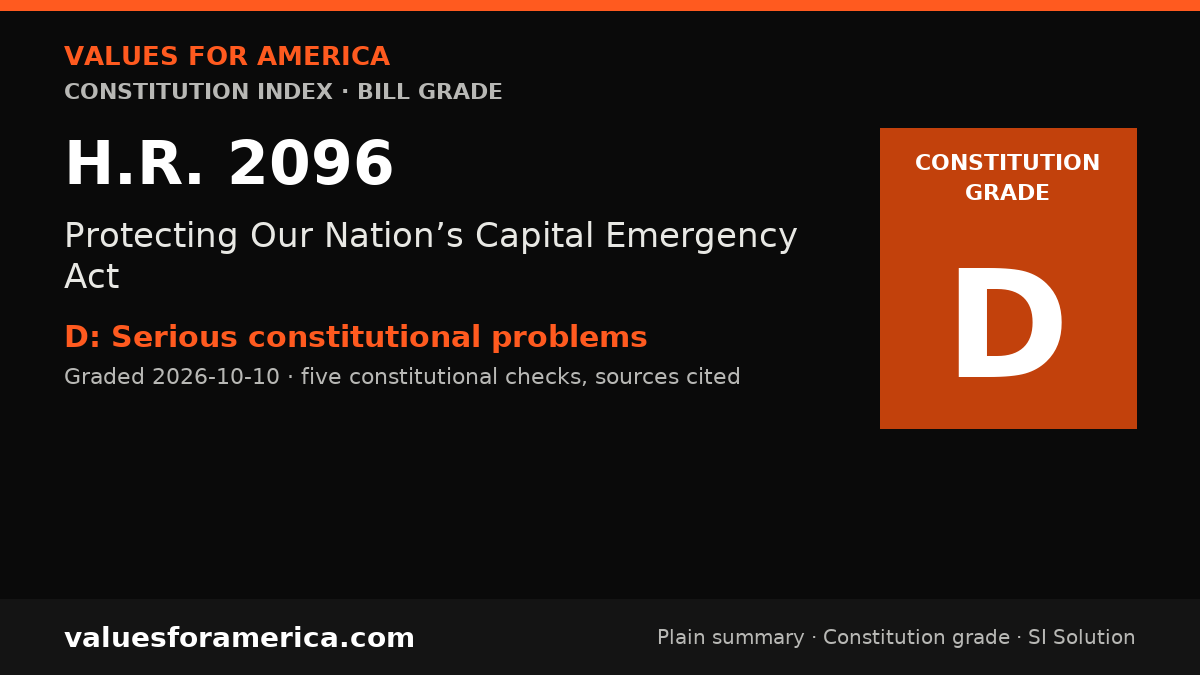
“VFA Constitution grade”
Serious constitutional problems
Graded 2026-10-10
SI-generated grade · five published checks · not individually reviewed by a person · methodology
This bill is likely unconstitutional because it violates the constitutional principle of federalism and the Tenth Amendment by overriding the District of Columbia's local self-governance in a matter of purely local police administration, without any enumerated federal power. It also undermines due process and transparency in disciplinary proceedings, and consolidates decision-making at the federal level contrary to the principle of decentralization.
-
✗ Concern · Enumerated powers
The federal government has no enumerated power under Article I, Section 8 to regulate the internal disciplinary procedures of a local police department. The District of Columbia is a federal district, and Congress has plenary power over it under Article I, Section 8, Clause 17, but this power is typically exercised through local self-government. The bill's interference with D.C.'s local police dis… -
✗ Concern · Bill of Rights
The bill eliminates a requirement for public notice of disciplinary hearings, which undermines the public's right to know about government proceedings, a core component of the First Amendment's guarantee of freedom of the press and the public's right to petition. Additionally, by shortening the statute of limitations for initiating disciplinary actions, the bill may deprive officers of due process… -
✗ Concern · Individual sovereignty
The bill restricts the rights of MPD officers to fair disciplinary procedures, including the right to a timely and transparent hearing. By shortening the statute of limitations and eliminating public notice, it reduces the ability of officers to defend their reputations and livelihoods, and it reduces the public's ability to hold police accountable. These restrictions are not justified by a compel… -
✗ Concern · Decentralization
The bill fails the decentralization test. (1) Individuals and families cannot handle police discipline on their own, but (2) the local community of the District of Columbia can handle this without federal involvement, as it has its own elected government and police department. (3) The state (or in this case, the District) can handle this without federal involvement. (4) The bill consolidates decis… -
✗ Concern · Due process and takings
The bill's shortening of the statute of limitations for disciplinary actions may deprive officers of procedural due process by making it more difficult to challenge allegations, and the elimination of public notice of hearings reduces transparency, which is a component of due process. The bill does not provide for just compensation for any property interests affected, and it appears to be arbitrar…
Sources: Congress.gov: HR 2096 summary
Report an error in this grade
What should pass
“VFA SI Solution”
No solution yet
A sourced SI draft appears here once it passes automated checks (Constitution citation, source verification, independent SI critic). How publication works.
Related on VFA

For journalists and bloggers
“Embed this grade”
Free to use with the link back. The badge and card update when the grade changes. Embed terms →
