H.R. 2071 explained · 119th Congress · Pending in Congress
Save Our Shrimpers Act
Cosponsors: 20 (3 D, 17 R) · per Congress.gov, 2026-10-08
Introduced: 2025-03-11
Latest action (2026-05-13): Received in the Senate and Read twice and referred to the Committee on Foreign Relations.
What H.R. 2071 does, in plain terms
Save Our Shrimpers Act This bill prohibits federal funds from being made available to international financial institutions (e.g., the International Monetary Fund) for financing activities related to foreign shrimp farms. The bill also requires an annual report on compliance by U.S. leadership of international financial institutions with policies to oppose financing for certain commodities or minerals. Specifically, the bill requires the Department of the Treasury to condition any provision of federal funds to an international financial institution on the requirement that the funds not be used to finance any activity related to shrimp farming, shrimp processing, or the export of shrimp in any foreign country. Under current law, Treasury must instruct U.S. leadership of international financial institutions to oppose providing financial assistance for the production or extraction of any commodity or mineral for export if (1) the commodity or mineral is in surplus on world markets, and (2) the export of such commodity or mineral will cause substantial injury to U.S. producers of a competing commodity or mineral (or of the same or a similar commodity or mineral). This bill requires the Government Accountability Office to investigate and annually report to Congress on the extent to which U.S. leadership at these institutions have carried out Treasury's instructions.
Official summary by the Congressional Research Service, via Congress.gov.
Constitution Index
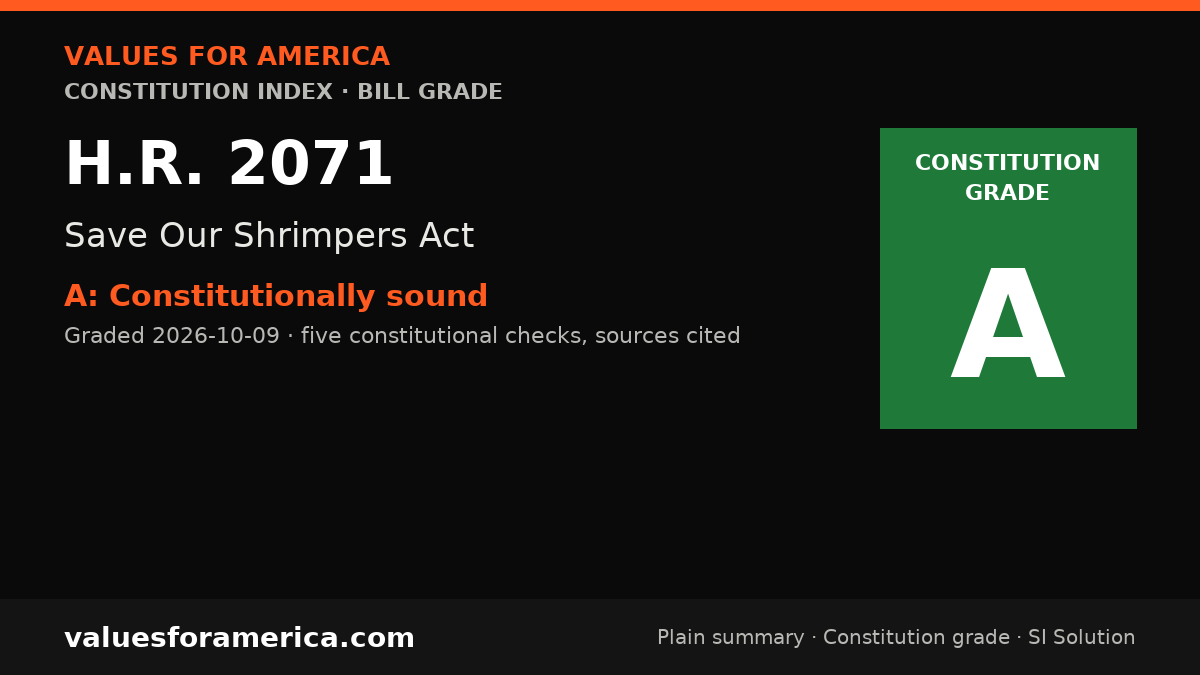
“VFA Constitution grade”
Constitutionally sound
Graded 2026-10-09
SI-generated grade · five published checks · not individually reviewed by a person · methodology
The Save Our Shrimpers Act is fully constitutional. It operates within Congress's enumerated powers over foreign commerce and federal spending, does not infringe any Bill of Rights protections, respects individual sovereignty by not restricting personal conduct, appropriately centralizes decision-making at the federal level for international financial matters, and does not violate due process or takings principles.
-
✓ Passes · Enumerated powers
Congress has authority under Article I, Section 8, Clause 1 (taxing and spending for the general welfare) and Clause 3 (regulating commerce with foreign nations) to condition federal funds to international financial institutions and to require reports on compliance with policies affecting foreign trade. The bill's subject matter—foreign shrimp farming and international finance—falls squarely withi… -
✓ Passes · Bill of Rights
The bill imposes no restriction on speech, religion, press, assembly, petition, arms, quartering, search and seizure, self-incrimination, due process, trial rights, jury rights, cruel and unusual punishment, or unenumerated rights. It only conditions federal funding to international bodies and requires reporting; it does not target any individual or group protected by the Bill of Rights. -
✓ Passes · Individual sovereignty
The bill does not restrict what any person may do with their own person, property, speech, labor, or belief. It does not prohibit U.S. citizens from engaging in shrimp farming, processing, or trade. It merely directs how federal funds may be used by international financial institutions, which does not infringe on individual liberty. The government has no burden to justify a restriction because non… -
✓ Passes · Decentralization
The action concerns international financial institutions and foreign trade—matters that inherently require federal authority. An individual or family cannot handle such matters; local communities and counties cannot; and states cannot condition federal funds or direct U.S. leadership at international bodies. The federal level is the minimum necessary, so no consolidation upward occurs. All four qu… -
✓ Passes · Due process and takings
The bill does not deprive any person of life, liberty, or property without due process. It does not take private property for public use without just compensation. It merely imposes prospective conditions on federal funding to international institutions, which is a routine exercise of the spending power and does not trigger procedural or substantive due process concerns, nor the Takings Clause of …
Sources: Congress.gov: HR 2071 summary
Report an error in this grade
What should pass
“VFA SI Solution”
No solution yet
A sourced SI draft appears here once it passes automated checks (Constitution citation, source verification, independent SI critic). How publication works.
Related on VFA

For journalists and bloggers
“Embed this grade”
Free to use with the link back. The badge and card update when the grade changes. Embed terms →
