H.R. 2056 explained · 119th Congress · Pending in Congress
District of Columbia Federal Immigration Compliance Act of 2025
Cosponsors: 1 (0 D, 1 R) · per Congress.gov, 2026-10-11
Introduced: 2025-03-11
Latest action (2025-06-12): Received in the Senate and Read twice and referred to the Committee on Homeland Security and Governmental Affairs.
What H.R. 2056 does, in plain terms
District of Columbia Federal Immigration Compliance Act This bill prohibits the District of Columbia (DC) from limiting its cooperation with federal immigration enforcement activities, except for certain instances involving witnesses and victims of crime. Specifically, the bill bars DC from adopting a law, policy, or practice prohibiting DC governmental entities from sending, receiving, maintaining, or exchanging information regarding the citizenship or immigration status of any individual with a federal, state, or local government entity. Further, DC may not adopt a law, policy, or practice of not complying with lawful requests from the Department of Homeland Security (DHS) to comply with a detainer for, or notify about the release of, an individual from custody. (A detainer is a formal request from DHS that a state or locality hold an individual in custody for up to 48 hours after the individual would otherwise be released so that DHS may facilitate the individual's removal.) The bill provides exceptions allowing DC to adopt policies of not sharing information or complying with a detainer request regarding an individual who comes forward as a victim or a witness of a crime.
Official summary by the Congressional Research Service, via Congress.gov.
Constitution Index
“VFA Constitution grade”
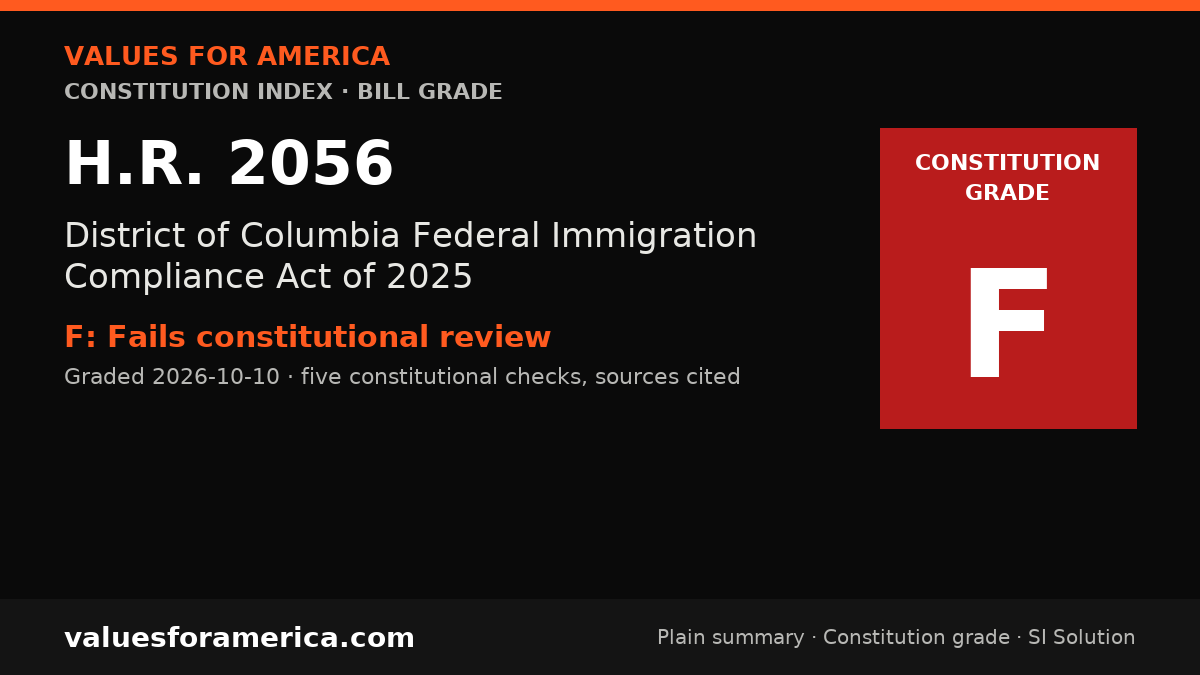
Fails constitutional review
Graded 2026-10-10
SI-generated grade · five published checks · not individually reviewed by a person · methodology
HR 2056 is a direct federal commandeering of a state-level government (the District of Columbia) in violation of the Tenth Amendment and the anti-commandeering doctrine. It forces DC to enforce federal immigration law, infringes on local sovereignty, and raises serious Fourth and Fifth Amendment concerns by compelling the sharing of immigration status information without individualized suspicion or due process.
-
✗ Concern · Enumerated powers
Congress has broad power over immigration under Article I, Section 8, Clause 4 (naturalization) and the Necessary and Proper Clause. However, the bill does not regulate immigration directly; it commands a local government to enforce federal immigration law. The Supreme Court has held that the federal government cannot 'commandeer' state or local governments to administer federal regulatory program… -
✗ Concern · Bill of Rights
The bill compels DC to share citizenship or immigration status information with federal authorities. This threatens Fourth Amendment protections against unreasonable searches and seizures by encouraging warrantless data collection and detention based on immigration status alone. It also implicates the Fifth Amendment's Due Process Clause by potentially detaining individuals without a judicial warr… -
✗ Concern · Individual sovereignty
The bill restricts the ability of individuals in DC to be free from federal immigration enforcement absent a criminal warrant. It forces local police to act as immigration enforcers, which undermines trust and can lead to detention of individuals who have committed no crime. The government has not shown a compelling justification for overriding local discretion in this area, especially given that … -
✗ Concern · Decentralization
The bill fails all four decentralization questions. (1) Individuals cannot handle federal immigration enforcement on their own. (2) Local communities cannot handle this without state involvement because the bill preempts local policy. (3) States (or DC) could handle cooperation with federal immigration enforcement without federal commandeering. (4) The bill consolidates decision-making at the fede… -
✗ Concern · Due process and takings
The bill requires DC to comply with DHS detainers, which are administrative requests, not judicial warrants. This bypasses the Fourth Amendment's warrant requirement and the Fifth Amendment's guarantee of procedural due process. Individuals may be held for up to 48 hours without a criminal charge or judicial hearing. The Takings Clause is not directly implicated, but the due process violation is c…
Sources: Congress.gov: HR 2056 summary
Report an error in this grade
What should pass
“VFA SI Solution”
No solution yet
A sourced SI draft appears here once it passes automated checks (Constitution citation, source verification, independent SI critic). How publication works.
Related on VFA

For journalists and bloggers
“Embed this grade”
Free to use with the link back. The badge and card update when the grade changes. Embed terms →
