H.R. 2035 explained · 119th Congress · Pending in Congress
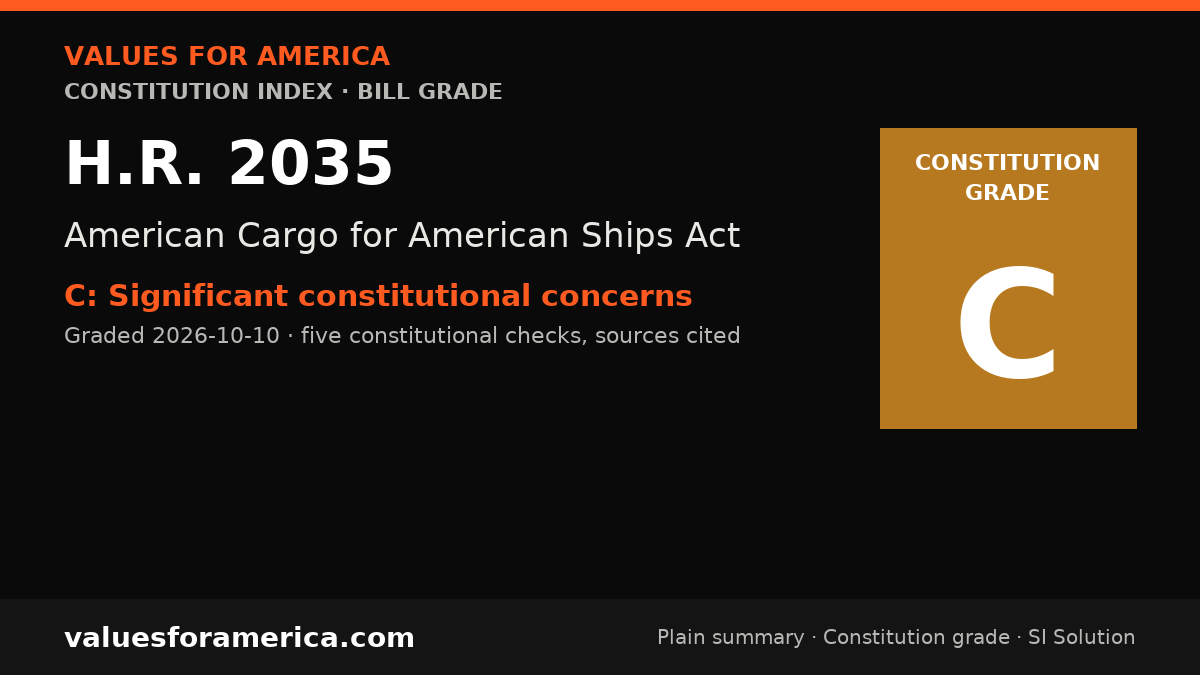
American Cargo for American Ships Act
Cosponsors: 1 (0 D, 1 R) · per Congress.gov, 2026-10-11
Introduced: 2025-03-11
Latest action (2025-06-10): Received in the Senate and Read twice and referred to the Committee on Commerce, Science, and Transportation.
What H.R. 2035 does, in plain terms
American Cargo for American Ships Act This bill requires 100% of equipment, materials, and commodities procured, furnished, or financed by the Department of Transportation (DOT) and transported on ocean vessels to be transported on U.S.-flagged commercial vessels. (Current cargo preference laws require that a minimum percentage of federally financed ocean cargo be transported on U.S.-flagged commercial vessels. For civilian agencies and agricultural cargo, the minimum is generally 50%.) Specifically, the bill imposes the requirement on DOT (for cargo it contracts for or procures for itself) and recipients of DOT funding (for cargo DOT has financed with federal funds or advanced funds for the recipient to obtain). As under current cargo preference laws, the requirement applies to the extent those vessels are available at fair and reasonable rates for U.S.-flagged commercial vessels, in a manner that will ensure fair and reasonable participation of U.S.-flagged commercial vessels by geographic area.
Official summary by the Congressional Research Service, via Congress.gov.
Constitution Index
“VFA Constitution grade”
Significant constitutional concerns
Graded 2026-10-10
SI-generated grade · five published checks · not individually reviewed by a person · methodology
The bill raises significant constitutional concerns by expanding federal cargo preference requirements beyond the traditional 50% threshold to 100% for DOT-related ocean transport. While Congress has authority under the Commerce Clause to regulate interstate and foreign commerce, the 100% mandate may overreach by effectively reserving all such transport for U.S.-flagged vessels, potentially burdening foreign commerce and raising due process and takings concerns for affected parties. The bill also centralizes decision-making at the federal level, failing the decentralization test.
-
✓ Passes · Enumerated powers
Congress has authority under Article I, Section 8, Clause 3 (Commerce Clause) to regulate commerce with foreign nations and among the several states. Requiring U.S.-flagged vessels for federally financed ocean transport falls within this power, as it directly regulates commercial shipping and federal procurement. The bill's scope is limited to DOT and its funding recipients, which is a legitimate … -
✓ Passes · Bill of Rights
The bill does not infringe on any of the first ten amendments. It does not restrict speech, religion, assembly, press, petition, arms, quartering, search and seizure, self-incrimination, due process, takings, fair trial, jury, cruel and unusual punishment, or unenumerated rights. The requirement applies to commercial shipping, not to individual rights. -
✗ Concern · Individual sovereignty
The bill restricts the freedom of DOT and its funding recipients to contract for ocean transport services as they see fit, mandating that 100% of such transport be on U.S.-flagged vessels. While the government has a compelling interest in supporting the U.S. merchant marine, the 100% requirement is a significant restriction on economic liberty and may not be the least restrictive means to achieve … -
✗ Concern · Decentralization
The bill fails the decentralization test. (1) Individuals and families cannot handle ocean transport of DOT cargo without government involvement, so the first question is answered 'no.' (2) Local communities and counties cannot handle this, so the second question is 'no.' (3) States could potentially handle this without federal involvement, as states have their own procurement and transportation n… -
✗ Concern · Due process and takings
The bill may raise due process and takings concerns. It imposes a new 100% requirement on DOT and funding recipients, which could disrupt existing contracts and impose additional costs. While the bill includes a 'fair and reasonable rates' exception, it does not provide a clear process for affected parties to challenge the application of the requirement or seek compensation for any losses. This co…
Sources: Congress.gov: HR 2035 summary
Report an error in this grade
What should pass
“VFA SI Solution”
No solution yet
A sourced SI draft appears here once it passes automated checks (Constitution citation, source verification, independent SI critic). How publication works.
Related on VFA

For journalists and bloggers
“Embed this grade”
Free to use with the link back. The badge and card update when the grade changes. Embed terms →
