H.R. 2004 explained · 119th Congress · Pending in Congress
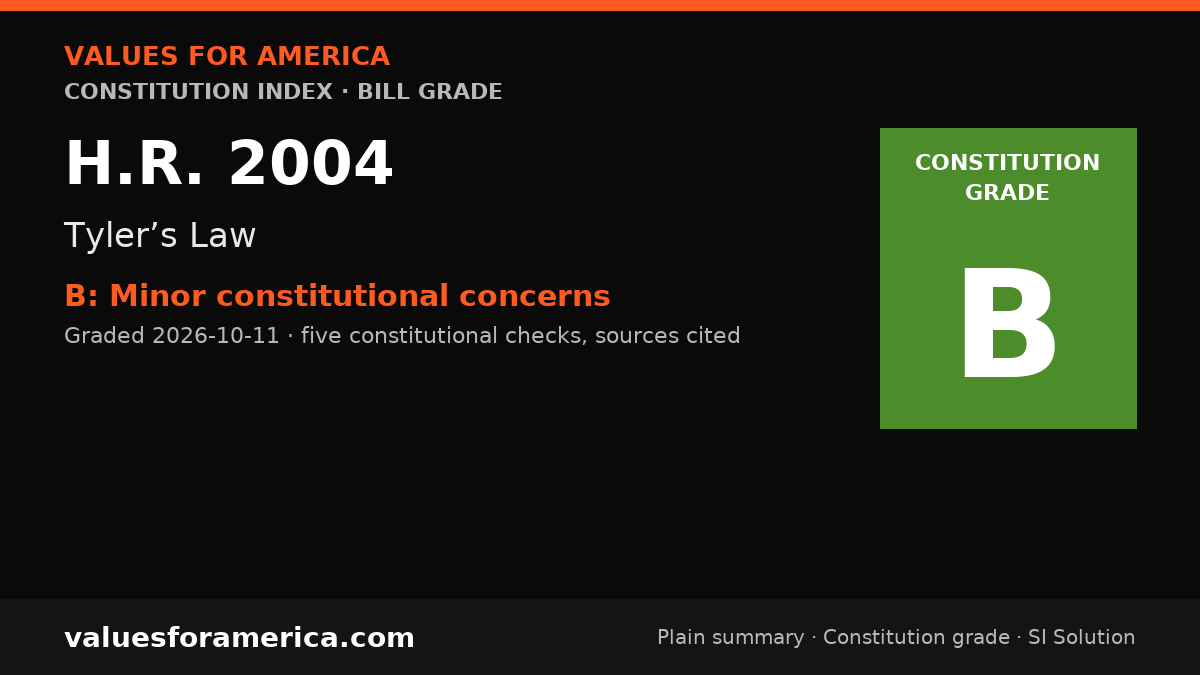
Tyler’s Law
Cosponsors: 65 (35 D, 30 R) · per Congress.gov, 2026-10-14
Introduced: 2025-03-10
Latest action (2026-09-16): Received in the Senate. Read twice. Placed on Senate Legislative Calendar under General Orders. Calendar No. 625.
What H.R. 2004 does, in plain terms
Tyler’s Law This bill requires the Department of Health and Human Services (HHS) to complete, within one year after the bill’s enactment, a study on how frequently Medicare-participating hospital emergency departments test for fentanyl in patients experiencing an overdose, the costs associated with such testing, and how such testing may impact patients. Within six months after the study’s completion and based on its results, HHS must issue guidance regarding (1) whether hospital emergency departments should implement fentanyl testing as a routine procedure for patients experiencing an overdose, (2) how to ensure clinicians know which substances they are testing for in routine drug tests, and (3) how fentanyl testing may affect the future risk of overdose and other health outcomes.
Official summary by the Congressional Research Service, via Congress.gov.
Constitution Index
“VFA Constitution grade”
Minor constitutional concerns
Graded 2026-10-11
SI-generated grade · five published checks · not individually reviewed by a person · methodology
HR 2004, Tyler's Law, directs the Department of Health and Human Services to conduct a study and issue guidance regarding fentanyl testing in hospital emergency departments. The bill does not mandate testing or impose penalties; it merely authorizes a study and non-binding guidance. While the federal government has authority to regulate Medicare-participating hospitals under the Spending Clause, the bill's prescriptive guidance could raise concerns about federal overreach into medical practice. However, because the guidance is non-binding and the study is informational, the bill is mostly sound with minor constitutional tensions.
-
✓ Passes · Enumerated powers
The federal government has authority to attach conditions to Medicare funding under Article I, Section 8, Clause 1 (Spending Clause). Requiring a study and issuing guidance to Medicare-participating hospitals is a permissible exercise of the spending power, as it is reasonably related to the federal interest in the Medicare program. The bill does not mandate state action or regulate outside federa… -
✓ Passes · Bill of Rights
The bill does not infringe on any enumerated rights in the Bill of Rights. It does not restrict speech, religion, assembly, press, petition, arms, quartering, search and seizure, self-incrimination, due process, takings, trial rights, or cruel and unusual punishment. The study and guidance are informational and non-coercive, so no constitutional right is implicated. -
✓ Passes · Individual sovereignty
The bill does not restrict individual liberty. It does not mandate testing, treatment, or any action by patients. It merely directs a study and the issuance of non-binding guidance to hospitals. Individuals retain full autonomy over their medical decisions. The burden of justification for any restriction is not triggered because no restriction exists. -
✗ Concern · Decentralization
The bill fails the decentralization test because it consolidates decision-making at the federal level for a matter that could be handled by states or local communities. While the federal government has a legitimate interest in Medicare, the study and guidance could be conducted at the state level without federal involvement. However, the bill does not directly violate the Tenth Amendment because i… -
✓ Passes · Due process and takings
The bill does not deprive any person of life, liberty, or property without due process. It does not impose fines, penalties, or mandates. The study and guidance are non-binding and do not affect property rights. There is no taking of private property for public use without just compensation. The bill is procedural and informational, so due process concerns are not implicated.
Sources: Congress.gov: HR 2004 summary
Report an error in this grade
What should pass
“VFA SI Solution”
No solution yet
A sourced SI draft appears here once it passes automated checks (Constitution citation, source verification, independent SI critic). How publication works.
Related on VFA

For journalists and bloggers
“Embed this grade”
Free to use with the link back. The badge and card update when the grade changes. Embed terms →
