H.R. 1998 explained · 119th Congress · Pending in Congress
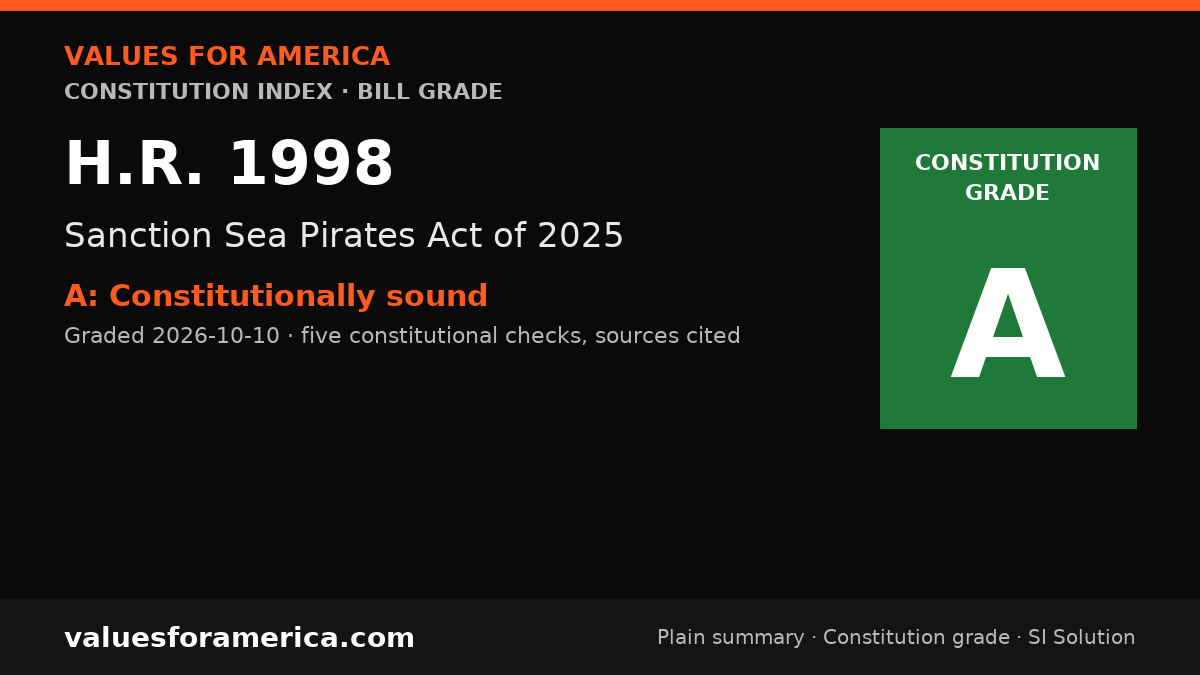
Sanction Sea Pirates Act of 2025
Cosponsors: 4 (2 D, 2 R) · per Congress.gov, 2026-10-11
Introduced: 2025-03-10
Latest action (2025-06-24): Received in the Senate and Read twice and referred to the Committee on Foreign Relations.
What H.R. 1998 does, in plain terms
Sanction Sea Pirates Act of 2025 This bill requires the President to impose visa- and property-blocking sanctions on any foreign person (individual or entity) that the President determines knowingly engages in piracy. The bill also applies civil and criminal penalties to persons that violate, attempt to violate, conspire to violate, or cause a violation of the regulations promulgated to carry out such sanctions.
Official summary by the Congressional Research Service, via Congress.gov.
Constitution Index
“VFA Constitution grade”
Constitutionally sound
Graded 2026-10-10
SI-generated grade · five published checks · not individually reviewed by a person · methodology
This bill is fully constitutional. It operates within the federal government's enumerated foreign affairs and commerce powers, does not infringe any Bill of Rights protections, respects individual sovereignty by targeting only foreign persons engaged in piracy, passes all decentralization tests because foreign piracy is inherently a federal matter, and provides due process through presidential determination and regulatory implementation.
-
✓ Passes · Enumerated powers
The bill falls squarely within Congress's enumerated powers under Article I, Section 8, Clause 10 (Define and Punish Piracies and Felonies on the High Seas) and Clause 3 (Regulate Commerce with Foreign Nations). Sanctions on foreign persons engaging in piracy are a traditional exercise of federal authority over international affairs and maritime commerce. The federal government has exclusive const… -
✓ Passes · Bill of Rights
The bill targets foreign persons (individuals or entities) who are not U.S. persons or within U.S. jurisdiction for the conduct of piracy. The Bill of Rights generally protects persons within U.S. territory or under U.S. control, not foreign actors abroad engaged in criminal activity on the high seas. The civil and criminal penalties apply only to persons who violate sanctions regulations, which i… -
✓ Passes · Individual sovereignty
The bill restricts the property and travel of foreign persons who knowingly engage in piracy—a violent criminal act that violates international law and the law of nations. The government has a compelling constitutional interest in suppressing piracy, which is explicitly authorized by Article I, Section 8, Clause 10. The restriction is narrowly tailored to those who commit piracy, not to innocent i… -
✓ Passes · Decentralization
Piracy on the high seas is inherently an international and federal matter that no individual, family, local community, or state could effectively address. The four-question test confirms: (1) No individual or family can sanction foreign pirates; (2) No local community or county can impose visa blocks or property freezes on foreign entities; (3) No state has constitutional authority over foreign af… -
✓ Passes · Due process and takings
The bill provides procedural due process by requiring the President to make a determination that a foreign person 'knowingly engages in piracy' before imposing sanctions. This is a standard administrative process with notice and opportunity to be heard through regulatory procedures. The property blocking is not a taking under the Fifth Amendment because it is a temporary sanction tied to illegal c…
Sources: Congress.gov: HR 1998 summary
Report an error in this grade
What should pass
“VFA SI Solution”
No solution yet
A sourced SI draft appears here once it passes automated checks (Constitution citation, source verification, independent SI critic). How publication works.
Related on VFA

For journalists and bloggers
“Embed this grade”
Free to use with the link back. The badge and card update when the grade changes. Embed terms →
