H.R. 1966 explained · 119th Congress · Pending in Congress
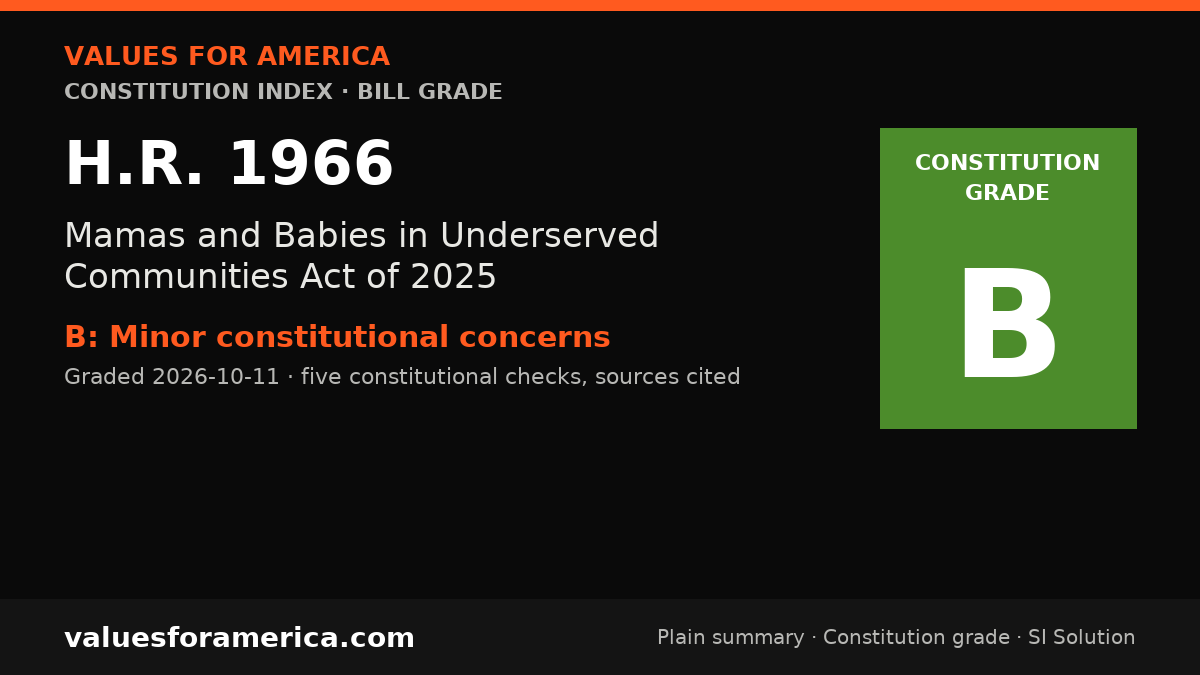
Mamas and Babies in Underserved Communities Act of 2025
Cosponsors: 40 (40 D, 0 R) · per Congress.gov, 2026-10-12
Introduced: 2025-03-06
Latest action (2025-03-06): Referred to the House Committee on Energy and Commerce.
What H.R. 1966 does, in plain terms
Mamas and Babies in Underserved Communities Act of 2025 This bill establishes Department of Health and Human Services grants for public or nonprofit private health care providers to expand and improve maternal health care services (including prenatal, postnatal, and postpartum care) and reduce disparities in access to such care. Health care providers are eligible to apply if they serve one or more minority, low-income, or medically underserved communities.
Official summary by the Congressional Research Service, via Congress.gov.
Constitution Index
“VFA Constitution grade”
Minor constitutional concerns
Graded 2026-10-11
SI-generated grade · five published checks · not individually reviewed by a person · methodology
This bill is mostly constitutional but has minor tensions regarding federal power and decentralization. It operates within Congress's spending power but extends federal influence into areas traditionally reserved to states and individuals.
-
✓ Passes · Enumerated powers
Congress has authority under the Spending Clause (Article I, Section 8, Clause 1) to tax and spend for the general welfare. Providing grants for maternal health care falls within this power, as the Supreme Court has long upheld conditional spending to achieve federal objectives. However, the bill does not regulate commerce or exercise any other enumerated power directly; it relies solely on spendi… -
✓ Passes · Bill of Rights
The bill does not infringe any rights protected by the Bill of Rights. It imposes no restrictions on speech, religion, assembly, press, petition, arms, quartering, search and seizure, self-incrimination, due process, fair trial, jury, cruel and unusual punishment, or unenumerated rights. It merely offers voluntary grants to health care providers. -
✓ Passes · Individual sovereignty
The bill does not restrict individual liberty. It does not mandate any action by individuals or compel participation in health care programs. Providers voluntarily apply for grants, and patients are not required to receive services. The burden of justification is met because the government is not restricting freedom but offering funding. -
✗ Concern · Decentralization
The bill fails the decentralization test on two of four questions. An individual or family cannot handle maternal health care disparities alone (Question 1: false). A local community or county could potentially address these disparities without state involvement (Question 2: true). A state could handle this without federal involvement (Question 3: true). However, the bill consolidates decision-mak… -
✓ Passes · Due process and takings
The bill does not bypass due process or take property without just compensation. It establishes a voluntary grant program with no penalties, fines, or property seizures. Providers apply and receive funds under standard administrative procedures, which provide fair notice and opportunity to participate.
Sources: Congress.gov: HR 1966 summary
Report an error in this grade
What should pass
“VFA SI Solution”
No solution yet
A sourced SI draft appears here once it passes automated checks (Constitution citation, source verification, independent SI critic). How publication works.
Related on VFA

For journalists and bloggers
“Embed this grade”
Free to use with the link back. The badge and card update when the grade changes. Embed terms →
