H.R. 1956 explained · 119th Congress · Pending in Congress
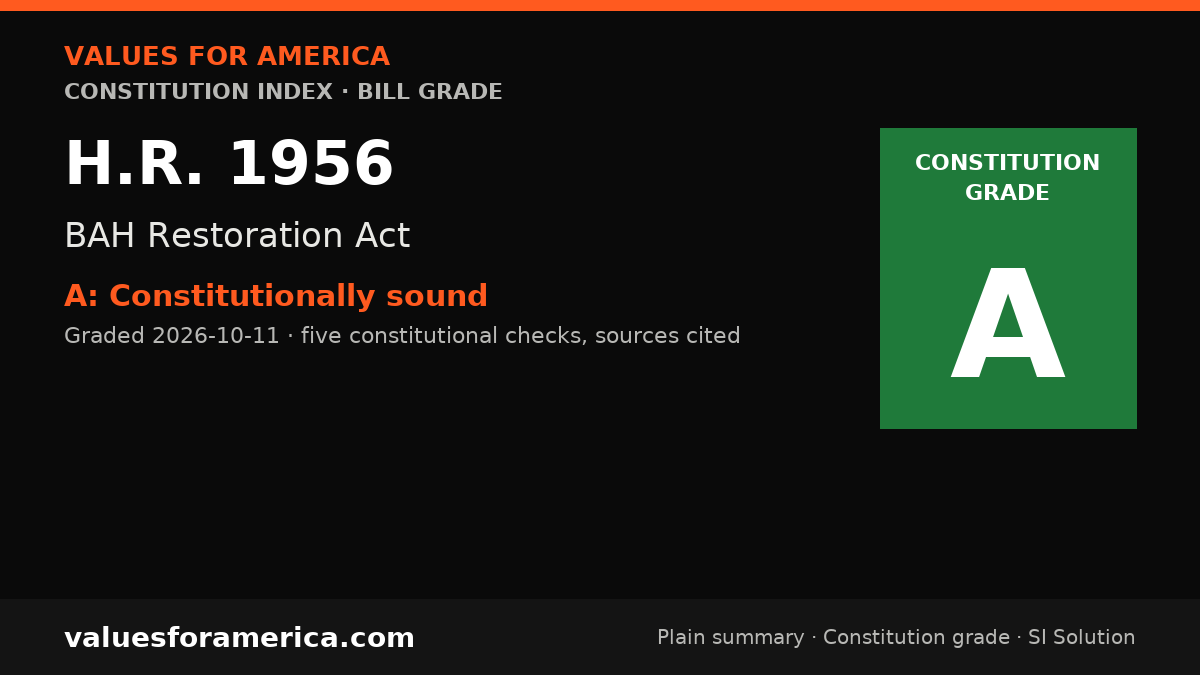
BAH Restoration Act
Cosponsors: 37 (30 D, 7 R) · per Congress.gov, 2026-10-12
Introduced: 2025-03-06
Latest action (2025-03-06): Referred to the House Committee on Armed Services.
What H.R. 1956 does, in plain terms
BAH Restoration Act This bill increases the monthly amount of the basic housing allowance for members of the uniformed services inside the United States. Specifically, the monthly amount of allowance for a member must be the amount of the monthly cost of adequate housing in the area, as determined by the Department of Defense, for members of the uniformed services serving in the same pay grade and same dependency status as the member. (Currently, the allowance is based on the difference between this amount and a percentage of the national average monthly cost of housing for members with the same pay grade and dependency status.)
Official summary by the Congressional Research Service, via Congress.gov.
Constitution Index
“VFA Constitution grade”
Constitutionally sound
Graded 2026-10-11
SI-generated grade · five published checks · not individually reviewed by a person · methodology
The BAH Restoration Act is a straightforward adjustment to the method of calculating a military housing allowance. It falls squarely within Congress's enumerated power to provide for the common defense and to make rules for the armed forces. The bill does not infringe on any constitutional right, does not restrict individual sovereignty, does not centralize authority beyond the federal level (which is appropriate for military pay), and does not implicate due process or takings concerns. It is fully constitutional.
-
✓ Passes · Enumerated powers
Congress has explicit authority under Article I, Section 8, Clause 14 to 'make Rules for the Government and Regulation of the land and naval Forces,' and under Clause 12 to 'raise and support Armies.' Adjusting the basic housing allowance for uniformed services members is a direct exercise of this power to regulate and support the military. The bill does not exceed this enumerated authority. -
✓ Passes · Bill of Rights
The bill does not implicate any of the first ten amendments. It does not restrict speech, religion, assembly, press, petition, the right to bear arms, quartering of soldiers, search and seizure, self-incrimination, due process, takings, trial rights, or cruel and unusual punishment. It is a purely economic benefit adjustment for military personnel. -
✓ Passes · Individual sovereignty
The bill does not restrict any individual's freedom over their person, property, speech, labor, or belief. It increases a monetary allowance for eligible service members, which is a benefit, not a restriction. There is no burden on individual liberty; the government is providing additional compensation, not limiting action. -
✓ Passes · Decentralization
The military is a federal responsibility, and the Constitution grants Congress the power to regulate the armed forces. This is not a matter that an individual, local community, or state could handle without federal involvement, as military pay is inherently a federal function. The bill does not consolidate decision-making upward beyond the necessary federal level; it is a federal action in a feder… -
✓ Passes · Due process and takings
The bill does not deprive anyone of life, liberty, or property without due process. It does not take private property for public use without just compensation. It simply changes the formula for a government benefit, which does not create a vested property right that would trigger the Takings Clause. There is no procedural or substantive due process issue.
Sources: Congress.gov: HR 1956 summary
Report an error in this grade
What should pass
“VFA SI Solution”
No solution yet
A sourced SI draft appears here once it passes automated checks (Constitution citation, source verification, independent SI critic). How publication works.
Related on VFA

For journalists and bloggers
“Embed this grade”
Free to use with the link back. The badge and card update when the grade changes. Embed terms →
