H.R. 1955 explained · 119th Congress · Pending in Congress
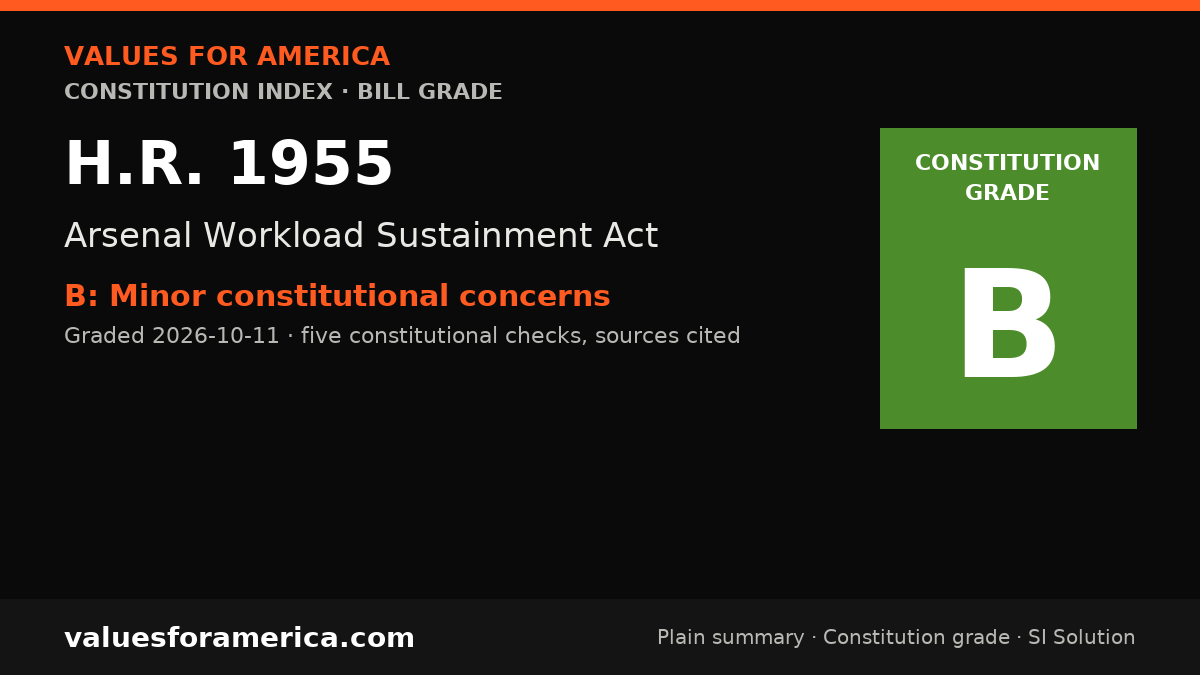
Arsenal Workload Sustainment Act
Cosponsors: none · per Congress.gov, 2026-10-12
Introduced: 2025-03-06
Latest action (2025-03-06): Referred to the House Committee on Armed Services.
What H.R. 1955 does, in plain terms
Arsenal Workload Sustainment Act This bill requires the Department of Defense (DOD) to establish a five-year pilot program to give preference to any procurement action or solicitation with a non-public partner that uses a government-owned and operated arsenal of the Department of the Army in any type of contractual agreement with the government. Under the program, DOD must add 20% to the price of the bid of non-public partners that do not use a government-owned arsenal. DOD must also give preference to non-public partners that utilize the Advanced Manufacturing Center of Excellence of the Army and ensure not less than 25% of the activities under the partnership are performed by DOD employees.
Official summary by the Congressional Research Service, via Congress.gov.
Constitution Index
“VFA Constitution grade”
Minor constitutional concerns
Graded 2026-10-11
SI-generated grade · five published checks · not individually reviewed by a person · methodology
This bill is mostly sound but has minor constitutional tensions. It operates within Congress's enumerated powers under Article I, Section 8 to provide for the common defense and raise and support Armies. It does not directly infringe any Bill of Rights protections, though the 20% price penalty on non-participating partners raises a mild concern under the Fifth Amendment's Due Process and Takings Clauses if applied arbitrarily. The program does not restrict individual sovereignty, and decentralization is acceptable as it involves federal military procurement. The primary issue is the potential for arbitrary economic discrimination against private contractors without clear procedural safeguards, which is fixable.
-
✓ Passes · Enumerated powers
Congress has explicit constitutional authority under Article I, Section 8, Clause 12 to raise and support Armies, and Clause 14 to make rules for the governance of the land and naval forces. This bill directs procurement policy for Army arsenals, which falls squarely within Congress's power to provide for the national defense and regulate military logistics. There is no overreach into areas reserv… -
✓ Passes · Bill of Rights
The bill does not restrict speech, religion, press, assembly, petition, arms, quartering, search and seizure, self-incrimination, fair trial, jury, or cruel and unusual punishment. It imposes no criminal penalties or searches. The 20% price penalty is a financial incentive, not a punishment, and does not implicate the Eighth Amendment. No Bill of Rights provision is directly violated. -
✓ Passes · Individual sovereignty
The bill applies to non-public partners (contractors) voluntarily choosing to bid on DOD procurement. It does not restrict any individual's person, property, speech, labor, or belief. Contractors remain free to decline participation. The government has a compelling interest in maintaining domestic arsenal capacity for national security, and the burden on contractors is minimal and voluntary. -
✓ Passes · Decentralization
This is a federal military procurement matter. An individual or family cannot handle national defense logistics (Question 1: false). A local community or county cannot manage Army arsenals (Question 2: false). A state could theoretically operate its own arsenals, but the Constitution vests military power in the federal government (Question 3: false). The action consolidates decision-making at the … -
✗ Concern · Due process and takings
The bill imposes a 20% price penalty on non-public partners that do not use a government-owned arsenal. This creates a financial disadvantage for contractors who choose alternative facilities. While not a direct taking of property, the penalty could be seen as arbitrary economic discrimination without clear standards or procedural safeguards. The Fifth Amendment's Due Process Clause requires that …
Sources: Congress.gov: HR 1955 summary
Report an error in this grade
What should pass
“VFA SI Solution”
No solution yet
A sourced SI draft appears here once it passes automated checks (Constitution citation, source verification, independent SI critic). How publication works.
Related on VFA

For journalists and bloggers
“Embed this grade”
Free to use with the link back. The badge and card update when the grade changes. Embed terms →
