H.R. 1945 explained · 119th Congress · Pending in Congress
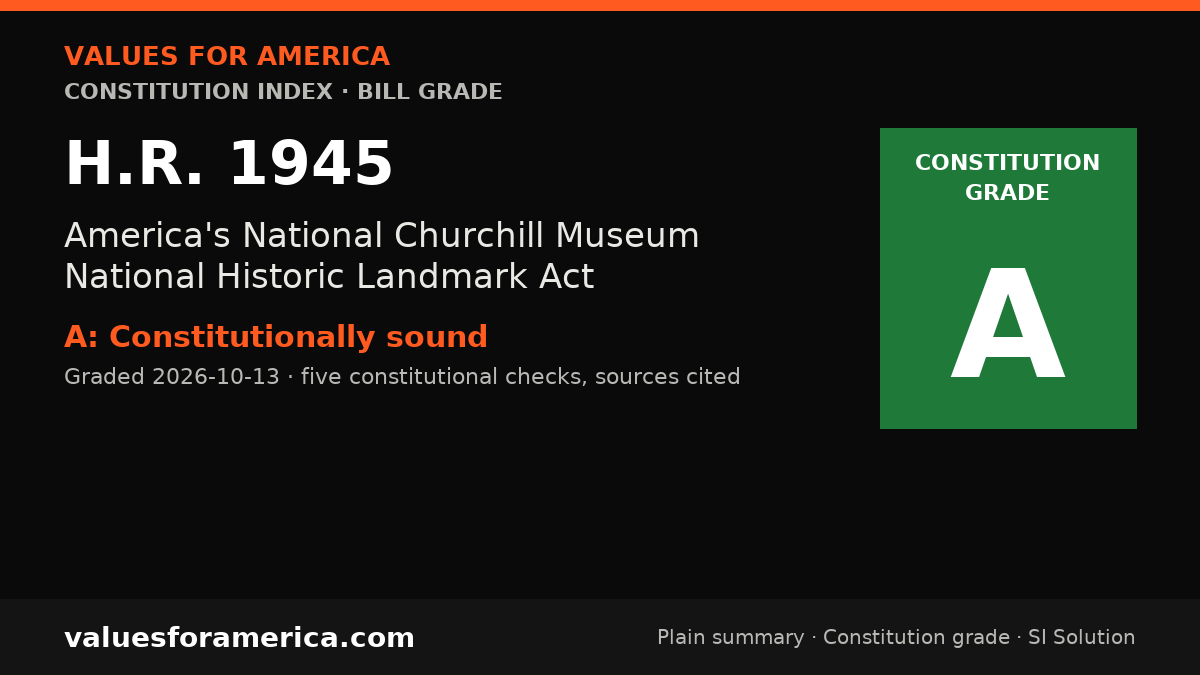
America's National Churchill Museum National Historic Landmark Act
Cosponsors: 3 (1 D, 2 R) · per Congress.gov, 2026-10-14
Introduced: 2025-03-06
Latest action (2026-10-14): Message on Senate action sent to the House.
What H.R. 1945 does, in plain terms
America's National Churchill Museum National Historic Landmark Act This bill designates the America’s National Churchill Museum, including the Winston Churchill Memorial, located at Westminster College in Fulton, Missouri, as the America’s National Churchill Museum National Historic Landmark. (Former British Prime Minister Winston Churchill gave a speech titled The Sinews of Peace, also widely known as the Iron Curtain Speech, at the college in 1946.) The bill permits the Department of the Interior to enter into cooperative agreements with public and private entities for the purposes of protecting historic resources at the landmark and providing educational and interpretive facilities for the public. Interior may provide technical and financial assistance to partner entities. The bill also directs Interior to conduct a special resource study to evaluate the national significance of the landmark and to determine the suitability and feasibility of designating it as a unit of the National Park System. The study must consider alternatives to that designation for the preservation, protection, and interpretation of the landmark, and must include cost estimates associated with identified alternatives.
Official summary by the Congressional Research Service, via Congress.gov.
Constitution Index
“VFA Constitution grade”
Constitutionally sound
Graded 2026-10-13
SI-generated grade · five published checks · not individually reviewed by a person · methodology
This bill is a routine federal designation of a national historic landmark, well within Congress's enumerated powers under the Property Clause and the General Welfare Clause. It does not infringe on any constitutional rights, respects individual sovereignty, and appropriately delegates implementation to the Department of the Interior with cooperative agreements. The designation does not consolidate power beyond the federal level in a way that violates the Tenth Amendment, as it concerns federal property and a national historic resource. The bill includes procedural safeguards such as a resource study and consideration of alternatives, ensuring due process in the designation process.
-
✓ Passes · Enumerated powers
Congress has authority under Article IV, Section 3, Clause 2 (the Property Clause) to make rules and regulations respecting the territory or other property belonging to the United States. Designating a national historic landmark and authorizing the Department of the Interior to enter into cooperative agreements for its protection and interpretation is a valid exercise of this power. Additionally, … -
✓ Passes · Bill of Rights
The bill does not restrict speech, religion, assembly, press, petition, or any other right protected by the Bill of Rights. It is a designation and study measure that imposes no restrictions on individuals. The First Amendment is not implicated, and no other amendment is affected. -
✓ Passes · Individual sovereignty
The bill does not restrict any individual's use of their person, property, speech, labor, or belief. It merely designates a landmark and authorizes cooperative agreements and a study. There is no burden on individual freedom, and the government's action is benign and non-coercive. -
✓ Passes · Decentralization
The designation of a national historic landmark is inherently a federal function because it involves recognition of national significance and management of federal historic resources. The bill does not consolidate decision-making beyond the necessary level; it involves the federal government in a matter that is national in scope, while allowing for cooperative agreements with local and private ent… -
✓ Passes · Due process and takings
The bill does not take private property without just compensation. It designates a landmark and authorizes cooperative agreements, which are voluntary. The special resource study includes consideration of alternatives and cost estimates, ensuring that any future designation is based on thorough analysis and not arbitrary action. There is no deprivation of life, liberty, or property without due pro…
Sources: Congress.gov: HR 1945 summary
Report an error in this grade
What should pass
“VFA SI Solution”
No solution yet
A sourced SI draft appears here once it passes automated checks (Constitution citation, source verification, independent SI critic). How publication works.
Related on VFA

For journalists and bloggers
“Embed this grade”
Free to use with the link back. The badge and card update when the grade changes. Embed terms →
