H.R. 1944 explained · 119th Congress · Pending in Congress
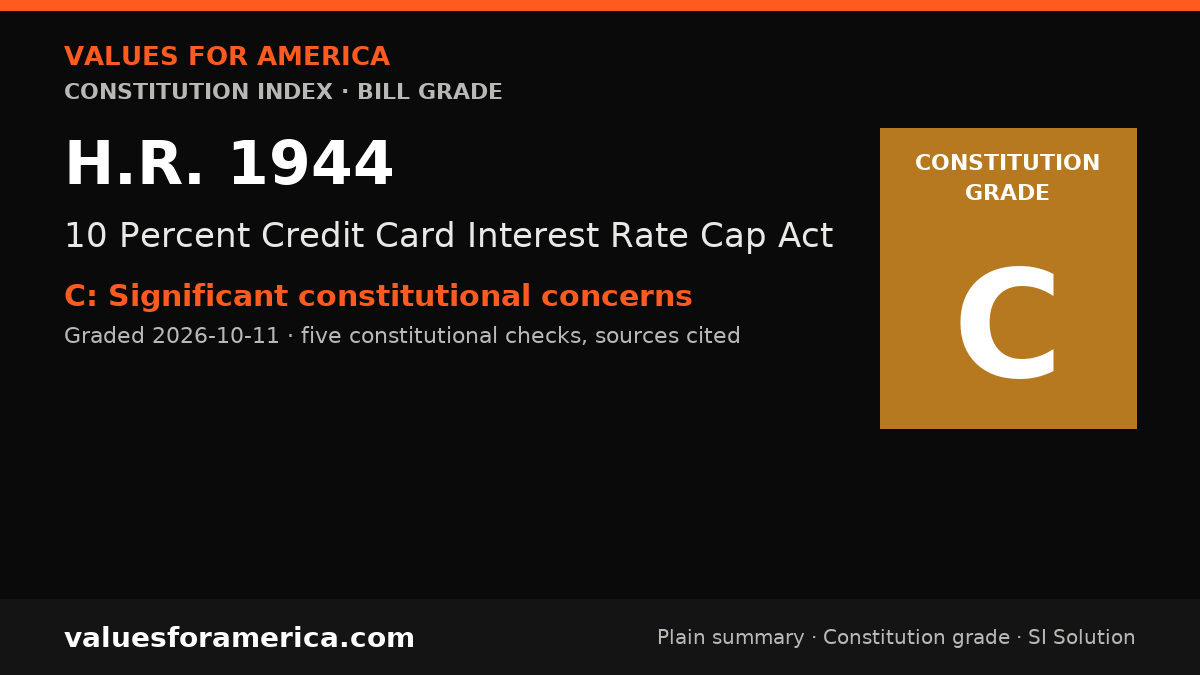
10 Percent Credit Card Interest Rate Cap Act
Cosponsors: 1 (0 D, 1 R) · per Congress.gov, 2026-10-12
Introduced: 2025-03-06
Latest action (2025-03-06): Referred to the House Committee on Financial Services.
What H.R. 1944 does, in plain terms
10 Percent Credit Card Interest Rate Cap Act This bill temporarily caps credit card interest rates at 10%. Creditors that knowingly violate this bill forfeit the entire interest of the debt. The bill also provides a private right of action for debtors to recover interest, finance charges, or fees. The action must be brought within two years of the violation. In addition, violations of this bill are subject to civil liability under the Truth in Lending Act, which is enforced by the Consumer Financial Protection Bureau and the Federal Trade Commission. These changes sunset on January 1, 2031.
Official summary by the Congressional Research Service, via Congress.gov.
Constitution Index
“VFA Constitution grade”
Significant constitutional concerns
Graded 2026-10-11
SI-generated grade · five published checks · not individually reviewed by a person · methodology
The bill likely exceeds Congress's enumerated powers by imposing a nationwide price control on credit card interest rates, which is not a regulation of interstate commerce in the traditional sense but rather a direct mandate on private contracts. It also raises significant due process and individual sovereignty concerns by retroactively altering existing contracts and restricting the freedom to contract. However, it does not directly violate a specific Bill of Rights provision, and the sunset provision mitigates some concerns. The bill consolidates power at the federal level, failing the decentralization test.
-
✗ Concern · Enumerated powers
Congress's authority to regulate commerce among the several states (Article I, Section 8, Clause 3) has been interpreted broadly, but a blanket cap on credit card interest rates is a direct regulation of private contracts and lending practices that may not constitute 'commerce' in the sense of interstate economic activity. While credit cards are used in interstate commerce, the bill does not regul… -
✓ Passes · Bill of Rights
The bill does not directly infringe upon the rights protected by the first ten amendments. It does not restrict speech, religion, assembly, press, petition, arms, quartering, search and seizure, self-incrimination, due process (in the procedural sense), fair trial, jury, cruel and unusual punishment, or unenumerated rights. The Tenth Amendment is implicated because the bill may exceed federal powe… -
✗ Concern · Individual sovereignty
The bill restricts the freedom of contract between creditors and debtors by imposing a maximum interest rate. This limits individuals' ability to negotiate terms for credit, which is a fundamental aspect of personal and economic liberty. The government must demonstrate a compelling justification for such a restriction, and while consumer protection is a legitimate goal, the bill's blanket cap may … -
✗ Concern · Decentralization
The bill fails the decentralization test. (1) Individuals and families could potentially handle credit card interest rates through private negotiation and state-level consumer protection laws, so the individual can handle it. (2) Local communities and counties could regulate local lending practices, so the local level can handle it. (3) States have historically regulated interest rates and usury l… -
✗ Concern · Due process and takings
The bill raises due process concerns because it retroactively applies to existing credit card agreements, altering the terms of contracts without providing adequate notice or a hearing. This may violate the Due Process Clause of the Fifth Amendment, which protects against arbitrary government action. Additionally, the bill's forfeiture of all interest for violations could be seen as a taking of pr…
Sources: Congress.gov: HR 1944 summary
Report an error in this grade
The Framers
“Founders’ Verdict”
Confidence 0.50
Archived SI output (machine-generated)No editorial review recorded. This historical SI verdict was machine-generated by software and predates the review desk; check it against the official bill text.
Synthesis
2-2 split: CONSTITUTIONAL under interstate commerce power (Hamilton, Marshall) vs. UNCONSTITUTIONAL as state/reserved power (Madison, Jefferson)
The power to cap interest rates on credit card transactions falls within Congress's authority to regulate commerce among the several states, as such financial instruments and transactions inherently involve interstate commerce in a commercial republic. This regulation is a proper means to ensure the stability and uniformity of national commerce, preventing the disunion of economic interests that plagued the confederation. Pursuant to the necessary and proper clause, Congress may employ such measures to execute its enumerated powers effectively, as the ability to regulate commerce includes the …
The federal government possesses only those powers expressly delegated by the Constitution. No provision grants Congress authority to regulate or cap interest rates on private credit transactions between individuals or entities. Such interference in voluntary contracts invades the sphere of individual liberty and private economic dealings, which are reserved to the states or the people. Strict construction demands that where the Constitution is silent, federal power ceases.
The proposed legislation imposes a cap on interest rates for private credit card transactions, regulating the terms of contracts between private parties. Such authority resides in the police powers of the states, not among the enumerated powers of Congress. The Constitution grants Congress specific powers, including to regulate commerce among the states, but this does not encompass dictating interest rates in ordinary private lending, which lacks the character of interstate commercial regulation contemplated at the founding. Extending federal power here would violate the principle of limited e…
The power to regulate commerce among the several states, vested in Congress by the Constitution, extends to transactions involving credit instruments that cross state lines, as such activities form part of the national commercial intercourse. A limitation on interest rates charged on credit cards is a proper regulation of this commerce, as it bears a plain relation to the prevention of abuses in interstate financial dealings. This measure falls within the necessary and proper means to execute the commerce power, being neither prohibited nor plainly adapted to some other end.
Report an error in this Founders' Verdict
What should pass
“VFA SI Solution”
No solution yet
A sourced SI draft appears here once it passes automated checks (Constitution citation, source verification, independent SI critic). How publication works.
Related on VFA

For journalists and bloggers
“Embed this grade”
Free to use with the link back. The badge and card update when the grade changes. Embed terms →
