H.R. 1941 explained · 119th Congress · Pending in Congress
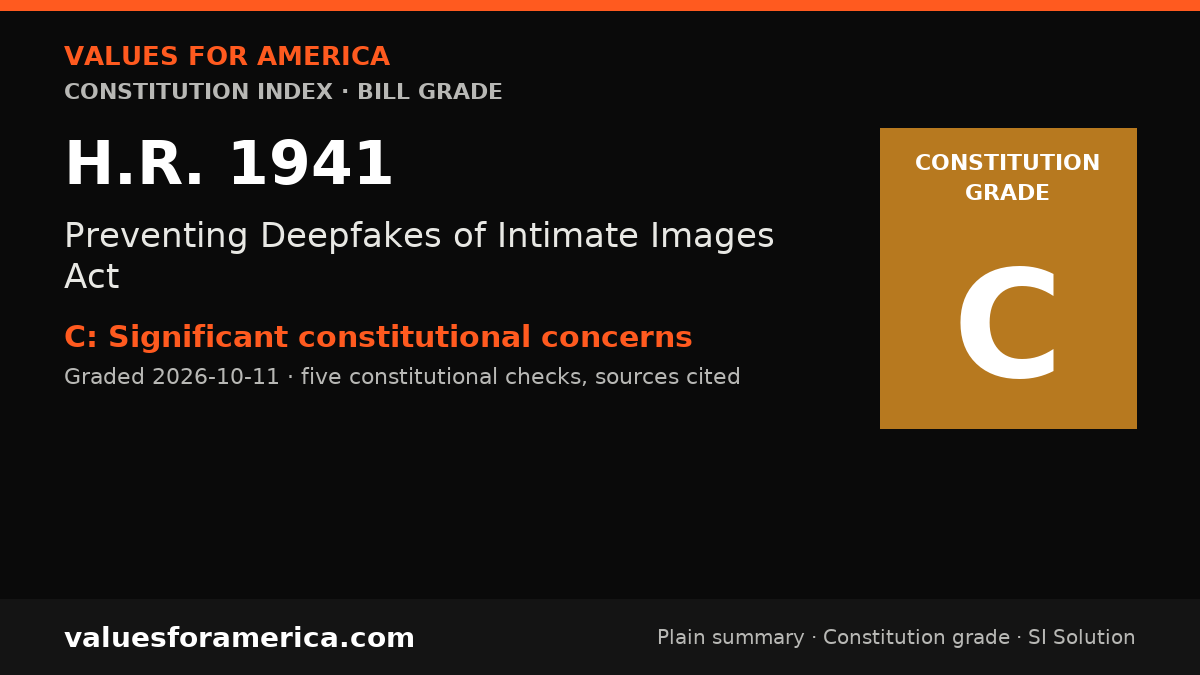
Preventing Deepfakes of Intimate Images Act
Cosponsors: 12 (9 D, 3 R) · per Congress.gov, 2026-10-12
Introduced: 2025-03-06
Latest action (2025-03-06): Referred to the House Committee on the Judiciary.
What H.R. 1941 does, in plain terms
Preventing Deepfakes of Intimate Images Act This bill makes it a crime to intentionally disclose (or threaten to disclose) a digital depiction that has been altered using digital manipulation of an individual engaging in sexually explicit conduct.
Official summary by the Congressional Research Service, via Congress.gov.
Constitution Index
“VFA Constitution grade”
Significant constitutional concerns
Graded 2026-10-11
SI-generated grade · five published checks · not individually reviewed by a person · methodology
The bill criminalizes the nonconsensual disclosure of intimate deepfakes, which is a legitimate exercise of federal power under the Commerce Clause, but it raises significant concerns regarding the scope of speech restrictions and the potential for overbreadth, as well as the federalization of a crime that states are well-equipped to handle. The bill's definition of 'digital depiction' and 'sexually explicit conduct' may inadvertently cover protected speech, such as satire or political commentary, and the lack of a clear intent requirement for disclosure could chill legitimate expression. While the bill does not directly violate the Bill of Rights, its broad language and federal reach require careful narrowing to avoid infringing on First Amendment rights and to respect principles of federalism.
-
✓ Passes · Enumerated powers
Congress has authority under Article I, Section 8, Clause 3 (Commerce Clause) to regulate the disclosure of intimate deepfakes because such disclosures involve interstate commerce, including the use of the internet and digital platforms that cross state lines. The bill targets a form of harmful speech that has a substantial effect on interstate commerce, and the federal interest in protecting indi… -
✗ Concern · Bill of Rights
The bill raises significant First Amendment concerns. While the government can regulate certain categories of speech, such as obscenity and true threats, the bill's definition of 'digital depiction' and 'sexually explicit conduct' may be overbroad, potentially covering protected speech like satire, parody, or artistic expression. The bill criminalizes disclosure without requiring proof of intent t… -
✓ Passes · Individual sovereignty
The bill protects individual sovereignty by safeguarding a person's control over their intimate images, which is a fundamental aspect of personal autonomy and privacy. The right to privacy in intimate matters is deeply rooted in the Constitution (see Griswold v. Connecticut, 381 U.S. 479 (1965) and Lawrence v. Texas, 539 U.S. 558 (2003)). By criminalizing the nonconsensual disclosure of intimate d… -
✗ Concern · Decentralization
The bill fails the decentralization test because it consolidates criminal enforcement at the federal level when states are fully capable of addressing this issue. States have long enacted laws against revenge porn and nonconsensual intimate image sharing, and they are better positioned to handle local cases. The federal government's involvement is not necessary to address this issue, as states can… -
✓ Passes · Due process and takings
The bill does not violate due process or the Takings Clause. It provides fair notice of what conduct is prohibited, and the criminal penalties are not arbitrary or capricious. The bill does not take property without just compensation; it regulates conduct, not property. The bill's provisions are clear enough to satisfy the void-for-vagueness doctrine, though the definition of 'digital depiction' c…
Sources: Congress.gov: HR 1941 summary
Report an error in this grade
What should pass
“VFA SI Solution”
No solution yet
A sourced SI draft appears here once it passes automated checks (Constitution citation, source verification, independent SI critic). How publication works.
Related on VFA

For journalists and bloggers
“Embed this grade”
Free to use with the link back. The badge and card update when the grade changes. Embed terms →
