H.R. 1940 explained · 119th Congress · Pending in Congress
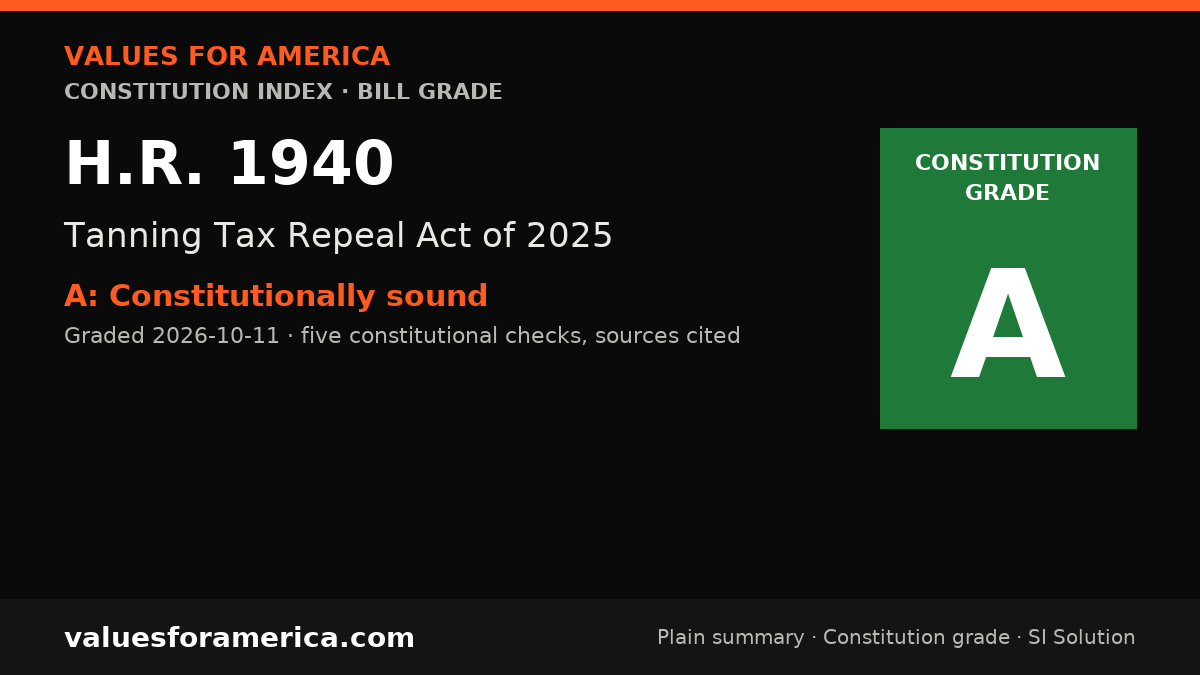
Tanning Tax Repeal Act of 2025
Cosponsors: 26 (0 D, 26 R) · per Congress.gov, 2026-10-12
Introduced: 2025-03-06
Latest action (2025-03-06): Referred to the House Committee on Ways and Means.
What H.R. 1940 does, in plain terms
Tanning Tax Repeal Act of 2025 This bill repeals the 10% excise tax imposed on the amount paid for indoor tanning services.
Official summary by the Congressional Research Service, via Congress.gov.
Constitution Index
“VFA Constitution grade”
Constitutionally sound
Graded 2026-10-11
SI-generated grade · five published checks · not individually reviewed by a person · methodology
The bill simply repeals a federal excise tax on indoor tanning services. Repealing a tax is well within Congress's broad taxing power under Article I, Section 8, Clause 1, and it does not infringe any constitutional right. In fact, it reduces the federal footprint and returns decision-making to individuals and states, aligning with constitutional principles of limited government and decentralization.
-
✓ Passes · Enumerated powers
Congress has explicit authority to levy taxes under Article I, Section 8, Clause 1. Repealing an existing excise tax is a valid exercise of that same power. The bill does not create new federal authority; it removes a federal tax, which is clearly within Congress's enumerated powers. -
✓ Passes · Bill of Rights
The bill does not implicate any of the first ten amendments. It does not restrict speech, religion, assembly, press, petition, arms, quartering, search and seizure, self-incrimination, due process, takings, trial rights, or cruel and unusual punishment. Repealing a tax on tanning services has no bearing on any enumerated right. -
✓ Passes · Individual sovereignty
Repealing a tax reduces government restriction on individual economic activity. Individuals and businesses will retain more of their own property and face less government interference in their choice to provide or use tanning services. This enhances, rather than restricts, individual sovereignty. -
✓ Passes · Decentralization
The bill passes all four questions. Individuals and families can decide for themselves whether to use tanning services without federal involvement. Local communities and states can regulate or tax tanning services as they see fit. The federal government is not consolidating power; it is withdrawing from a specific tax area, leaving more room for individual and state decision-making. -
✓ Passes · Due process and takings
The bill does not deprive anyone of life, liberty, or property without due process. It does not take property; it removes a tax, which leaves more property in private hands. There is no procedural or substantive due process concern, and no takings issue under the Fifth Amendment.
Sources: Congress.gov: HR 1940 summary
Report an error in this grade
What should pass
“VFA SI Solution”
No solution yet
A sourced SI draft appears here once it passes automated checks (Constitution citation, source verification, independent SI critic). How publication works.
Related on VFA

For journalists and bloggers
“Embed this grade”
Free to use with the link back. The badge and card update when the grade changes. Embed terms →
