H.R. 1927 explained · 119th Congress · Pending in Congress
CLEAR Act of 2025
Cosponsors: 4 (0 D, 4 R) · per Congress.gov, 2026-10-12
Introduced: 2025-03-06
Latest action (2025-03-06): Referred to the House Committee on the Judiciary.
What H.R. 1927 does, in plain terms
Clear Law Enforcement for Criminal Alien Removal Act of 2025 or the CLEAR Act of 2025 This bill establishes requirements and programs related to the detention of individuals unlawfully present in the United States and facing removal, including the role of state and local governments in this process. The bill provides that state and local governments have the authority to assist in the enforcement of federal immigration laws, including by apprehending individuals and transferring them to federal custody. Jurisdictions that prohibit such cooperation are barred from receiving certain federal funding. The Department of Homeland Security (DHS) must within 48 hours of a request by a state or local authority take custody of an individual unlawfully present in the United States. The bill also establishes requirements for state or local detention and provides for reimbursement for reasonable expenses. The Government Accountability Office must also audit such reimbursements. DHS must also construct 20 additional detention facilities in the United States for individuals facing removal. The bill also (1) extends certain federal immunity from liability to state and local law enforcement officers, (2) provides immunity to state or local law enforcement agencies from certain money damages, and (3) requires states to participate in programs to expedite the removal of individuals subject to removal who are serving criminal sentences. The bill also establishes a grant program, provides for the development of state and local law enforcement training materials, and requires state and local governments to provide information about certain detained individuals.
Official summary by the Congressional Research Service, via Congress.gov.
Constitution Index
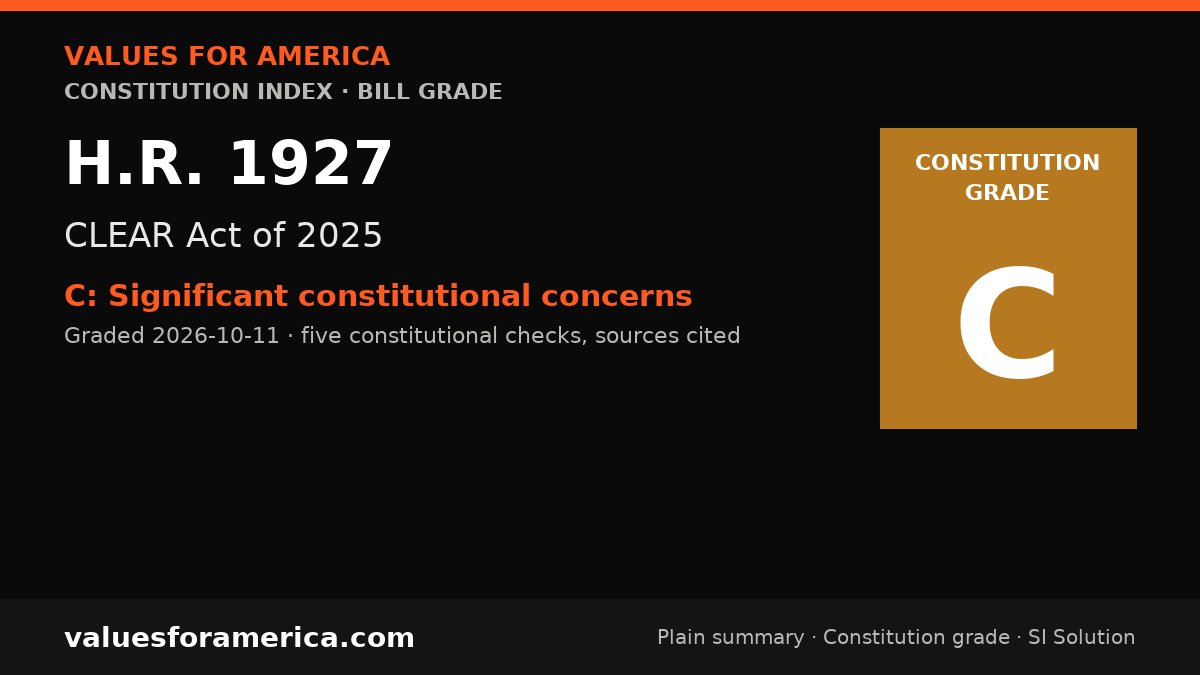
“VFA Constitution grade”
Significant constitutional concerns
Graded 2026-10-11
SI-generated grade · five published checks · not individually reviewed by a person · methodology
The CLEAR Act of 2025 raises significant constitutional concerns. While the federal government has broad authority over immigration and naturalization, the bill's provisions coercing state and local cooperation through funding conditions and immunity grants create serious federalism and Tenth Amendment issues. The mandatory detention and expedited removal provisions also implicate due process and individual liberty, though they may be supportable under federal immigration power. The bill's consolidation of immigration enforcement at the federal level, with state and local governments acting as agents, fails the decentralization test in part. Overall, the bill requires structural revisions to align with constitutional limits on federal power and to protect due process rights.
-
✓ Passes · Enumerated powers
The federal government has explicit authority over immigration and naturalization under Article I, Section 8, Clause 4, and the power to regulate commerce with foreign nations under Article I, Section 8, Clause 3. The bill's provisions regarding detention, removal, and cooperation with state and local law enforcement fall within these enumerated powers. However, the bill's use of funding condition… -
✗ Concern · Bill of Rights
The bill raises concerns under the Fourth Amendment (unreasonable seizure) and the Fifth Amendment (due process). Mandatory detention of individuals unlawfully present, without individualized hearings, could violate procedural due process. The extension of immunity to state and local officers may also undermine the right to petition for redress under the First Amendment by shielding officials from… -
✗ Concern · Individual sovereignty
The bill restricts the liberty of individuals unlawfully present by mandating detention and expedited removal. While the government has a compelling interest in enforcing immigration laws, the bill's provisions may not provide adequate procedural protections, such as the right to a hearing before a neutral adjudicator. The burden is on the government to justify these restrictions, and the bill's b… -
✗ Concern · Decentralization
The bill fails the decentralization test because it consolidates immigration enforcement at the federal level, requiring state and local governments to participate as agents. While immigration is inherently a federal matter, the bill's coercive funding conditions and mandates on state and local governments violate the Tenth Amendment's reservation of powers to the states. The questions: (1) indivi… -
✗ Concern · Due process and takings
The bill's mandatory detention and expedited removal provisions may bypass procedural due process, including the right to a fair hearing and the presumption of innocence. The bill also extends immunity to state and local officers, which could shield them from liability for due process violations. The Takings Clause is not directly implicated, but the bill's funding conditions could be seen as a ta…
Sources: Congress.gov: HR 1927 summary
Report an error in this grade
What should pass
“VFA SI Solution”
No solution yet
A sourced SI draft appears here once it passes automated checks (Constitution citation, source verification, independent SI critic). How publication works.
Related on VFA

For journalists and bloggers
“Embed this grade”
Free to use with the link back. The badge and card update when the grade changes. Embed terms →
