H.R. 1925 explained · 119th Congress · Pending in Congress
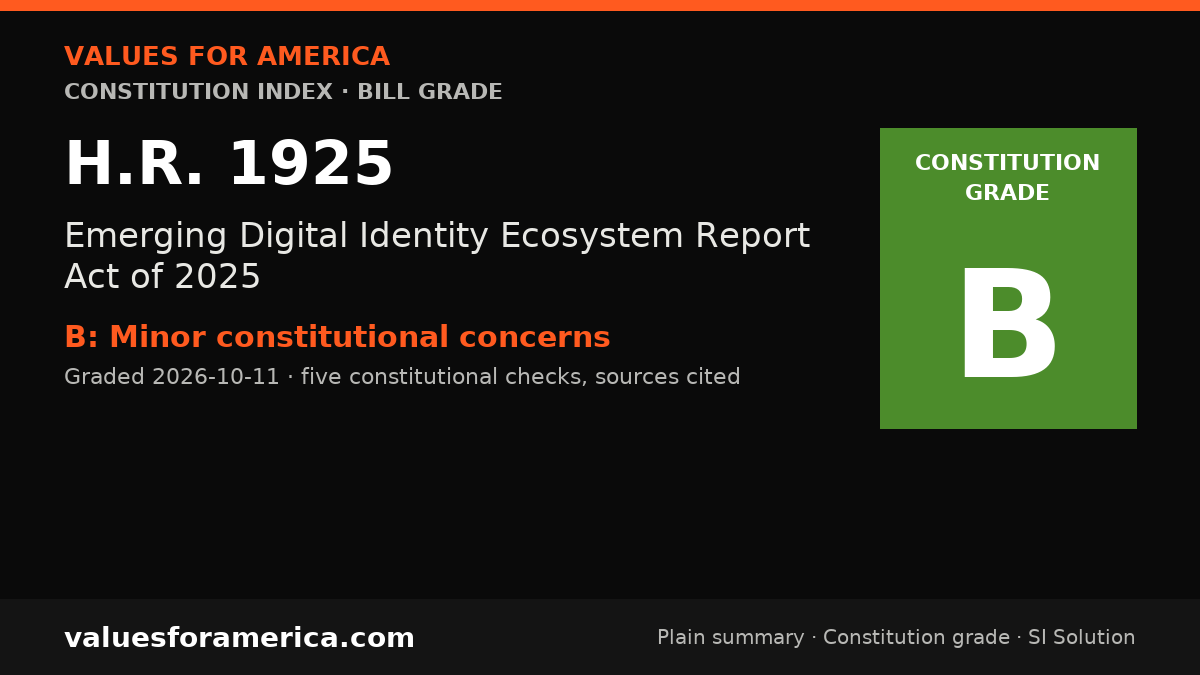
Emerging Digital Identity Ecosystem Report Act of 2025
Cosponsors: 1 (1 D, 0 R) · per Congress.gov, 2026-10-12
Introduced: 2025-03-06
Latest action (2025-03-06): Referred to the Subcommittee on Transportation and Maritime Security.
What H.R. 1925 does, in plain terms
Emerging Digital Identity Ecosystem Report Act of 2025 This bill directs the Transportation Security Administration to submit a report to Congress on digital identity ecosystems and the homeland security value of these ecosystems in the transportation sector.
Official summary by the Congressional Research Service, via Congress.gov.
Constitution Index
“VFA Constitution grade”
Minor constitutional concerns
Graded 2026-10-11
SI-generated grade · five published checks · not individually reviewed by a person · methodology
The bill merely directs the TSA to produce a report on digital identity ecosystems in transportation. It does not itself authorize any surveillance, data collection, or restriction of rights. However, the subject matter touches on potential future expansions of federal identity infrastructure, which raises concerns about federal overreach and privacy. The bill is mostly sound but should be amended to explicitly prohibit any data collection or surveillance activities and to require that any future recommendations respect constitutional limits.
-
✓ Passes · Enumerated powers
Congress has authority over interstate commerce and transportation security under Article I, Section 8, Clause 3 (Commerce Clause). Directing the TSA to report on digital identity ecosystems in the transportation sector falls within this authority as a matter of informing potential future regulation. The bill itself does not exercise any coercive power; it only mandates a study and report. -
✓ Passes · Bill of Rights
The bill does not infringe any enumerated rights. It does not restrict speech, religion, assembly, press, petition, arms, quartering, search and seizure, self-incrimination, due process, takings, trial rights, or cruel and unusual punishment. It merely requires a report. However, the subject matter—digital identity—could implicate Fourth Amendment privacy concerns if future actions are taken, but … -
✓ Passes · Individual sovereignty
The bill does not restrict any individual's control over their person, property, speech, labor, or belief. It imposes no obligations on individuals. It only requires the TSA to produce a report. The burden of justification for any future restrictions would apply then, not now. -
✗ Concern · Decentralization
The bill fails the decentralization test because it consolidates decision-making about digital identity at the federal level. While the report itself is informational, the subject matter—digital identity ecosystems—could be handled by states or localities, and the federal government has no enumerated power to create a national identity system. The bill's focus on 'homeland security value' suggests… -
✓ Passes · Due process and takings
The bill does not bypass due process, presumption of innocence, or take property without just compensation. It imposes no penalties, no adjudications, and no property seizures. It is purely informational.
Sources: Congress.gov: HR 1925 summary
Report an error in this grade
What should pass
“VFA SI Solution”
No solution yet
A sourced SI draft appears here once it passes automated checks (Constitution citation, source verification, independent SI critic). How publication works.
Related on VFA

For journalists and bloggers
“Embed this grade”
Free to use with the link back. The badge and card update when the grade changes. Embed terms →
