H.R. 1924 explained · 119th Congress · Pending in Congress
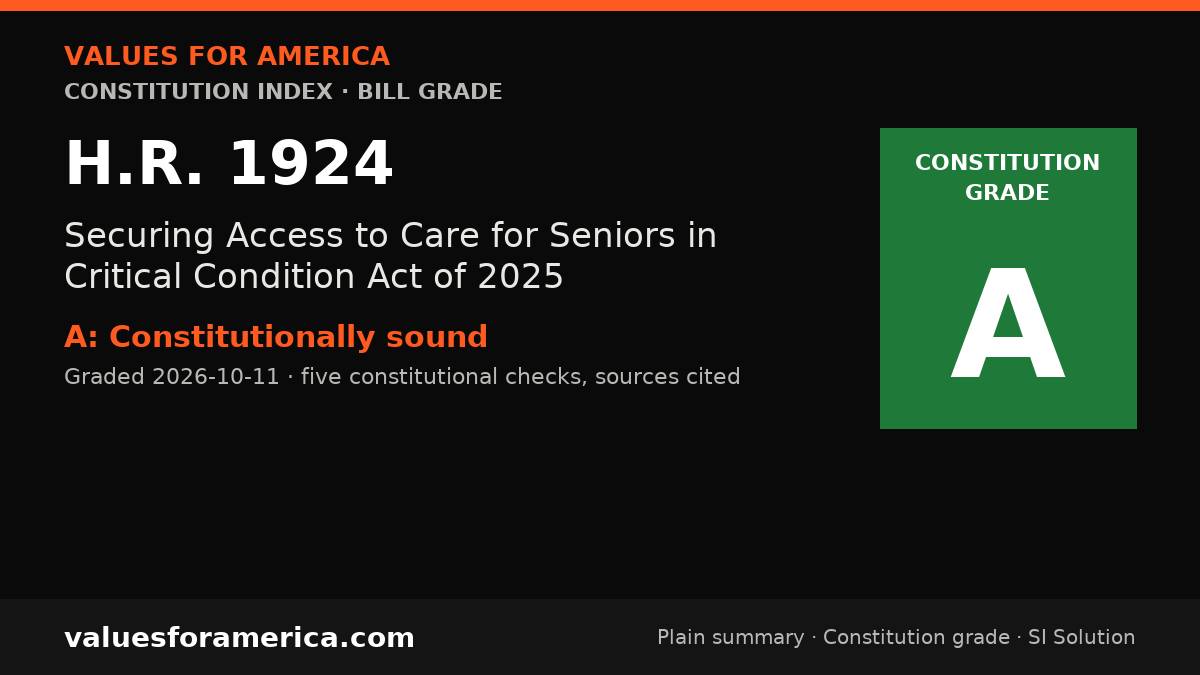
Securing Access to Care for Seniors in Critical Condition Act of 2025
Cosponsors: 9 (2 D, 7 R) · per Congress.gov, 2026-10-12
Introduced: 2025-03-06
Latest action (2025-03-06): Referred to the House Committee on Ways and Means.
What H.R. 1924 does, in plain terms
Securing Access to Care for Seniors in Critical Condition Act of 2025 This bill exempts discharges from long-term care hospitals (LTCHs) from the Medicare site-neutral payment rate if the discharge meets specified high acuity criteria and occurs on or after October 1, 2026. (The site-neutral rate is the lower of Medicare’s acute care hospital payment rate under the inpatient prospective payment system or 100% of the cost of the stay. LTCH stays that do not qualify for the specialized LTCH payment rate under Medicare are instead paid at the site-neutral rate.)
Official summary by the Congressional Research Service, via Congress.gov.
Constitution Index
“VFA Constitution grade”
Constitutionally sound
Graded 2026-10-11
SI-generated grade · five published checks · not individually reviewed by a person · methodology
This bill is a narrow adjustment to Medicare reimbursement rates for long-term care hospitals, operating within Congress's enumerated power to spend for the general welfare and to regulate interstate commerce. It does not infringe on any constitutional rights, does not restrict individual sovereignty, does not centralize authority beyond the federal role already established in Medicare, and does not implicate due process or takings concerns.
-
✓ Passes · Enumerated powers
Congress has the power to spend for the general welfare under Article I, Section 8, Clause 1, and to regulate interstate commerce under Article I, Section 8, Clause 3. Medicare is a federal spending program, and adjusting payment rates for hospitals participating in Medicare is a valid exercise of the spending power. The bill does not exceed these enumerated powers. -
✓ Passes · Bill of Rights
The bill does not implicate any of the first ten amendments. It does not affect speech, religion, assembly, press, petition, arms, quartering, search and seizure, self-incrimination, due process, takings, trial rights, jury rights, cruel and unusual punishment, or unenumerated rights. It is a purely economic adjustment to Medicare reimbursement. -
✓ Passes · Individual sovereignty
The bill does not restrict any individual's control over their person, property, speech, labor, or belief. It only changes how Medicare reimburses certain hospitals. Individuals are not compelled to do anything, and no personal freedoms are curtailed. -
✓ Passes · Decentralization
The bill concerns Medicare, a federal program, and adjusts payment rates for hospitals that voluntarily participate. The federal government already administers Medicare, and this bill does not consolidate new decision-making authority. It does not affect state or local authority, and individuals and families are not involved in setting Medicare rates. The federal role is established and appropriat… -
✓ Passes · Due process and takings
The bill does not deprive any person of life, liberty, or property without due process. It does not take private property for public use without just compensation. Hospitals are not entitled to a specific Medicare payment rate, and changes to reimbursement rates are a routine exercise of congressional spending authority, not a taking.
Sources: Congress.gov: HR 1924 summary
Report an error in this grade
What should pass
“VFA SI Solution”
No solution yet
A sourced SI draft appears here once it passes automated checks (Constitution citation, source verification, independent SI critic). How publication works.
Related on VFA

For journalists and bloggers
“Embed this grade”
Free to use with the link back. The badge and card update when the grade changes. Embed terms →
