H.R. 1922 explained · 119th Congress · Pending in Congress
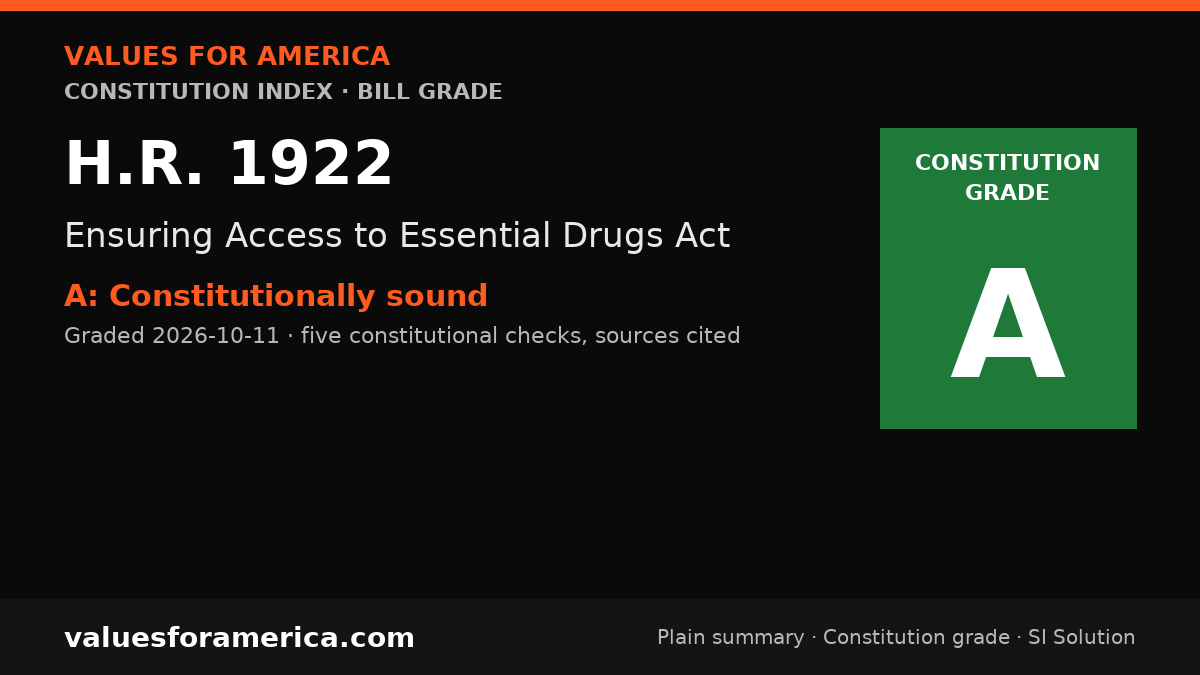
Ensuring Access to Essential Drugs Act
Cosponsors: 2 (1 D, 1 R) · per Congress.gov, 2026-10-12
Introduced: 2025-03-06
Latest action (2025-03-06): Referred to the Committee on Energy and Commerce, and in addition to the Committee on Ways and Means, for a period to be subsequently determined by the Speaker, in each case for consideration of such provisions as fall within the jurisdiction of the committee concerned.
What H.R. 1922 does, in plain terms
Ensuring Access to Essential Drugs Act This bill exempts certain brand-name drugs from the Medicare Part D Manufacturer Discount Program. Under the program, drug manufacturers provide discounts to beneficiaries who have incurred costs above the annual deductible under the Medicare prescription drug benefit. Specifically, the bill exempts from the program orally administered, brand-name drugs that are considered generics for purposes of the Medicaid Drug Rebate Program (per an exception granted by the Centers for Medicare & Medicaid Services).
Official summary by the Congressional Research Service, via Congress.gov.
Constitution Index
“VFA Constitution grade”
Constitutionally sound
Graded 2026-10-11
SI-generated grade · five published checks · not individually reviewed by a person · methodology
This bill is fully constitutional. It operates within Congress's enumerated power over Medicare (a federal spending program), does not infringe any Bill of Rights protections, respects individual sovereignty by not restricting personal conduct, passes all decentralization tests, and does not violate due process or takings protections.
-
✓ Passes · Enumerated powers
Congress has explicit authority under Article I, Section 8, Clause 1 (the Spending Clause) to provide for the general welfare through programs like Medicare. The bill merely adjusts the terms of the Medicare Part D Manufacturer Discount Program, which is a lawful exercise of Congress's power to set conditions on federal spending. No enumerated power is exceeded. -
✓ Passes · Bill of Rights
The bill does not restrict speech, religion, assembly, press, petition, arms, quartering, search and seizure, self-incrimination, due process, fair trial, jury rights, cruel and unusual punishment, or any other right protected by the first ten amendments. It is a purely economic regulation of a federal program that imposes no burdens on individual liberties. -
✓ Passes · Individual sovereignty
The bill does not restrict what any individual may do with their person, property, speech, labor, or belief. It only changes which drugs are subject to a discount program within Medicare. Individuals remain free to purchase drugs, choose insurance plans, or opt out of Medicare entirely. No restriction on individual sovereignty exists. -
✓ Passes · Decentralization
The bill passes all four questions. (1) Individuals and families cannot handle Medicare pricing alone — this is a federal program. (2) Local communities cannot administer a national prescription drug benefit. (3) States cannot unilaterally alter federal Medicare rules. (4) The bill does not consolidate decision-making upward; it merely adjusts an existing federal program. The Tenth Amendment is no… -
✓ Passes · Due process and takings
The bill does not deprive any person of life, liberty, or property without due process. It does not impose criminal penalties, seize property, or take private property for public use without just compensation. Drug manufacturers voluntarily participate in Medicare; the bill merely changes the terms of that voluntary program. No due process or takings issue arises.
Sources: Congress.gov: HR 1922 summary
Report an error in this grade
What should pass
“VFA SI Solution”
No solution yet
A sourced SI draft appears here once it passes automated checks (Constitution citation, source verification, independent SI critic). How publication works.
Related on VFA

For journalists and bloggers
“Embed this grade”
Free to use with the link back. The badge and card update when the grade changes. Embed terms →
