H.R. 1919 explained · 119th Congress · Pending in Congress
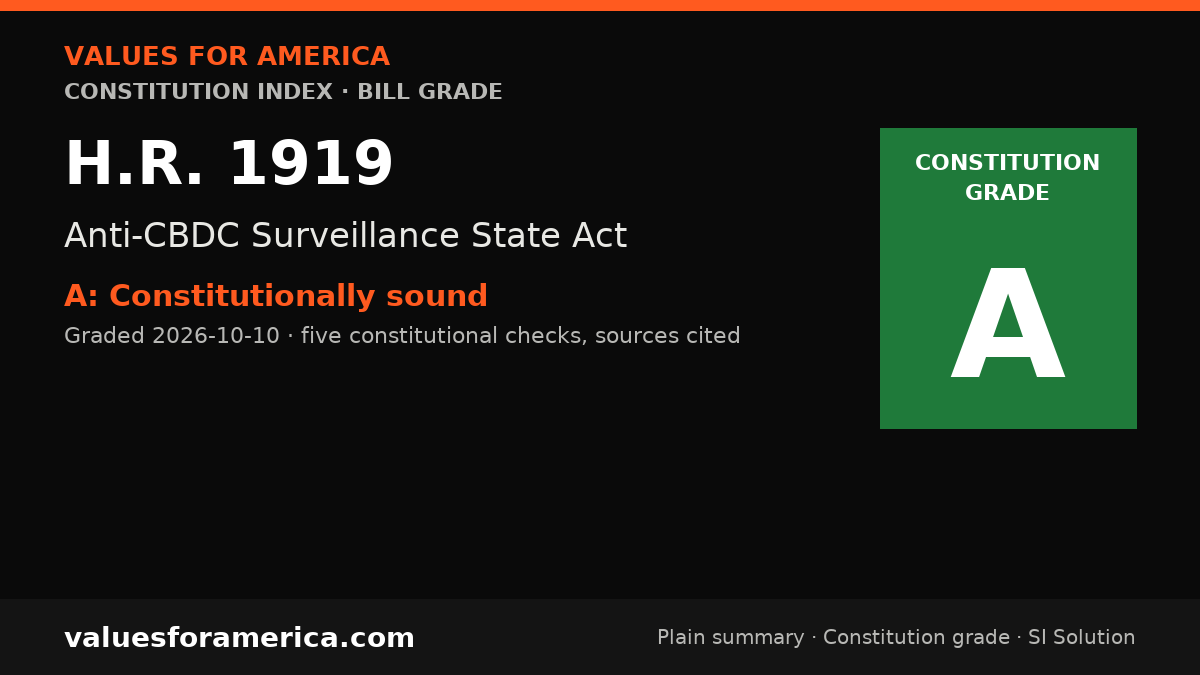
Anti-CBDC Surveillance State Act
Cosponsors: 135 (0 D, 135 R) · per Congress.gov, 2026-10-11
Introduced: 2025-03-06
Latest action (2025-07-17): Motion to reconsider laid on the table Agreed to without objection.
What H.R. 1919 does, in plain terms
Anti-CBDC Surveillance State Act This bill prohibits a Federal Reserve bank from offering products or services directly to an individual, maintaining an account on behalf of an individual, or issuing a central bank digital currency (i.e., a digital dollar). Further, the Board of Governors of the Federal Reserve System is prohibited from using a central bank digital currency to implement monetary policy or from testing, studying, creating, or implementing a central bank digital currency, with exceptions as provided by the bill.
Official summary by the Congressional Research Service, via Congress.gov.
Constitution Index
“VFA Constitution grade”
Constitutionally sound
Graded 2026-10-10
SI-generated grade · five published checks · not individually reviewed by a person · methodology
This bill is fully constitutional. It restricts federal authority, protects individual privacy and financial autonomy, and does not infringe any enumerated rights. It properly leaves monetary policy and digital currency decisions to Congress and the states, and it prevents federal surveillance through a central bank digital currency.
-
✓ Passes · Enumerated powers
The bill restricts the Federal Reserve's authority, which is a creature of Congress. Congress has the power to coin money and regulate the value thereof (Article I, Section 8, Clause 5) and to make all laws necessary and proper for executing its enumerated powers (Article I, Section 8, Clause 18). Prohibiting the Federal Reserve from offering CBDCs is a valid exercise of Congress's power to define… -
✓ Passes · Bill of Rights
The bill does not infringe any of the first ten amendments. It actually protects Fourth Amendment rights by preventing the federal government from creating a surveillance-capable digital currency that could track individual financial transactions without a warrant. It does not restrict speech, religion, assembly, press, petition, arms, quartering, self-incrimination, due process, takings, trial ri… -
✓ Passes · Individual sovereignty
The bill enhances individual sovereignty by preventing the federal government from offering CBDC accounts directly to individuals, thereby preserving the ability of individuals to use private financial institutions and cash without federal surveillance. It does not restrict any individual's person, property, speech, labor, or belief. The burden of justification is on the government, and here the g… -
✓ Passes · Decentralization
The bill passes all four questions of the decentralization test. (1) Individuals can handle their own financial transactions without a federal CBDC. (2) Local communities and counties can handle financial services without federal involvement. (3) States can handle monetary and financial matters without federal involvement, as they have historically. (4) The bill does not consolidate decision-makin… -
✓ Passes · Due process and takings
The bill does not bypass due process or take property without just compensation. It does not deprive any person of life, liberty, or property without due process of law. It merely prohibits the Federal Reserve from offering certain products and services. It does not affect existing property rights or contractual obligations.
Sources: Congress.gov: HR 1919 summary
Report an error in this grade
What should pass
“VFA SI Solution”
No solution yet
A sourced SI draft appears here once it passes automated checks (Constitution citation, source verification, independent SI critic). How publication works.
Related on VFA

For journalists and bloggers
“Embed this grade”
Free to use with the link back. The badge and card update when the grade changes. Embed terms →
