H.R. 1916 explained · 119th Congress · Pending in Congress
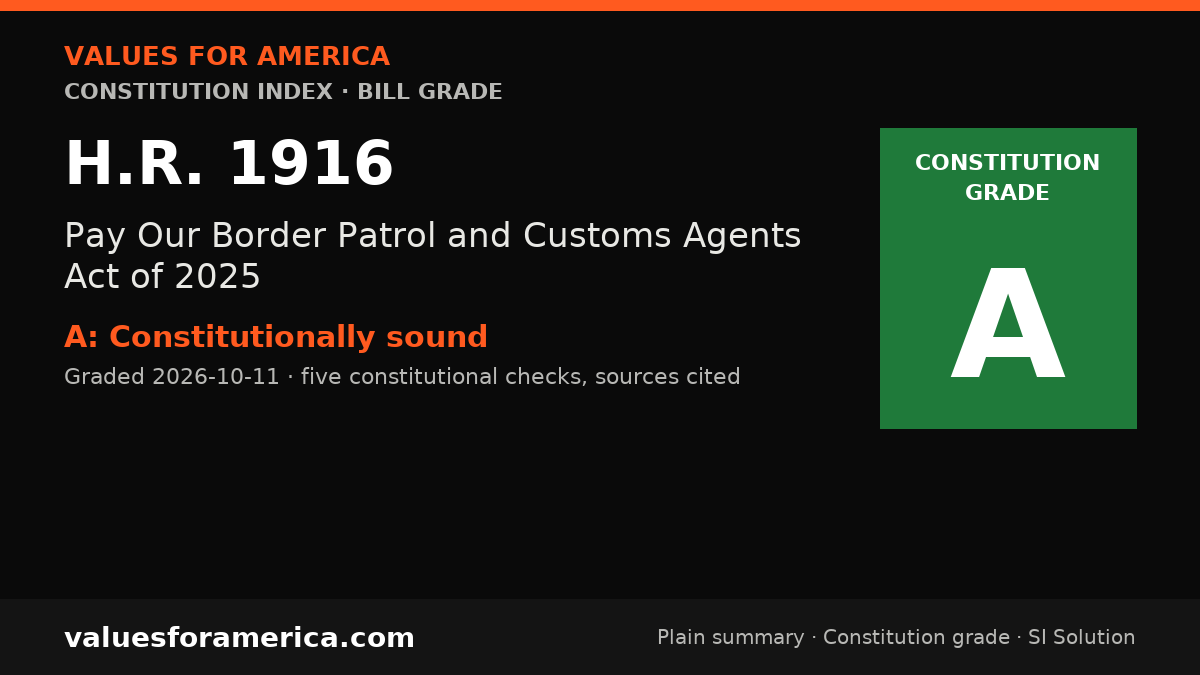
Pay Our Border Patrol and Customs Agents Act of 2025
Cosponsors: 20 (1 D, 19 R) · per Congress.gov, 2026-10-12
Introduced: 2025-03-06
Latest action (2025-03-06): Referred to the House Committee on Appropriations.
What H.R. 1916 does, in plain terms
Pay Our Border Patrol and Customs Agents Act of 2025 This bill provides FY2025 appropriations for the salaries and expenses of certain U.S. Customs and Border Protection (CBP) employees who are required to work during a lapse in appropriations (i.e., government shutdown) in FY2025. Specifically, the bill provides appropriations to CBP for the salaries and expenses of agents of the U.S. Border Patrol and officers of the Office of Field Operations who are excepted from furlough (i.e., required to work) during a lapse in discretionary appropriations in FY2025.
Official summary by the Congressional Research Service, via Congress.gov.
Constitution Index
“VFA Constitution grade”
Constitutionally sound
Graded 2026-10-11
SI-generated grade · five published checks · not individually reviewed by a person · methodology
This bill is fully constitutional. It provides appropriations for federal employees who are required to work during a government shutdown, which falls squarely within Congress's enumerated power to fund the executive branch. It does not infringe any rights, restrict individual sovereignty, centralize power beyond what the Constitution already authorizes, or violate due process or takings protections.
-
✓ Passes · Enumerated powers
Article I, Section 8, Clause 1 grants Congress the power to lay and collect taxes to 'pay the Debts and provide for the common Defence and general Welfare of the United States.' The bill appropriates funds for salaries of Border Patrol agents and customs officers, who are federal employees executing immigration and customs laws. This is a direct exercise of Congress's spending power and is within … -
✓ Passes · Bill of Rights
The bill does not regulate speech, religion, assembly, press, petition, arms, quartering, search and seizure, self-incrimination, trial rights, jury rights, cruel punishment, or any other right protected by the first ten amendments. It merely funds salaries for existing federal employees during a shutdown. No rights are implicated. -
✓ Passes · Individual sovereignty
The bill imposes no restriction on any individual's person, property, speech, labor, or belief. It does not mandate any action by private citizens. It only authorizes payment to federal employees who are already required by law to work during a shutdown. Individual sovereignty is untouched. -
✓ Passes · Decentralization
The bill funds federal employees who enforce federal immigration and customs laws—areas constitutionally assigned to the federal government under Article I, Section 8, Clause 4 (naturalization) and the plenary federal power over immigration. An individual or family cannot handle border security; a local community or county cannot manage national border enforcement; a state cannot unilaterally cont… -
✓ Passes · Due process and takings
The bill does not deprive any person of life, liberty, or property without due process. It does not take private property for public use. It simply provides appropriations to pay federal employees for work already performed. No procedural or substantive due process issue arises, and no takings clause analysis is triggered.
Sources: Congress.gov: HR 1916 summary
Report an error in this grade
What should pass
“VFA SI Solution”
No solution yet
A sourced SI draft appears here once it passes automated checks (Constitution citation, source verification, independent SI critic). How publication works.
Related on VFA

For journalists and bloggers
“Embed this grade”
Free to use with the link back. The badge and card update when the grade changes. Embed terms →
