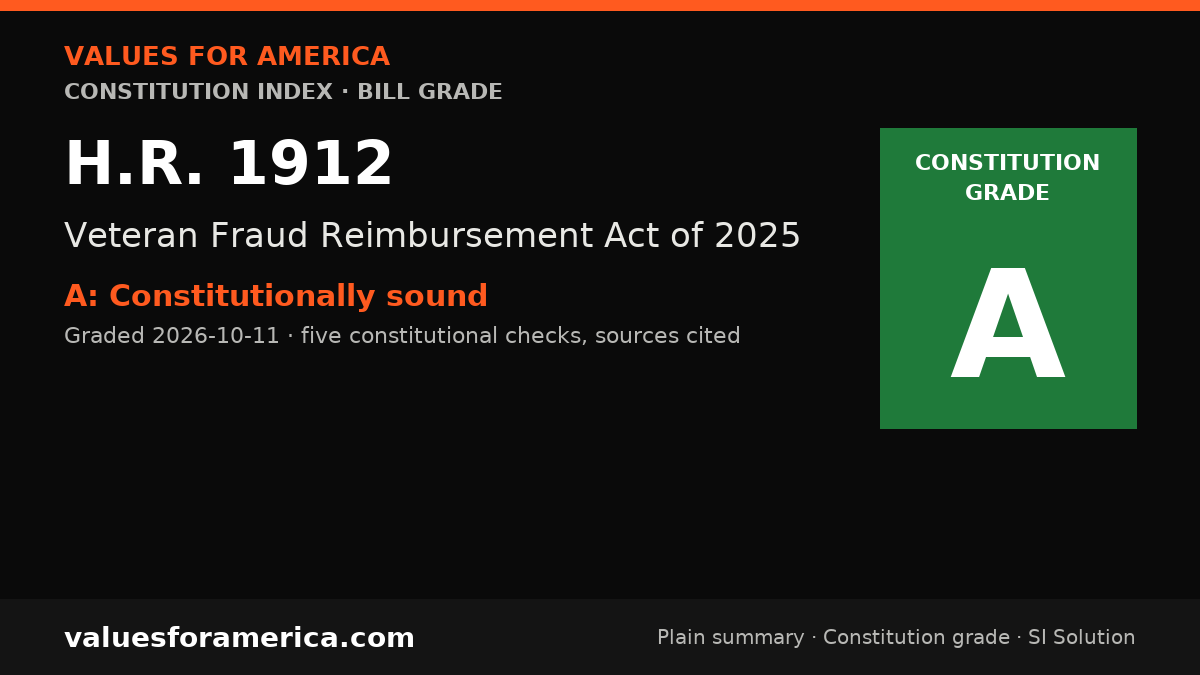
H.R. 1912 explained · 119th Congress · Became law
Veteran Fraud Reimbursement Act of 2025
Cosponsors: 7 (3 D, 4 R) · per Congress.gov, 2026-10-10
Introduced: 2025-03-06
Latest action (2025-12-12): Became Public Law No: 119-56.
What H.R. 1912 does, in plain terms
Veteran Fraud Reimbursement Act of 2025 This act modifies the procedures by which the Department of Veterans Affairs (VA) reissues misused benefits to a beneficiary, including by requiring the VA to establish methods and timing with respect to determining whether an instance of misuse by a fiduciary is the result of negligence by the VA. The act also provides that if a beneficiary predeceases a reissuance, the VA must pay the amount to a surviving beneficiary in the same method as certain other VA benefits are paid upon the death of a beneficiary. Under the act, the VA may not withhold the reissuing of a benefit payment by reason of a pending determination regarding the VA's negligence in relation to the instance of misuse by a fiduciary. Additionally, the VA is not required to make a determination regarding its negligence for each instance of misuse by a fiduciary of all or part of an individual's benefit paid to such fiduciary.
Official summary by the Congressional Research Service, via Congress.gov.
Constitution Index
“VFA Constitution grade”
Constitutionally sound
Graded 2026-10-11
SI-generated grade · five published checks · not individually reviewed by a person · methodology
The Veteran Fraud Reimbursement Act of 2025 is a constitutional exercise of federal power under the spending and property clauses, directly tied to the administration of veterans' benefits. It does not infringe on any constitutional right, respects individual sovereignty by protecting beneficiaries from fiduciary misconduct, and appropriately operates at the federal level where veterans' benefits are administered. The act enhances due process by ensuring timely reissuance of misused benefits and does not involve any taking of property without just compensation.
-
✓ Passes · Enumerated powers
The federal government has explicit authority to provide for the common defense and to raise and support armies, which includes the administration of veterans' benefits. Article I, Section 8, Clause 12 grants Congress the power to raise and support armies, and the Supreme Court has long recognized that veterans' benefits are a form of compensation for military service. The act directly regulates t… -
✓ Passes · Bill of Rights
The act does not implicate any of the first ten amendments. It does not restrict speech, religion, assembly, press, or petition; it does not affect the right to bear arms; it does not involve quartering of soldiers; it does not authorize searches or seizures; it does not compel self-incrimination or deprive anyone of life, liberty, or property without due process; it does not affect trial rights; … -
✓ Passes · Individual sovereignty
The act protects individual sovereignty by ensuring that veterans and their beneficiaries receive the benefits they are entitled to, even when a fiduciary has misused those funds. It does not restrict any individual's freedom over their person, property, speech, labor, or belief. Rather, it imposes obligations on the VA to act promptly and not to withhold payments pending negligence determinations… -
✓ Passes · Decentralization
The act concerns the administration of federal veterans' benefits, which is inherently a federal responsibility. An individual cannot handle the reissuance of VA benefits without government involvement because the benefits are administered by the federal government. Local communities and states do not have the authority or resources to administer federal veterans' benefits. The federal government … -
✓ Passes · Due process and takings
The act enhances procedural due process by requiring the VA to establish methods and timing for determining negligence and by prohibiting the withholding of reissued benefits pending such determinations. This ensures that beneficiaries receive their benefits without undue delay. There is no taking of property; rather, the act ensures that property (benefits) is returned to the rightful beneficiary…
Sources: Congress.gov: HR 1912 summary
Report an error in this grade
What should pass
“VFA SI Solution”
No solution yet
A sourced SI draft appears here once it passes automated checks (Constitution citation, source verification, independent SI critic). How publication works.
Related on VFA

For journalists and bloggers
“Embed this grade”
Free to use with the link back. The badge and card update when the grade changes. Embed terms →
