H.R. 1910 explained · 119th Congress · Pending in Congress
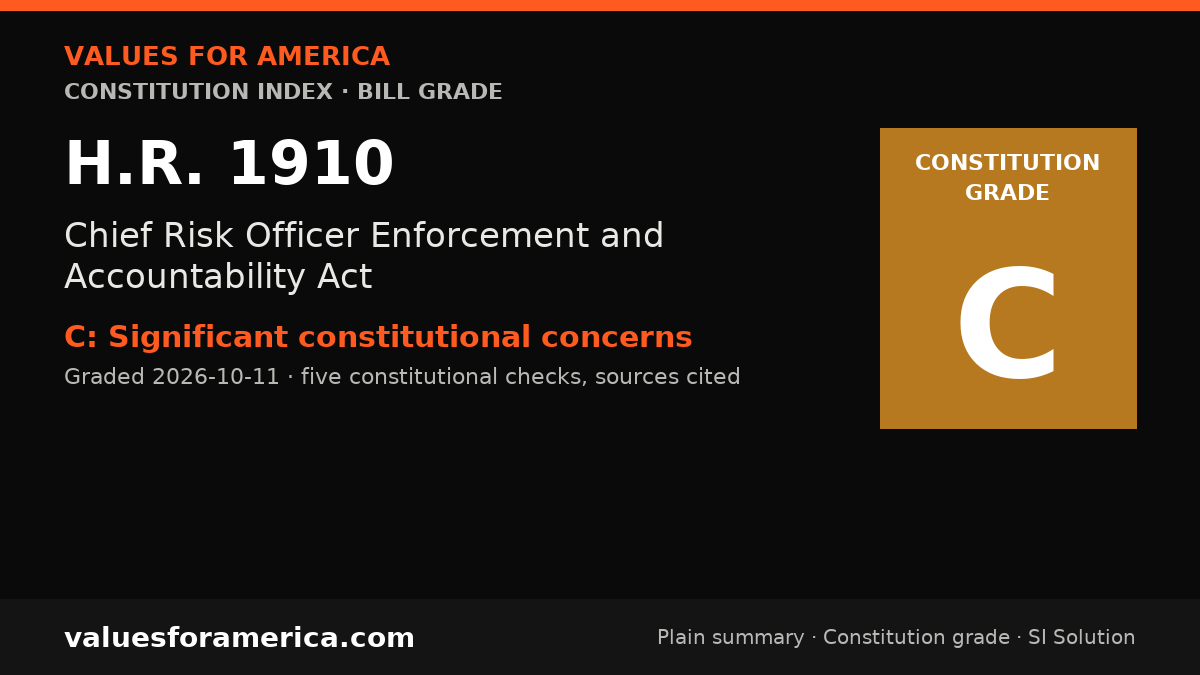
Chief Risk Officer Enforcement and Accountability Act
Cosponsors: 5 (5 D, 0 R) · per Congress.gov, 2026-10-12
Introduced: 2025-03-06
Latest action (2025-03-06): Referred to the House Committee on Financial Services.
What H.R. 1910 does, in plain terms
Chief Risk Officer Enforcement and Accountability Act This bill expands which financial companies must establish a risk committee and appoint a chief risk officer and provides statutory authority for requiring large bank holding companies to appoint a chief risk officer. Chief risk officers are responsible for the establishment of risk limits, monitoring compliance, and reporting any deficiencies to the risk committee. Risk committees are responsible for the oversight of the risk management practices of the entire company. Currently, large bank holding companies that are publicly traded are required to establish risk committees and, by regulation, have chief risk officers. Under the bill, risk committees and chief risk officers are also required for (1) privately held large bank holding companies, and (2) large banks that do not have a holding company. Additionally, the bill requires companies to notify regulators if the chief risk officer position is vacant within 24 hours of when the vacancy occurs. If the vacancy lasts 60 days or more, the company’s assets are capped at the amount held at the time the vacancy occurred. Further, the bill allows the Federal Reserve Board to require smaller bank holding companies to establish a risk committee and appoint a chief risk officer. Currently, the board is allowed to require smaller bank companies that are publicly traded to establish risk committees.
Official summary by the Congressional Research Service, via Congress.gov.
Constitution Index
“VFA Constitution grade”
Significant constitutional concerns
Graded 2026-10-11
SI-generated grade · five published checks · not individually reviewed by a person · methodology
The bill likely falls within Congress's enumerated powers over interstate commerce and banking, but it raises significant concerns regarding individual sovereignty and decentralization by imposing federal mandates on private corporate governance and potentially on smaller institutions without clear constitutional justification. The 24-hour vacancy notification and asset cap provisions may also implicate due process and property rights.
-
✓ Passes · Enumerated powers
Congress has authority under Article I, Section 8, Clause 3 (Commerce Clause) to regulate banking and financial institutions that affect interstate commerce. The bill's requirements for risk committees and chief risk officers for large banks and bank holding companies are within this authority, as they pertain to the safety and soundness of the financial system. The provision allowing the Federal … -
✓ Passes · Bill of Rights
The bill does not directly infringe on any of the first ten amendments. It does not restrict speech, religion, assembly, press, petition, arms, quartering, search and seizure, self-incrimination, due process, takings, fair trial, jury, cruel and unusual punishment, or unenumerated rights. The requirements are regulatory in nature and do not implicate these protections. -
✗ Concern · Individual sovereignty
The bill imposes federal mandates on private companies regarding their internal governance structures, requiring them to establish risk committees and appoint chief risk officers. While the government has a compelling interest in financial stability, the burden is on the government to justify these restrictions on private enterprise. The bill extends these requirements to privately held large bank… -
✗ Concern · Decentralization
The bill consolidates decision-making at the federal level by imposing uniform requirements on banks and bank holding companies, rather than allowing states or local communities to regulate their own financial institutions. While large banks operate across state lines and are subject to federal regulation, the bill also gives the Federal Reserve discretion to impose these requirements on smaller b… -
✗ Concern · Due process and takings
The bill's provision that caps a company's assets if a chief risk officer vacancy lasts 60 days or more could be seen as a taking of property without just compensation, as it directly restricts the company's ability to use its assets. Additionally, the 24-hour notification requirement may not provide adequate due process, as it imposes immediate obligations without a hearing or opportunity to cont…
Sources: Congress.gov: HR 1910 summary
Report an error in this grade
What should pass
“VFA SI Solution”
No solution yet
A sourced SI draft appears here once it passes automated checks (Constitution citation, source verification, independent SI critic). How publication works.
Related on VFA

For journalists and bloggers
“Embed this grade”
Free to use with the link back. The badge and card update when the grade changes. Embed terms →
