H.R. 1901 explained · 119th Congress · Pending in Congress
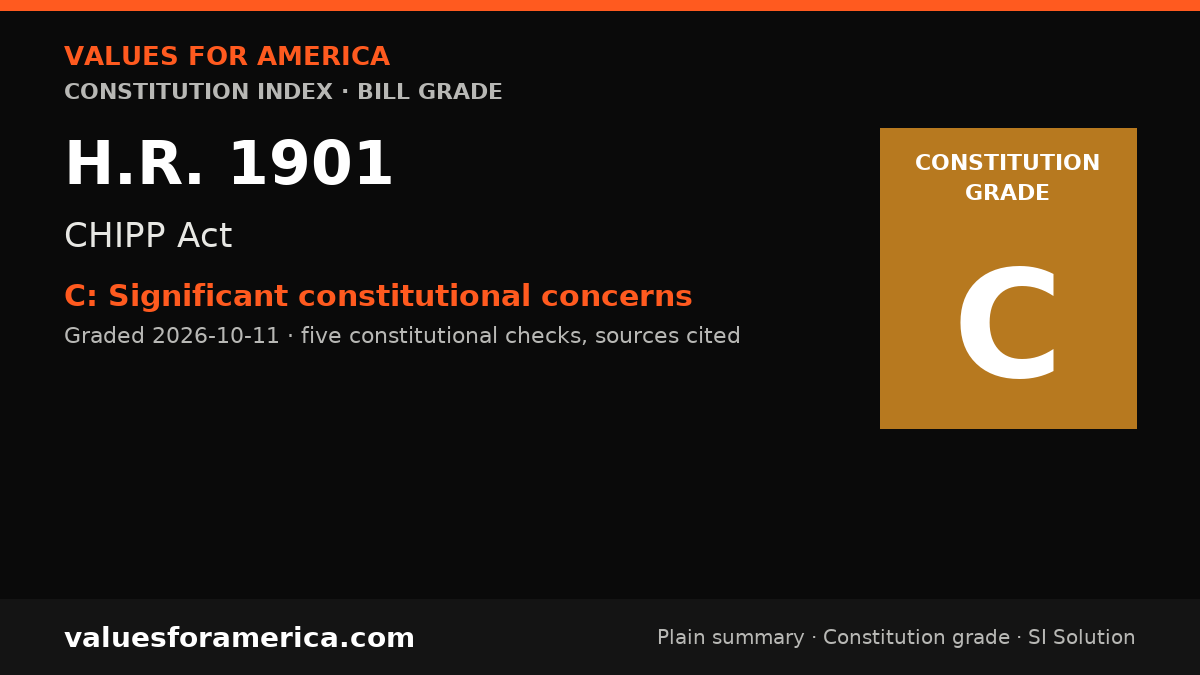
CHIPP Act
Cosponsors: 29 (29 D, 0 R) · per Congress.gov, 2026-10-12
Introduced: 2025-03-06
Latest action (2025-03-06): Referred to the House Committee on Energy and Commerce.
What H.R. 1901 does, in plain terms
Children’s Health Insurance Program Permanency Act or the CHIPP Act This bill permanently extends the Children's Health Insurance Program (CHIP) and related measures, programs, and authorities. Specifically, the bill permanently funds CHIP and related programs that support the development of child health quality measures and outreach and enrollment efforts. The bill also permanently authorizes the Medicaid and CHIP express lane eligibility option, which allows states to use information from designated programs (e.g., the Supplemental Nutrition Assistance Program) to streamline eligibility determinations for children. Additionally, under the bill, states may expand eligibility to children whose family income exceeds the otherwise applicable limits.
Official summary by the Congressional Research Service, via Congress.gov.
Constitution Index
“VFA Constitution grade”
Significant constitutional concerns
Graded 2026-10-11
SI-generated grade · five published checks · not individually reviewed by a person · methodology
The bill raises significant constitutional concerns because it permanently funds and expands a federal health insurance program for children, which goes beyond the enumerated powers of Congress and consolidates authority at the federal level. While the bill does not directly infringe on individual rights, it expands federal involvement in areas traditionally reserved to the states and families, and it may impose conditions on states that could implicate Tenth Amendment principles. The permanent authorization of CHIP and related programs, including the express lane eligibility option and expanded eligibility, represents a substantial federal role in health policy that is not explicitly enumerated in the Constitution.
-
✗ Concern · Enumerated powers
The bill relies on the Spending Clause (Article I, Section 8, Clause 1) and the General Welfare Clause, but the Supreme Court has held that Congress may spend for the general welfare, provided the spending is for the common benefit and not merely for local or special interests. However, the permanent extension of CHIP and related programs, including the express lane eligibility option and expanded… -
✓ Passes · Bill of Rights
The bill does not directly infringe on any of the first ten amendments. It does not restrict speech, religion, assembly, press, petition, arms, quartering, search and seizure, self-incrimination, due process, takings, fair trial, jury, cruel and unusual punishment, or unenumerated rights. The bill is a spending and health insurance measure that does not impose criminal penalties or restrict indivi… -
✗ Concern · Individual sovereignty
The bill expands government involvement in the lives of families by providing federal health insurance for children and encouraging states to expand eligibility. While this does not directly restrict individual freedom, it does create a dependency on federal programs and may influence family decisions regarding health care. The Ninth Amendment protects unenumerated rights, and the Tenth Amendment … -
✗ Concern · Decentralization
The bill fails the decentralization test. (1) Individuals and families can handle health insurance for children through private means or state programs without federal involvement. (2) Local communities and counties can address child health needs without state involvement. (3) States can handle child health insurance without federal involvement, as many did before CHIP. (4) The bill consolidates d… -
✓ Passes · Due process and takings
The bill does not bypass due process or take property without just compensation. It is a spending program that provides benefits, not a regulatory or punitive measure. There is no deprivation of life, liberty, or property without due process, and no taking of private property for public use without just compensation. The bill's provisions for eligibility determination and expansion do not implicat…
Sources: Congress.gov: HR 1901 summary
Report an error in this grade
What should pass
“VFA SI Solution”
No solution yet
A sourced SI draft appears here once it passes automated checks (Constitution citation, source verification, independent SI critic). How publication works.
Related on VFA

For journalists and bloggers
“Embed this grade”
Free to use with the link back. The badge and card update when the grade changes. Embed terms →
