H.R. 1880 explained · 119th Congress · Pending in Congress
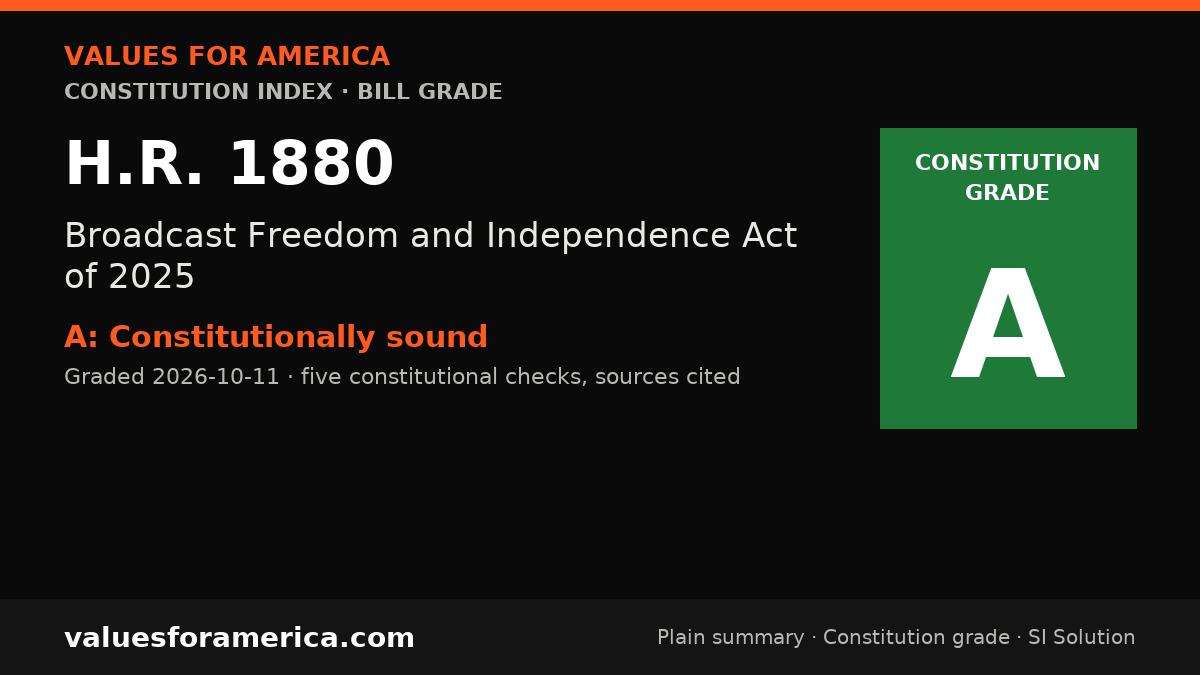
Broadcast Freedom and Independence Act of 2025
Cosponsors: 13 (13 D, 0 R) · per Congress.gov, 2026-10-12
Introduced: 2025-03-05
Latest action (2025-03-05): Referred to the House Committee on Energy and Commerce.
What H.R. 1880 does, in plain terms
Broadcast Freedom and Independence Act of 2025 This bill prohibits the Federal Communications Commission (FCC) from taking action against or imposing certain conditions on individuals on the basis of viewpoints broadcast or disseminated by the individuals or their affiliates. Specifically, the FCC may not revoke a license or authorization of, or otherwise take action against, an individual or entity on the basis of viewpoints broadcast or otherwise disseminated by the individual or entity or an affiliate thereof. Further, the FCC may not impose conditions on its approval of certain transactions on the basis of viewpoints broadcast or otherwise disseminated by the individual or entity seeking approval of the transaction, or an affiliate thereof. Under the bill, the FCC retains its authority to take action or impose conditions on the basis of (1) violations of certain existing laws regarding lottery information, fraud, and obscene language; or (2) the broadcast or other dissemination of content that constitutes incitement under the First Amendment.
Official summary by the Congressional Research Service, via Congress.gov.
Constitution Index
“VFA Constitution grade”
Constitutionally sound
Graded 2026-10-11
SI-generated grade · five published checks · not individually reviewed by a person · methodology
The Broadcast Freedom and Independence Act of 2025 is fully constitutional. It restricts the FCC from taking viewpoint-based actions against broadcasters, thereby reinforcing the First Amendment's prohibition on government censorship. The bill operates within Congress's enumerated power to regulate interstate commerce and the FCC's delegated authority, while preserving the FCC's ability to enforce existing laws against fraud, obscenity, and incitement. No rights are infringed, individual sovereignty is protected, decentralization is respected, and due process is upheld.
-
✓ Passes · Enumerated powers
Congress has authority under Article I, Section 8, Clause 3 (Commerce Clause) to regulate interstate communications, including broadcasting. The FCC was created under this power. This bill limits the FCC's discretion in a manner consistent with that authority, and does not exceed enumerated federal powers. -
✓ Passes · Bill of Rights
The bill directly protects First Amendment rights by prohibiting the FCC from revoking licenses or imposing conditions based on viewpoints broadcast. It explicitly preserves the FCC's ability to act against incitement (consistent with Brandenburg v. Ohio) and other unprotected speech (fraud, obscenity). No other Bill of Rights provisions are implicated. -
✓ Passes · Individual sovereignty
The bill enhances individual sovereignty by preventing the government from punishing broadcasters for expressing viewpoints. It does not restrict any individual's person, property, speech, labor, or belief; rather, it removes a government threat to those freedoms. The burden on government to justify viewpoint discrimination is not met here, and the bill properly curbs that discrimination. -
✓ Passes · Decentralization
The bill does not consolidate power upward; it restricts federal action. An individual or family can handle broadcasting without government viewpoint policing (passes question 1). Local communities and states do not need federal involvement in viewpoint regulation (passes questions 2 and 3). The bill reduces federal consolidation of decision-making (passes question 4). -
✓ Passes · Due process and takings
The bill does not bypass due process or take property without just compensation. It preserves the FCC's authority to act based on violations of law, which would involve proper procedures. By prohibiting arbitrary viewpoint-based actions, it actually strengthens substantive due process protections against arbitrary government action.
Sources: Congress.gov: HR 1880 summary
Report an error in this grade
What should pass
“VFA SI Solution”
No solution yet
A sourced SI draft appears here once it passes automated checks (Constitution citation, source verification, independent SI critic). How publication works.
Related on VFA

For journalists and bloggers
“Embed this grade”
Free to use with the link back. The badge and card update when the grade changes. Embed terms →
