H.R. 1877 explained · 119th Congress · Pending in Congress
Protecting Americans’ Social Security Data Act
Cosponsors: 152 (152 D, 0 R) · per Congress.gov, 2026-10-12
Introduced: 2025-03-05
Latest action (2025-03-05): Referred to the House Committee on Ways and Means.
What H.R. 1877 does, in plain terms
Protecting Americans’ Social Security Data Act This bill prohibits political appointees and special government employees from accessing Social Security data systems that contain personally identifiable information about Social Security beneficiaries. Specifically, political appointees and special government employees may not access systems maintained by the Social Security Administration (SSA) that issue or record Social Security account numbers, that are used to determine eligibility for or to pay Social Security benefits, or that otherwise contain personally identifiable information about individuals receiving or applying for benefits. The bill also establishes a civil right of action for an individual whose information was negligently accessed or disclosed in violation of these provisions. The individual may bring suit against the United States if the violator was a U.S. employee or officer, or against the violator if they were not a U.S. employee or officer. Such a claim must be brought within two years of the affected individual’s discovery of the violation. Upon a finding of liability, defendants are liable for specified monetary damages. If an individual is criminally charged or subject to proposed disciplinary or adverse action by a federal or state agency for having accessed or disclosed information in violation of these provisions, SSA must notify the individual whose information was accessed or disclosed of the violation as soon as practicable. Finally, the bill requires the SSA Office of the Inspector General to investigate and report to Congress on any unauthorized access to or disclosure of information in a beneficiary data system.
Official summary by the Congressional Research Service, via Congress.gov.
Constitution Index
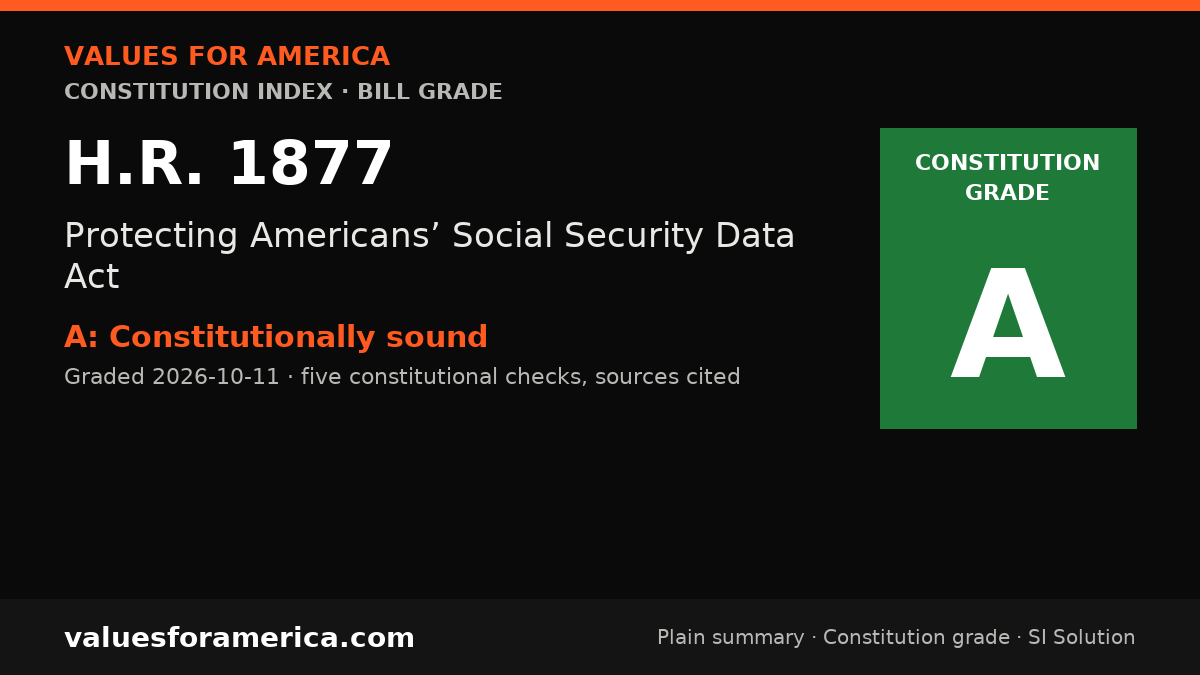
“VFA Constitution grade”
Constitutionally sound
Graded 2026-10-11
SI-generated grade · five published checks · not individually reviewed by a person · methodology
The bill restricts access to Social Security data systems by political appointees and special government employees, which is a reasonable exercise of Congress's power to protect the integrity of federal benefit programs. It does not infringe on any constitutional rights, respects individual sovereignty by providing a remedy for unauthorized access, and appropriately delegates oversight to the SSA Inspector General. The bill does not consolidate power upward beyond the federal level, as it addresses a federal agency's data systems.
-
✓ Passes · Enumerated powers
Congress has the power to legislate on matters concerning federal agencies and programs under Article I, Section 8, Clause 18 (the Necessary and Proper Clause), which allows Congress to make laws necessary for executing its enumerated powers, including managing the Social Security system. The bill regulates access to SSA data systems, which is within Congress's authority to oversee federal agencie… -
✓ Passes · Bill of Rights
The bill does not infringe on any of the first ten amendments. It restricts government employees' access to data, not the rights of individuals. It does not implicate the First, Second, Third, Fourth, Fifth, Sixth, Seventh, Eighth, Ninth, or Tenth Amendments. The bill actually enhances privacy protections for beneficiaries, which is consistent with the spirit of the Fourth Amendment's protection a… -
✓ Passes · Individual sovereignty
The bill protects individuals' control over their personal information by limiting who can access it and providing a civil remedy for unauthorized access. This does not restrict individual freedom; rather, it safeguards it. The burden on the government to justify access is increased, which aligns with the principle that individuals have a right to privacy in their personal data. -
✓ Passes · Decentralization
The bill addresses a federal agency's data systems, which are inherently federal in nature. An individual cannot handle the protection of SSA data systems alone, nor can a local community or state regulate federal employees' access to federal systems. The action is appropriately at the federal level because it concerns federal employees and federal data. It does not consolidate decision-making upw… -
✓ Passes · Due process and takings
The bill provides a civil right of action for individuals whose information was negligently accessed or disclosed, with a two-year statute of limitations from discovery. This ensures procedural due process by giving affected individuals a remedy. It does not take property without just compensation; rather, it provides a mechanism for damages. The bill also requires notification to individuals if t…
Sources: Congress.gov: HR 1877 summary
Report an error in this grade
What should pass
“VFA SI Solution”
No solution yet
A sourced SI draft appears here once it passes automated checks (Constitution citation, source verification, independent SI critic). How publication works.
Related on VFA

For journalists and bloggers
“Embed this grade”
Free to use with the link back. The badge and card update when the grade changes. Embed terms →
