H.R. 1876 explained · 119th Congress · Pending in Congress
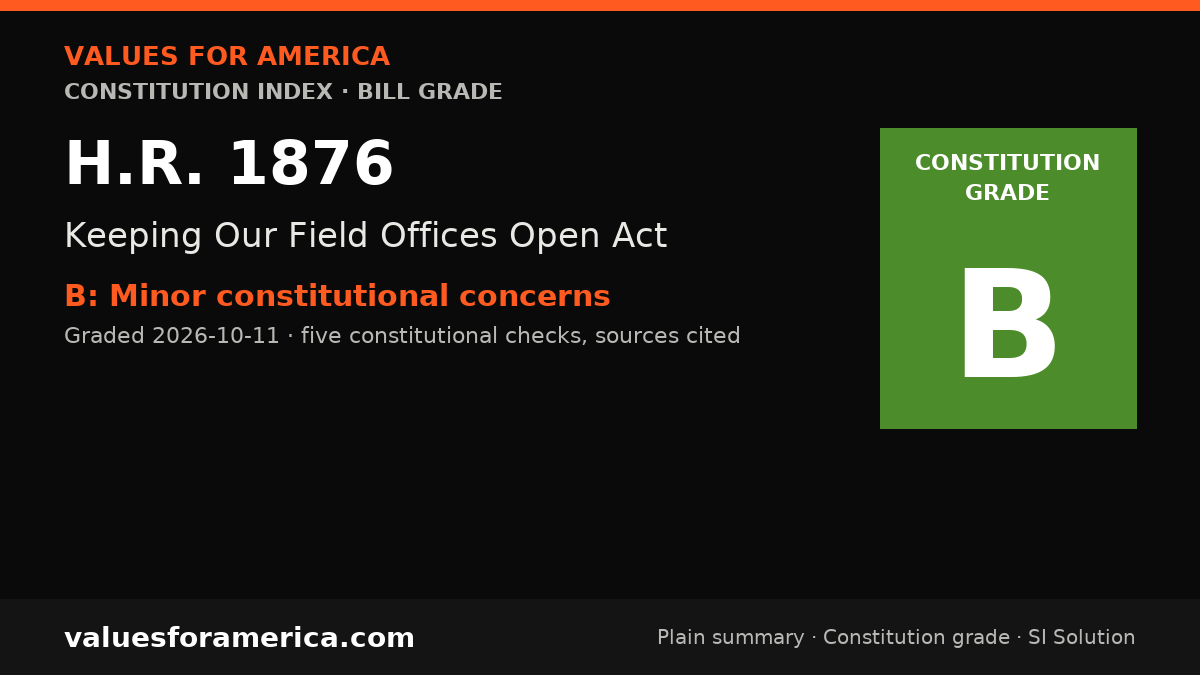
Keeping Our Field Offices Open Act
Cosponsors: 130 (130 D, 0 R) · per Congress.gov, 2026-10-12
Introduced: 2025-03-05
Latest action (2025-03-05): Referred to the House Committee on Ways and Means.
What H.R. 1876 does, in plain terms
Keeping Our Field Offices Open Act This bill temporarily prohibits the closure or consolidation of, or other limitation of access to, Social Security Administration (SSA) offices and stations, and sets forth procedural requirements for future changes to office and station availability. Specifically, the bill prohibits through at least January 21, 2029, the closure or consolidation of, or other limitation of access to, SSA field offices, hearing offices, and resident stations. On or after that date, SSA must submit a report to Congress justifying its process for selecting stations and offices to be closed, consolidated, or limited. The prohibition is lifted 180 days after the submission of such report. The bill also sets forth requirements that must be met before SSA may close, consolidate, or otherwise limit access to an office or station after the initial moratorium expires. At least 120 days before such a change takes effect, SSA must provide public notice to individuals in affected areas, including information on how lost access to SSA services will be replaced. SSA must also conduct at least two public hearings on each such change. Further, SSA must provide a hearing to any individual who makes a timely showing that a determination to close, consolidate, or limit an office or station is arbitrary, capricious, or deficient in another specified manner. Finally, a closure, consolidation, or limitation may not result in the total number of SSA offices or stations falling below the number of such offices or stations in operation on January 20, 2025.
Official summary by the Congressional Research Service, via Congress.gov.
Constitution Index
“VFA Constitution grade”
Minor constitutional concerns
Graded 2026-10-11
SI-generated grade · five published checks · not individually reviewed by a person · methodology
The bill is a federal action that restricts the executive branch's ability to close or consolidate Social Security Administration offices. It is within Congress's enumerated powers under the Spending Clause and Necessary and Proper Clause, as it regulates the administration of a federal benefit program. The bill does not infringe on individual rights; rather, it enhances procedural protections for affected individuals. The main constitutional tension is that it imposes procedural requirements on the executive branch, which may raise separation of powers concerns, but these are not severe enough to render the bill unconstitutional. The bill does not consolidate power upward; it actually preserves local access to federal services.
-
✓ Passes · Enumerated powers
Congress has the power to legislate on matters of federal spending and to make all laws necessary and proper for executing its enumerated powers (Article I, Section 8, Clause 1 and Clause 18). The Social Security Administration is a federal agency created under Congress's spending power, and regulating its operations is within Congress's authority to oversee the administration of federal programs.… -
✓ Passes · Bill of Rights
The bill does not infringe on any of the first ten amendments. It imposes procedural requirements on the executive branch but does not restrict speech, religion, assembly, press, petition, arms, quartering, search and seizure, self-incrimination, due process, takings, fair trial, jury, cruel and unusual punishment, or unenumerated rights. In fact, it provides additional due process protections by … -
✓ Passes · Individual sovereignty
The bill does not restrict individual liberty; it protects access to federal services. It imposes obligations on the government to provide notice and hearings, which enhances individual sovereignty by ensuring that individuals have a voice in decisions that affect their access to benefits. The burden on the government is appropriate and does not restrict personal freedom. -
✓ Passes · Decentralization
The bill does not consolidate decision-making at a higher level of government; it actually prevents the federal government from reducing local access to SSA offices. It requires public notice and hearings at the local level, which supports community involvement. The questions: (1) Individuals cannot handle SSA services without government involvement, so the individual cannot handle this; (2) Local… -
✓ Passes · Due process and takings
The bill enhances procedural due process by requiring public notice, public hearings, and individual hearings for those affected by office closures. It does not take property without just compensation; it regulates the operation of federal offices, which is not a taking. The requirements are non-arbitrary and provide fair notice and opportunity to be heard.
Sources: Congress.gov: HR 1876 summary
Report an error in this grade
What should pass
“VFA SI Solution”
No solution yet
A sourced SI draft appears here once it passes automated checks (Constitution citation, source verification, independent SI critic). How publication works.
Related on VFA

For journalists and bloggers
“Embed this grade”
Free to use with the link back. The badge and card update when the grade changes. Embed terms →
