H.R. 1873 explained · 119th Congress · Pending in Congress
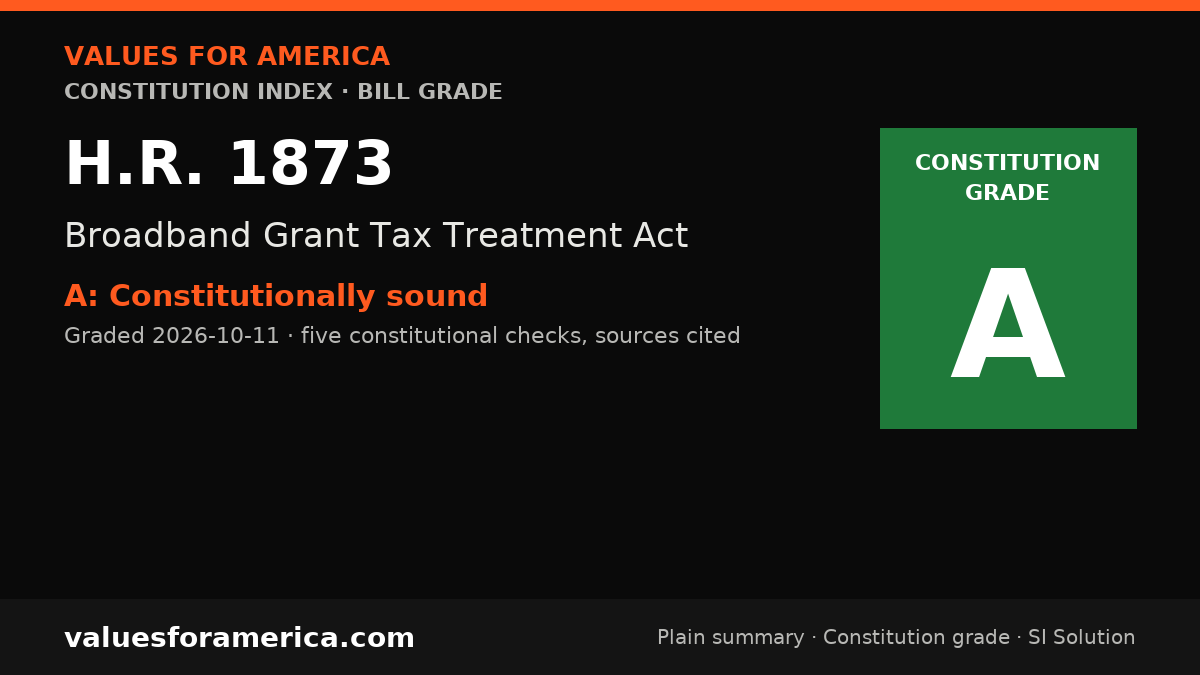
Broadband Grant Tax Treatment Act
Cosponsors: 15 (7 D, 8 R) · per Congress.gov, 2026-10-12
Introduced: 2025-03-05
Latest action (2025-03-05): Referred to the House Committee on Ways and Means.
What H.R. 1873 does, in plain terms
Broadband Grant Tax Treatment Act This bill excludes from gross income (for federal tax purposes) certain grants received for broadband deployment. As background, contributions of capital to a corporation generally are not taxable income. However, under an exception enacted in 2017 by the Tax Cuts and Jobs Act, grants from a government or civic organization are not contributions to capital and, thus, treated as taxable income. Prior to the Tax Cuts and Jobs Act, the Internal Revenue Service (IRS) considered certain grants from a government or civic organization contributions of capital and, thus, not taxable income. The bill specifically excludes from gross income grants received for broadband deployment from the National Telecommunications and Information Administration (NTIA) Broadband Equity, Access, and Deployment Program; NTIA State Digital Equity Capacity Grant Program; NTIA Digital Equity Competitive Grant Program; NTIA Enabling Middle Mile Broadband Infrastructure Program; Department of Agriculture ReConnect Program; Coronavirus State and Local Fiscal Recovery Funds and the Coronavirus Capital Projects Fund; and NTIA Tribal Broadband Connectivity Program and the Broadband Infrastructure Program. The bill also requires the IRS to issue guidance on the exclusion from gross income of such grants. The bill applies to funds received in tax years ending after March 11, 2023.
Official summary by the Congressional Research Service, via Congress.gov.
Constitution Index
“VFA Constitution grade”
Constitutionally sound
Graded 2026-10-11
SI-generated grade · five published checks · not individually reviewed by a person · methodology
The Broadband Grant Tax Treatment Act is a narrow, constitutionally sound exercise of Congress's taxing power. It simply excludes certain broadband deployment grants from gross income for federal tax purposes, which is a permissible exercise of Congress's authority under Article I, Section 8, Clause 1 to lay and collect taxes. The bill does not infringe on any constitutional rights, does not restrict individual sovereignty, and does not centralize power beyond the federal taxing authority already established. It also does not implicate due process or takings concerns.
-
✓ Passes · Enumerated powers
Congress has the explicit power to lay and collect taxes under Article I, Section 8, Clause 1. The bill operates entirely within the federal tax code, defining what is excluded from gross income. This is a direct exercise of the taxing power and is therefore within enumerated federal authority. -
✓ Passes · Bill of Rights
The bill does not implicate any of the first ten amendments. It does not restrict speech, religion, assembly, press, petition, arms, quartering, search and seizure, self-incrimination, due process, takings, trial rights, or cruel and unusual punishment. It is a tax provision that grants a benefit (exclusion from income) and imposes no restriction on individual rights. -
✓ Passes · Individual sovereignty
The bill does not restrict what individuals can do with their person, property, speech, labor, or belief. It merely provides a tax exclusion for certain grants, which is a benefit, not a restriction. The burden of proof for any restriction is not triggered because there is no restriction. -
✓ Passes · Decentralization
The bill does not consolidate decision-making at a higher level of government. It is a federal tax provision that applies uniformly to grants from various federal programs. The grants themselves are already federal programs, and the bill simply clarifies their tax treatment. It does not expand federal power over broadband deployment; it only affects the tax code. The four-question test is not dire… -
✓ Passes · Due process and takings
The bill does not deprive anyone of life, liberty, or property without due process, nor does it take private property for public use without just compensation. It is a tax benefit provision that does not impose any penalty or seizure. There is no procedural or substantive due process concern, and no takings issue.
Sources: Congress.gov: HR 1873 summary
Report an error in this grade
What should pass
“VFA SI Solution”
No solution yet
A sourced SI draft appears here once it passes automated checks (Constitution citation, source verification, independent SI critic). How publication works.
Related on VFA

For journalists and bloggers
“Embed this grade”
Free to use with the link back. The badge and card update when the grade changes. Embed terms →
