H.R. 1870 explained · 119th Congress · Pending in Congress
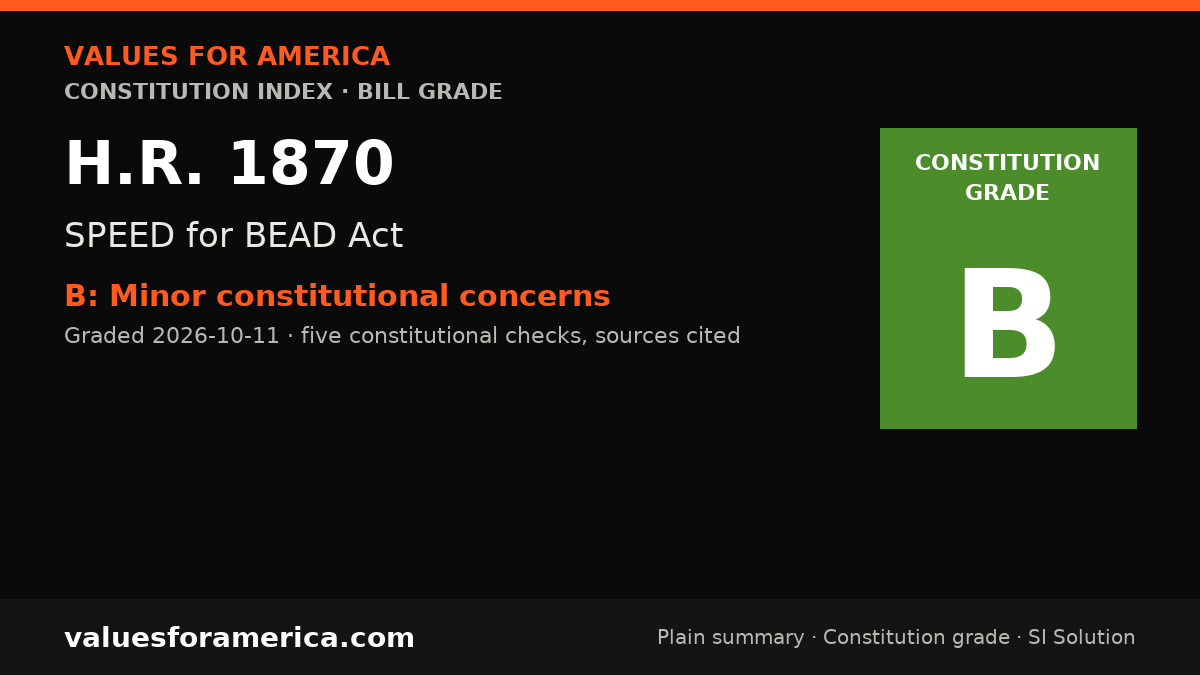
SPEED for BEAD Act
Cosponsors: 22 (0 D, 22 R) · per Congress.gov, 2026-10-12
Introduced: 2025-03-05
Latest action (2025-03-05): Referred to the House Committee on Energy and Commerce.
What H.R. 1870 does, in plain terms
Streamlining Program Efficiency and Expanding Deployment for BEAD Act or the SPEED for BEAD Act This bill makes certain changes to the Broadband, Equity, Access, and Deployment (BEAD) Program, including by expanding the broadband technologies that may qualify for funding and prohibiting states from regulating broadband rates in connection with the program. (The BEAD Program is administered by the National Telecommunications and Information Administration (NTIA) and provides funding to eligible entities for broadband deployment, connectivity, mapping, and adoption projects. Eligible entities include U.S. states, territories, and the District of Columbia.) Specifically, the bill establishes that projects using any broadband technology (e.g., satellite, fixed wireless, or fiber) may qualify for funding, provided the technology meets specified performance criteria. (Original BEAD rules established a preference for fiber projects.) The bill also explicitly prohibits eligible entities from regulating, setting, or otherwise mandating pursuant to the BEAD Program (1) rates charged for broadband service, or (2) methodologies used to calculate such rates. The prohibition includes rate regulation carried out in conjunction with the existing requirement that subgrantees offer at least one low-cost broadband service option to certain subscribers. Further, the bill prohibits the NTIA and eligible entities from establishing or enforcing conditions, preferences, or other requirements related to collective bargaining and labor agreements; climate change; diversity, equity, and inclusion; and other topics. The bill also modifies the purposes for which the funds may be used and the treatment of unused funds. Finally, the bill replaces the term Equity in the program’s name with Expansion.
Official summary by the Congressional Research Service, via Congress.gov.
Constitution Index
“VFA Constitution grade”
Minor constitutional concerns
Graded 2026-10-11
SI-generated grade · five published checks · not individually reviewed by a person · methodology
The SPEED for BEAD Act generally operates within federal enumerated powers under the Commerce Clause and Spending Clause, and does not directly infringe individual rights. However, the prohibition on state rate regulation raises significant federalism concerns under the Tenth Amendment, and the removal of equity considerations may indirectly affect equal protection interests. The bill is mostly sound but has constitutional tensions that require careful justification.
-
✓ Passes · Enumerated powers
The federal government has authority under Article I, Section 8, Clause 3 (Commerce Clause) to regulate interstate communications infrastructure, and under Article I, Section 8, Clause 1 (Spending Clause) to attach conditions to federal grants. The BEAD Program is a conditional spending program, and this bill modifies those conditions. Congress may set terms for federal funds, including technology… -
✓ Passes · Bill of Rights
The bill does not directly restrict speech, religion, assembly, press, petition, arms, quartering, search and seizure, self-incrimination, due process, fair trial, jury, cruel and unusual punishment, or unenumerated rights. The prohibition on conditions related to collective bargaining and labor agreements does not infringe the First Amendment right to association or petition, as it only restricts… -
✓ Passes · Individual sovereignty
The bill does not restrict individuals' control over their person, property, speech, labor, or belief. It governs the terms of federal grants to states and subgrantees, and prohibits states from regulating broadband rates. While rate regulation can affect property rights, the bill's prohibition on state rate regulation actually removes a government restriction on private broadband providers, there… -
✗ Concern · Decentralization
The bill fails the decentralization test because it prohibits states from regulating broadband rates in connection with the BEAD Program, which consolidates decision-making at the federal level. While broadband deployment involves interstate commerce justifying some federal role, rate regulation has traditionally been a state and local matter. The Tenth Amendment reserves to the states powers not … -
✓ Passes · Due process and takings
The bill does not deprive any person of life, liberty, or property without due process of law, nor does it take private property for public use without just compensation. The prohibition on rate regulation does not constitute a taking, as it removes a government restriction rather than appropriating property. The bill provides clear notice of the conditions attached to federal funds, satisfying pr…
Sources: Congress.gov: HR 1870 summary
Report an error in this grade
What should pass
“VFA SI Solution”
No solution yet
A sourced SI draft appears here once it passes automated checks (Constitution citation, source verification, independent SI critic). How publication works.
Related on VFA

For journalists and bloggers
“Embed this grade”
Free to use with the link back. The badge and card update when the grade changes. Embed terms →
