H.R. 186 explained · 119th Congress · Pending in Congress
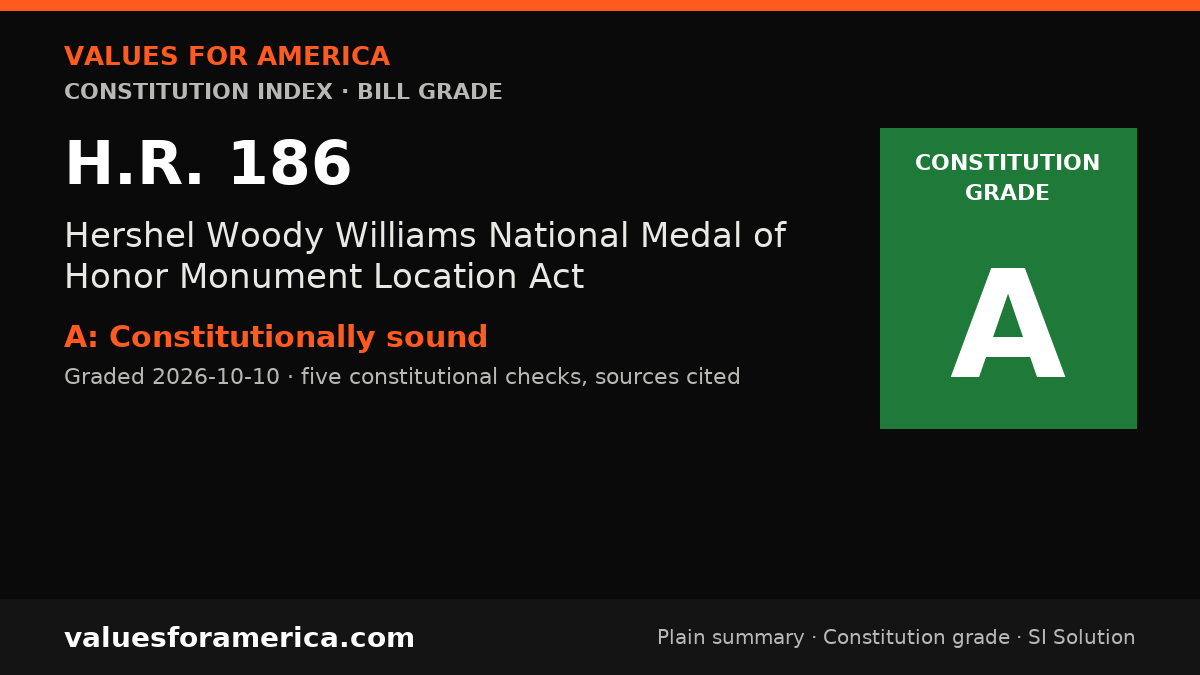
Hershel Woody Williams National Medal of Honor Monument Location Act
Cosponsors: 8 (2 D, 6 R) · per Congress.gov, 2026-10-10
Introduced: 2025-01-03
Latest action (2025-12-09): Committee on Energy and Natural Resources Subcommittee on National Parks. Hearings held. With printed Hearing: S.Hrg. 119-238.
What H.R. 186 does, in plain terms
Hershel "Woody" Williams National Medal of Honor Monument Location Act This bill requires the authorized monument honoring Medal of Honor recipients to be located within the Reserve (the great cross-axis of the National Mall, which generally extends from the Capitol to the Lincoln Memorial and from the White House to the Jefferson Memorial).
Official summary by the Congressional Research Service, via Congress.gov.
Constitution Index
“VFA Constitution grade”
Constitutionally sound
Graded 2026-10-10
SI-generated grade · five published checks · not individually reviewed by a person · methodology
The bill is a routine exercise of Congress's enumerated power over federal public lands and monuments. It does not infringe on any constitutional right, does not restrict individual sovereignty, and does not raise due process or takings concerns. The decision to place a monument on the National Mall is a federal matter, and the bill does not consolidate power beyond what is necessary for a national memorial.
-
✓ Passes · Enumerated powers
Congress has explicit authority under Article I, Section 8, Clause 17 to exercise exclusive legislation over the District of Columbia, which includes the National Mall. Additionally, the Property Clause (Article IV, Section 3, Clause 2) grants Congress power to dispose of and make rules respecting federal property. Locating a monument on federal land is a direct exercise of these powers. -
✓ Passes · Bill of Rights
The bill does not implicate any of the first ten amendments. It does not restrict speech, religion, assembly, press, petition, arms, quartering, search and seizure, self-incrimination, due process, takings, trial rights, or cruel and unusual punishment. It merely designates a location for a monument. -
✓ Passes · Individual sovereignty
The bill imposes no restrictions on individuals' use of their person, property, speech, labor, or belief. It does not require any individual to do or refrain from doing anything. The burden on government to justify restrictions is not triggered because there is no restriction. -
✓ Passes · Decentralization
The National Mall is federal property of unique national significance. An individual, family, local community, or state could not reasonably manage a national monument honoring Medal of Honor recipients. The decision to place the monument is inherently federal, and the bill does not consolidate decision-making beyond the minimum necessary—it simply directs the location of an already-authorized mon… -
✓ Passes · Due process and takings
The bill does not deprive any person of life, liberty, or property, nor does it take private property for public use. It concerns only the placement of a monument on already-federal land. No procedural or substantive due process issues arise.
Sources: Congress.gov: HR 186 summary
Report an error in this grade
What should pass
“VFA SI Solution”
No solution yet
A sourced SI draft appears here once it passes automated checks (Constitution citation, source verification, independent SI critic). How publication works.
Related on VFA

For journalists and bloggers
“Embed this grade”
Free to use with the link back. The badge and card update when the grade changes. Embed terms →
