H.R. 1852 explained · 119th Congress · Pending in Congress
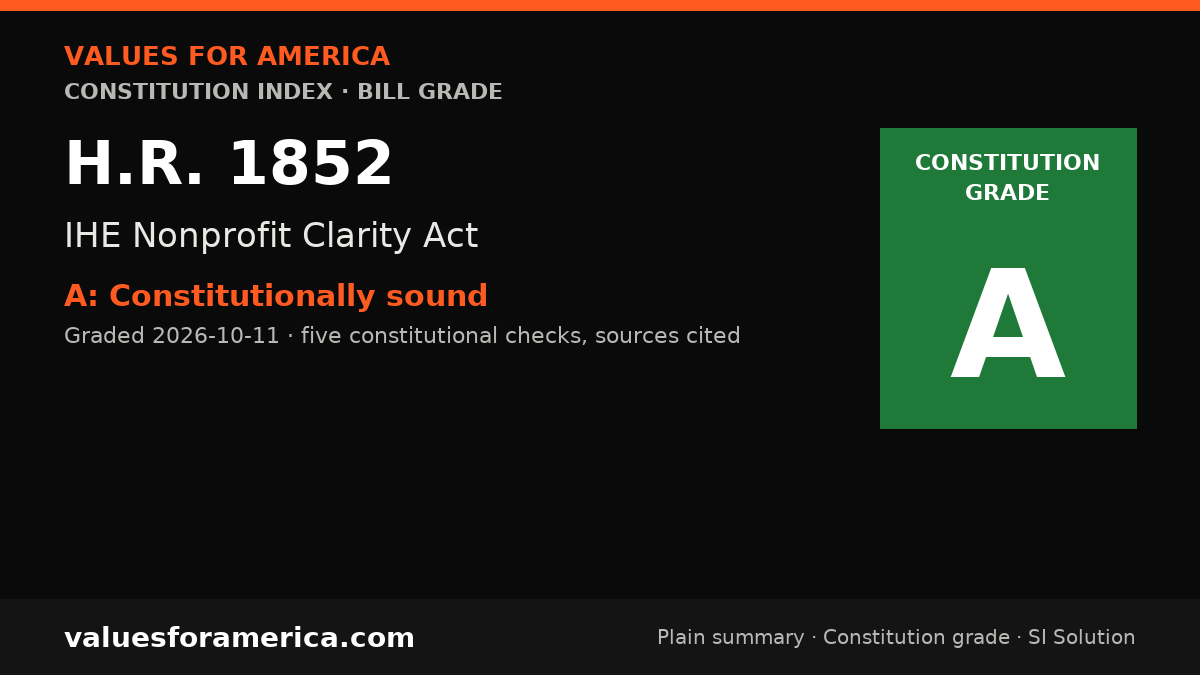
IHE Nonprofit Clarity Act
Cosponsors: none · per Congress.gov, 2026-10-12
Introduced: 2025-03-05
Latest action (2025-03-05): Referred to the House Committee on Education and Workforce.
What H.R. 1852 does, in plain terms
IHE Nonprofit Clarity Act This bill specifies that an institution of higher education (IHE) that is recognized as a tax-exempt nonprofit organization under Section 501(c)(3) of the Internal Revenue Code of 1986 must also be deemed as a nonprofit IHE for purposes of the Higher Education Act of 1965. Thus, if the Internal Revenue Service recognizes an IHE as a tax-exempt nonprofit organization, then the Department of Education must also recognize the IHE as a nonprofit IHE.
Official summary by the Congressional Research Service, via Congress.gov.
Constitution Index
“VFA Constitution grade”
Constitutionally sound
Graded 2026-10-11
SI-generated grade · five published checks · not individually reviewed by a person · methodology
The bill is a modest administrative clarification that aligns the Department of Education's classification of nonprofit institutions with the IRS's existing tax-exempt determination. It does not expand federal power, infringe on rights, or centralize authority beyond what already exists in federal higher education law. It passes all constitutional checks.
-
✓ Passes · Enumerated powers
The bill operates within the existing federal framework for higher education, which is supported by the Spending Clause (Article I, Section 8, Clause 1) and the Necessary and Proper Clause (Article I, Section 8, Clause 18). It merely harmonizes definitions between two federal statutes, both of which are within Congress's spending power. No new or expanded authority is created. -
✓ Passes · Bill of Rights
The bill does not implicate any of the first ten amendments. It does not restrict speech, religion, assembly, press, petition, arms, quartering, search and seizure, self-incrimination, due process, takings, trial rights, or cruel and unusual punishment. It is a purely administrative classification rule. -
✓ Passes · Individual sovereignty
The bill does not restrict individual liberty or property. It only affects the classification of institutions for federal education funding purposes. It does not impose new obligations on individuals or institutions; it simply ensures consistency between IRS and Department of Education determinations. -
✓ Passes · Decentralization
The bill does not shift decision-making to a higher level of government. It operates within the existing federal role in higher education, which is already established. It does not prevent individuals, local communities, or states from making their own choices about education; it merely clarifies a federal administrative process. -
✓ Passes · Due process and takings
The bill does not deprive anyone of life, liberty, or property without due process. It does not involve takings. It actually enhances procedural consistency by requiring the Department of Education to defer to the IRS's existing determination, which itself follows established administrative procedures.
Sources: Congress.gov: HR 1852 summary
Report an error in this grade
What should pass
“VFA SI Solution”
No solution yet
A sourced SI draft appears here once it passes automated checks (Constitution citation, source verification, independent SI critic). How publication works.
Related on VFA

For journalists and bloggers
“Embed this grade”
Free to use with the link back. The badge and card update when the grade changes. Embed terms →
