H.R. 1850 explained · 119th Congress · Pending in Congress
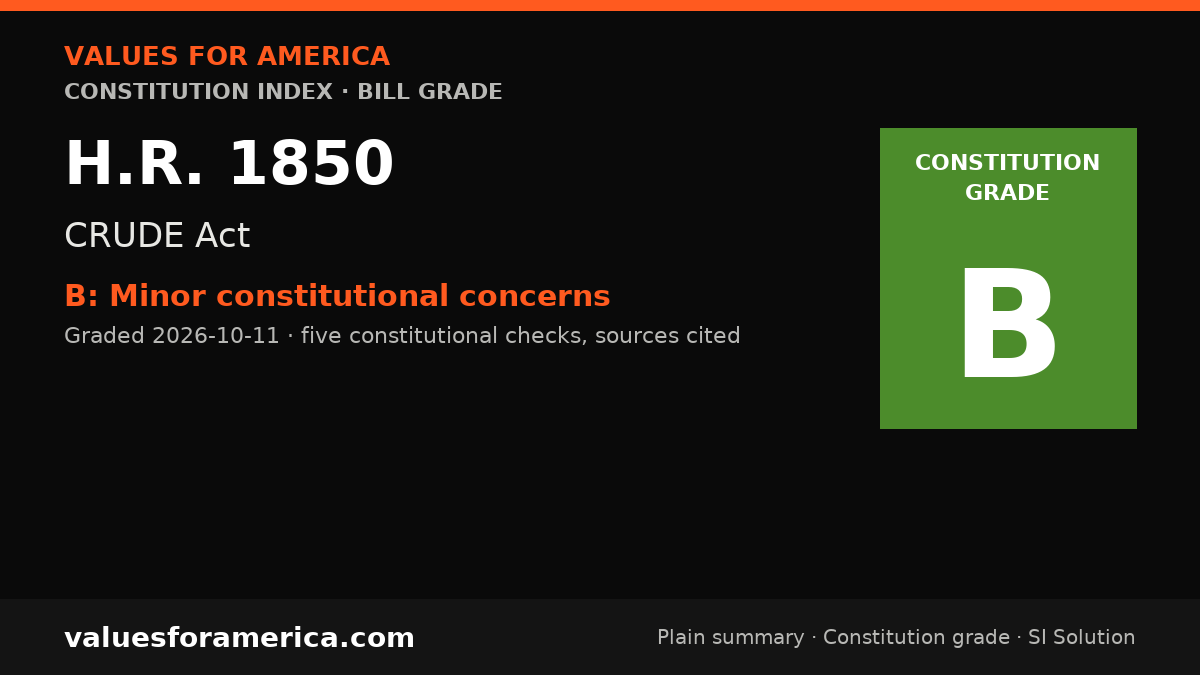
CRUDE Act
Cosponsors: 4 (0 D, 4 R) · per Congress.gov, 2026-10-12
Introduced: 2025-03-05
Latest action (2025-03-05): Referred to the House Committee on Foreign Affairs.
What H.R. 1850 does, in plain terms
Continuing Robust and Uninhibited Drilling and Exporting Act or the CRUDE Act This bill limits the President's authority to restrict the export of crude oil from the United States. Currently, the President may restrict the export of oil for up to a year if the President declares a national emergency; the restrictions are sanctions or trade restrictions that apply to countries, persons, or organizations for national security reasons; or the Department of Commerce, in consultation with the Department of Energy (DOE), finds and reports to the President that the export of U.S. crude oil has caused sustained material oil supply shortages or sustained oil prices significantly above world market levels that have caused or are likely to cause sustained material adverse employment effects. However, this bill only allows the President to impose such restrictions if the President declares a national emergency based on findings that are jointly issued by Department of Defense, DOE, and Commerce and include the conclusions described above about oil supply shortages or increased oil prices; or the restrictions are sanctions or trade restrictions that apply to countries, persons, or organization for national security reasons.
Official summary by the Congressional Research Service, via Congress.gov.
Constitution Index
“VFA Constitution grade”
Minor constitutional concerns
Graded 2026-10-11
SI-generated grade · five published checks · not individually reviewed by a person · methodology
The CRUDE Act restricts the President's authority to impose crude oil export restrictions, which is a permissible exercise of Congress's enumerated powers over foreign commerce and national defense. It does not infringe on individual rights, and it generally supports decentralization by reducing federal control over energy markets. However, it retains a national emergency exception that could be subject to abuse, and the joint findings requirement may create procedural hurdles that could delay necessary actions in genuine emergencies, creating minor tension with the President's foreign affairs powers.
-
✓ Passes · Enumerated powers
Congress has the power to regulate commerce with foreign nations under Article I, Section 8, Clause 3, and to make rules for the military under Article I, Section 8, Clause 14. Limiting the President's authority to restrict oil exports is a valid exercise of these powers, as it directly affects foreign commerce and national security. The bill does not exceed federal authority; it actually narrows … -
✓ Passes · Bill of Rights
The bill does not implicate any of the first ten amendments. It does not restrict speech, religion, assembly, press, petition, arms, quartering, search and seizure, self-incrimination, due process, takings, trial rights, or cruel and unusual punishment. It is a statutory limitation on executive authority, not a restriction on individual liberties. -
✓ Passes · Individual sovereignty
The bill does not restrict what individuals can do with their person, property, speech, labor, or belief. It affects the ability of the President to impose export restrictions, which indirectly may affect oil companies' ability to export, but this is a commercial regulation within Congress's commerce power, not a restriction on individual sovereignty. The burden is on the government to justify res… -
✓ Passes · Decentralization
The bill reduces federal control over oil exports, allowing market forces and state-level energy policies to play a larger role. It does not consolidate decision-making at a higher level; it actually devolves authority away from the federal executive. The four-question test: (1) individuals and families can benefit from freer markets without government involvement; (2) local communities and states… -
✓ Passes · Due process and takings
The bill does not bypass due process or take property without just compensation. It limits the President's ability to impose export restrictions, which could be seen as a form of regulatory taking, but the bill actually protects property rights by reducing the likelihood of such restrictions. The joint findings requirement provides a procedural safeguard, ensuring that any emergency restrictions a…
Sources: Congress.gov: HR 1850 summary
Report an error in this grade
What should pass
“VFA SI Solution”
No solution yet
A sourced SI draft appears here once it passes automated checks (Constitution citation, source verification, independent SI critic). How publication works.
Related on VFA

For journalists and bloggers
“Embed this grade”
Free to use with the link back. The badge and card update when the grade changes. Embed terms →
