H.R. 1849 explained · 119th Congress · Pending in Congress
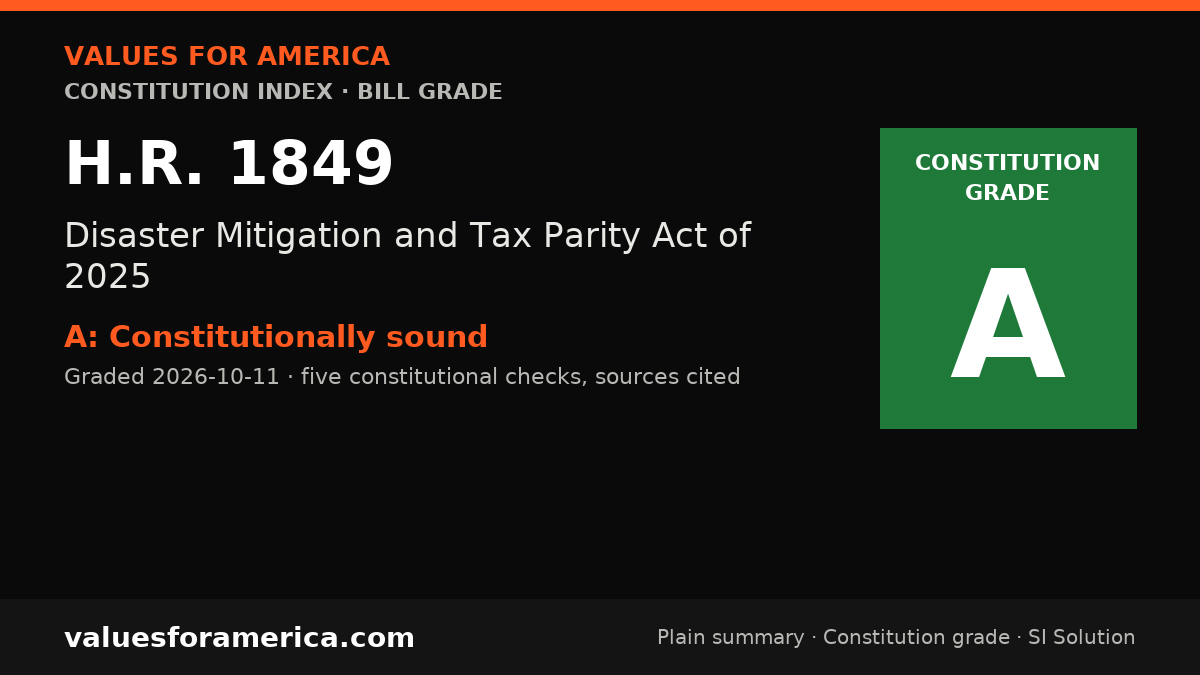
Disaster Mitigation and Tax Parity Act of 2025
Cosponsors: 32 (18 D, 14 R) · per Congress.gov, 2026-10-10
Introduced: 2025-03-05
Latest action (2026-02-04): ASSUMING FIRST SPONSORSHIP - Mr. Murphy asked unanimous consent that he may hereafter be considered as the first sponsor of H.R. 1849, a bill originally introduced by Representative LaMalfa, for the purpose of adding cosponsors and requesting reprintings pursuant to clause 7 of rule XII. Agreed to without objection.
What H.R. 1849 does, in plain terms
Disaster Mitigation and Tax Parity Act of 2025 This bill excludes from gross income, for federal income tax purposes, payments received from a state catastrophe loss mitigation program by an individual for the purpose of making improvements to the individual’s property that mitigate the impact of certain disasters. Under current law, individuals may exclude from gross income, for federal income tax purposes, payments received under the Robert T. Stafford Disaster Relief and Emergency Assistance Act or the National Flood Insurance Act (as in effect on April 15, 2005) for hazard mitigation. (Some exceptions apply.) Further, under current law, such payments do not increase the basis of the property for which the payments are made. The bill allows a similar exclusion from gross income for certain payments received by an individual from a program established by a state (or any political subdivision or instrumentality of the state), a joint powers authority, or an entity that was established by the state to provide essential or basic property insurance and is regulated by the state. Under the bill, such payments must be for making improvements to the individual’s property for the sole purpose of reducing damage that would be done to the property by a windstorm, earthquake, flood, or wildfire. Finally, the bill provides that such payments from a state catastrophe loss mitigation program do not increase the basis of the property for which the payments are made.
Official summary by the Congressional Research Service, via Congress.gov.
Constitution Index
“VFA Constitution grade”
Constitutionally sound
Graded 2026-10-11
SI-generated grade · five published checks · not individually reviewed by a person · methodology
This bill is a modest, constitutionally sound exercise of Congress's taxing power. It simply excludes certain state-administered disaster mitigation payments from federal gross income, thereby reducing the federal tax burden on individuals. It does not expand federal regulatory authority, infringe on any constitutional right, or centralize power beyond the federal taxing power already enumerated. The bill respects federalism by deferring to state-established programs and does not implicate due process or takings concerns.
-
✓ Passes · Enumerated powers
Congress has the explicit power to lay and collect taxes under Article I, Section 8, Clause 1. The bill operates entirely within this power by defining what constitutes gross income for federal income tax purposes. It does not regulate disaster mitigation directly; it merely provides a tax exclusion for certain payments, which is a classic exercise of the taxing power. No other enumerated power is… -
✓ Passes · Bill of Rights
The bill does not implicate any of the first ten amendments. It does not restrict speech, religion, assembly, press, petition, arms, quartering, search and seizure, self-incrimination, due process, takings, trial rights, or cruel and unusual punishment. It is a purely beneficial tax provision that leaves all individual rights untouched. -
✓ Passes · Individual sovereignty
The bill does not restrict any individual's use of their person, property, speech, labor, or belief. On the contrary, it reduces the tax burden on individuals who receive state mitigation payments, thereby increasing their disposable income and property rights. There is no government-imposed restriction; the burden of justification is not triggered because no restriction exists. -
✓ Passes · Decentralization
The bill passes all four questions of the decentralization test. (1) Individuals can handle disaster mitigation without government, but the bill does not require government involvement; it merely provides a tax benefit. (2) Local communities and states can and do establish catastrophe loss mitigation programs; the bill explicitly defers to state-established programs, not federal ones. (3) States c… -
✓ Passes · Due process and takings
The bill does not deprive anyone of life, liberty, or property without due process. It does not impose any penalty or take any property. The exclusion from gross income is a benefit, not a burden. There is no procedural or substantive due process concern, and no takings issue arises because the government is not taking property; it is simply declining to tax certain payments.
Sources: Congress.gov: HR 1849 summary
Report an error in this grade
What should pass
“VFA SI Solution”
No solution yet
A sourced SI draft appears here once it passes automated checks (Constitution citation, source verification, independent SI critic). How publication works.
Related on VFA

For journalists and bloggers
“Embed this grade”
Free to use with the link back. The badge and card update when the grade changes. Embed terms →
