H.R. 1840 explained · 119th Congress · Pending in Congress
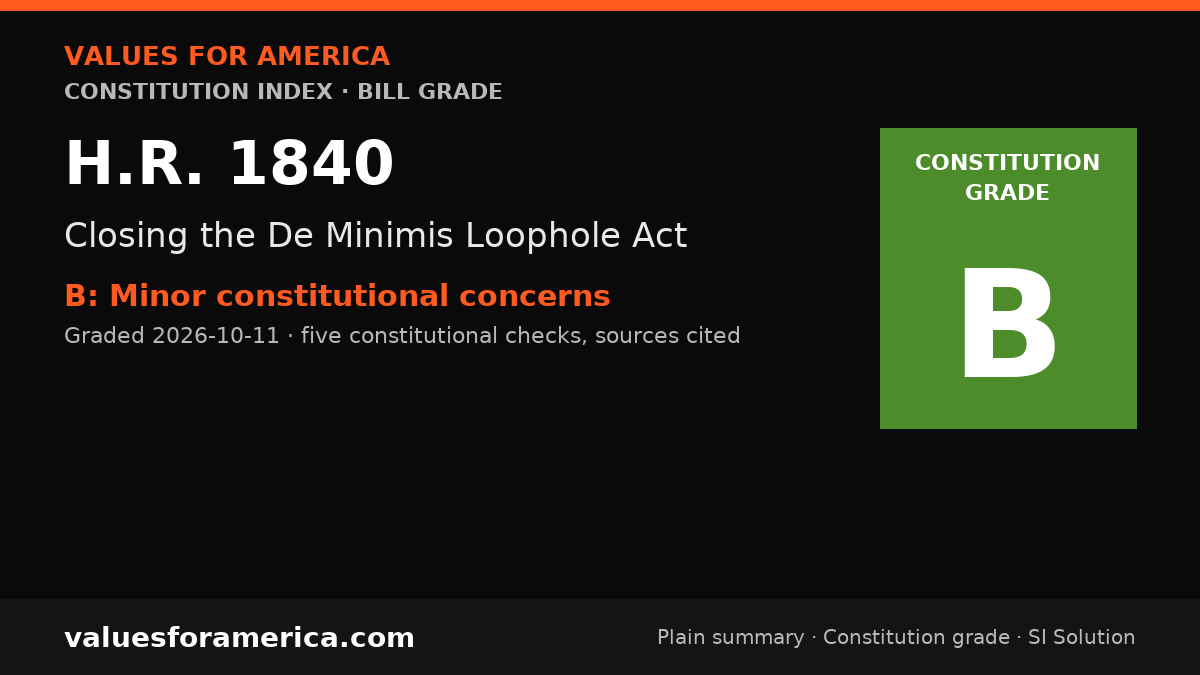
Closing the De Minimis Loophole Act
Cosponsors: 2 (2 D, 0 R) · per Congress.gov, 2026-10-12
Introduced: 2025-03-04
Latest action (2025-03-04): Referred to the House Committee on Ways and Means.
What H.R. 1840 does, in plain terms
Closing the De Minimis Loophole Act This bill immediately terminates de minimis treatment for goods originating in China and phases out such treatment for goods originating from all other countries. (Current law allows for U.S. imports under a de minimis threshold of $800 per shipment to enter free of tariffs, fees, and taxes.) Specifically, de minimis treatment ends (1) with respect to goods from China, beginning on the bill's enactment date (with an exception for goods already loaded onto a vessel or in transit during the three-day period that ends on the enactment date); and (2) with respect to goods from any other country, 120 days after the bill's enactment. During the 120-day period beginning on the date of the bill's enactment, the Department of the Treasury must carry out a rulemaking process. Among other elements, the rulemaking process must ensure that data requirements and entry procedures for informal modes of entry are sufficient to ensure the effective enforcement of U.S. laws and the efficient and accurate collection of duties, fees, and taxes. The bill directs Treasury, in the case of shipments sent through the international postal network, to determine appropriate fees and procedures to ensure consistency between the treatment of shipments by the U.S. Postal Service and other shipments.
Official summary by the Congressional Research Service, via Congress.gov.
Constitution Index
“VFA Constitution grade”
Minor constitutional concerns
Graded 2026-10-11
SI-generated grade · five published checks · not individually reviewed by a person · methodology
The bill is a federal exercise of the foreign commerce power, which is explicitly enumerated in Article I, Section 8, Clause 3. It does not infringe on individual rights, as it regulates the importation of goods, not speech, religion, or other protected activities. The primary constitutional concern is the delegation of rulemaking authority to the Treasury Department, which, while broad, is constrained by statutory directives and subject to judicial review. The bill also centralizes trade policy at the federal level, but this is consistent with the Constitution's grant of exclusive authority over foreign commerce. Overall, the bill is mostly sound, with minor due process concerns regarding the rulemaking process.
-
✓ Passes · Enumerated powers
The federal government has explicit authority to regulate foreign commerce under Article I, Section 8, Clause 3. This bill directly regulates imports, which is a core component of foreign commerce. The termination of de minimis treatment and the imposition of tariffs, fees, and taxes on imports fall squarely within this enumerated power. The bill also implicates the federal power to lay and collec… -
✓ Passes · Bill of Rights
The bill does not implicate any of the first ten amendments. It does not restrict speech, religion, assembly, press, or petition. It does not affect the right to bear arms, quartering of soldiers, search and seizure, self-incrimination, due process, fair trial, jury trial, cruel and unusual punishment, or unenumerated rights. The Tenth Amendment is not violated because the regulation of foreign co… -
✓ Passes · Individual sovereignty
The bill restricts the ability of individuals to import goods without paying tariffs, but this is a regulation of international trade, not a restriction on personal liberty. The government has a compelling interest in collecting revenue and enforcing trade laws. The burden on individuals is minimal and incidental to the exercise of a legitimate federal power. The bill does not restrict what a pers… -
✓ Passes · Decentralization
The four-question test: (1) An individual or family cannot handle the regulation of international trade without government involvement, as tariffs and trade enforcement require a centralized authority. (2) A local community or county cannot handle this, as foreign trade inherently crosses state and national boundaries. (3) A state cannot handle this without federal involvement, as the Constitution… -
✓ Passes · Due process and takings
The bill does not take property without just compensation; it imposes tariffs and fees on imports, which are not a taking under the Fifth Amendment. The rulemaking process directed by the bill must comply with the Administrative Procedure Act, which provides notice and comment, ensuring procedural due process. The bill does not bypass due process or the presumption of innocence. The only minor con…
Sources: Congress.gov: HR 1840 summary
Report an error in this grade
What should pass
“VFA SI Solution”
No solution yet
A sourced SI draft appears here once it passes automated checks (Constitution citation, source verification, independent SI critic). How publication works.
Related on VFA

For journalists and bloggers
“Embed this grade”
Free to use with the link back. The badge and card update when the grade changes. Embed terms →
