H.R. 1838 explained · 119th Congress · Pending in Congress
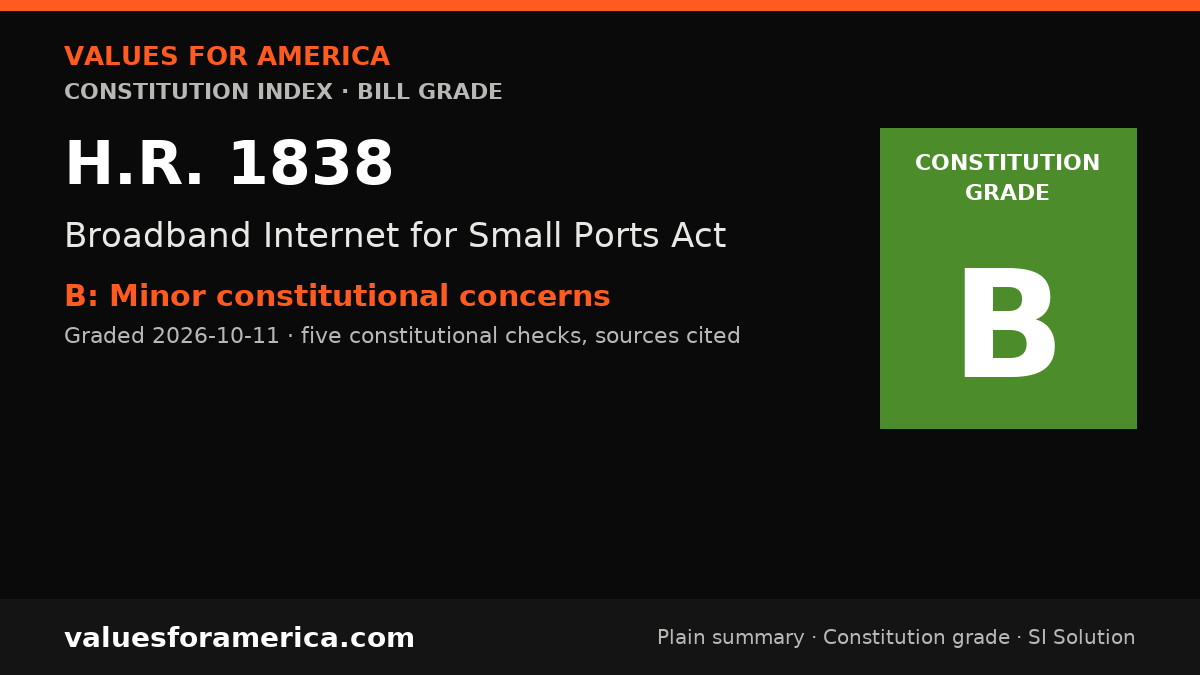
Broadband Internet for Small Ports Act
Cosponsors: 1 (0 D, 1 R) · per Congress.gov, 2026-10-12
Introduced: 2025-03-04
Latest action (2025-03-28): Referred to the Subcommittee on Commodity Markets, Digital Assets, and Rural Development.
What H.R. 1838 does, in plain terms
Broadband Internet for Small Ports Act This bill establishes priority for broadband projects near rural maritime ports under the Department of Agriculture (USDA) rural broadband grant and loan program, and makes other specified changes to the program’s structure and available support. Under current law, the rural broadband program provides grants, loans, and loan guarantees for the construction, improvement, and acquisition of broadband facilities and equipment in rural areas. The bill adjusts the level of priority given to certain categories of projects, including through the establishment of a new priority for projects that would increase broadband service in ports and shore-side facilities in rural areas. The bill also makes changes to the program’s parameters, including by changing available grant amounts and increasing the percentage of households in a community that must be unserved or underserved with broadband in order for projects in the community to qualify for loans or loan guarantees. Further, as a condition of receiving support, recipients must share with USDA geolocation information on new or upgraded broadband service established under the program. For proposed projects given high priority, the bill requires USDA to confirm that the relevant communities are currently unserved by conferring with relevant federal agencies and other broadband service data sources, and by performing site-specific testing to verify the unavailability of residential broadband service. Finally, the bill requires USDA to provide feedback and decisions to applicants in a timely manner, and to use certain program funds for oversight and accountability measures.
Official summary by the Congressional Research Service, via Congress.gov.
Constitution Index
“VFA Constitution grade”
Minor constitutional concerns
Graded 2026-10-11
SI-generated grade · five published checks · not individually reviewed by a person · methodology
The bill operates within the federal government's enumerated spending power and adjusts an existing rural broadband program, which is a permissible use of the Spending Clause. It does not directly infringe on individual rights, though the geolocation data-sharing requirement raises minor privacy concerns that are likely justified by program oversight. The program centralizes decision-making at the federal level, but it is a conditional spending program that leaves states and localities free to participate or not, so the decentralization concerns are moderate. Overall, the bill is mostly sound with minor tensions that are fixable.
-
✓ Passes · Enumerated powers
The bill authorizes spending under the USDA rural broadband program, which falls under Congress's power to spend for the general welfare (Article I, Section 8, Clause 1). While broadband is not explicitly enumerated, the Spending Clause allows Congress to attach conditions to federal funds, and the program is a valid exercise of that power. The bill does not mandate state action but offers volunta… -
✓ Passes · Bill of Rights
The bill does not restrict speech, religion, assembly, press, petition, arms, quartering, search and seizure, self-incrimination, due process, takings, trial rights, or cruel and unusual punishment. The geolocation data-sharing requirement is a condition of receiving voluntary federal funds, not a compelled disclosure, and does not constitute a search under the Fourth Amendment because participati… -
✓ Passes · Individual sovereignty
The bill does not restrict individual liberty. It provides funding for broadband infrastructure, which enhances individual capabilities. The geolocation reporting requirement applies only to recipients who voluntarily accept federal funds, and the burden is minimal and directly related to program oversight. The government has a compelling interest in ensuring that funds are used for their intended… -
✗ Concern · Decentralization
The bill fails the decentralization test because it consolidates decision-making at the federal level. While individuals and local communities could theoretically build broadband networks, the scale and cost of rural broadband infrastructure often exceed local capacity. States could handle this without federal involvement, but the federal program preempts state-level prioritization by setting nati… -
✓ Passes · Due process and takings
The bill does not take property without just compensation. It imposes conditions on voluntary grant recipients, and the requirement to share geolocation data is a contractual condition, not a taking. The bill also requires USDA to provide timely feedback and decisions to applicants, which supports procedural due process. There is no deprivation of life, liberty, or property without due process.
Sources: Congress.gov: HR 1838 summary
Report an error in this grade
What should pass
“VFA SI Solution”
No solution yet
A sourced SI draft appears here once it passes automated checks (Constitution citation, source verification, independent SI critic). How publication works.
Related on VFA

For journalists and bloggers
“Embed this grade”
Free to use with the link back. The badge and card update when the grade changes. Embed terms →
