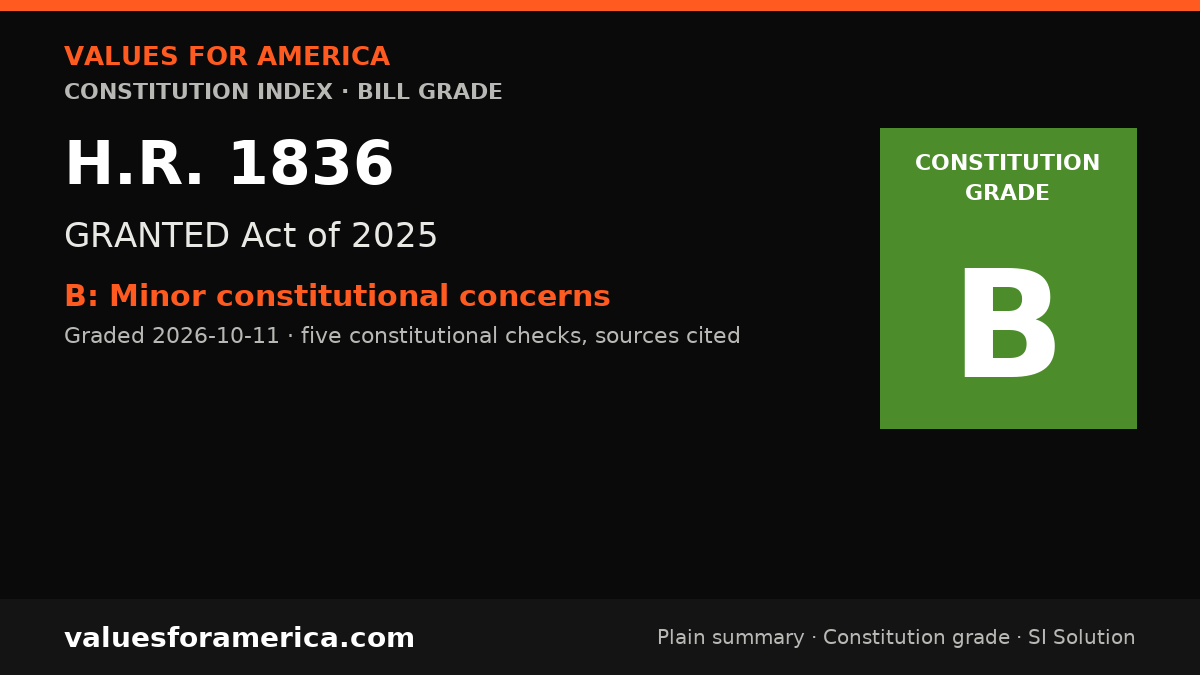
H.R. 1836 explained · 119th Congress · Pending in Congress
GRANTED Act of 2025
Cosponsors: none · per Congress.gov, 2026-10-12
Introduced: 2025-03-04
Latest action (2025-03-04): Referred to the Committee on Transportation and Infrastructure, and in addition to the Committee on Energy and Commerce, for a period to be subsequently determined by the Speaker, in each case for consideration of such provisions as fall within the jurisdiction of the committee concerned.
What H.R. 1836 does, in plain terms
Granting Remaining Applications Not Treated Efficiently or Delayed Act of 2025 or the GRANTED Act of 2025 This bill provides for the automatic approval of a complete application to place or maintain communications facilities (e.g., telecommunications antennas and equipment) on federal property after the application has been pending with a federal agency for 270 days. (Under current law, individuals and entities may apply for an easement, right-of-way, or lease to install, construct, modify, or maintain a communications facility in, on, or over federal property. The federal agency with control over the relevant property is required to act on such an application within 270 days.) The bill requires agencies to act on applications within 270 days of their receipt of a complete application, rather than within 270 days of an application’s filing. Under the bill, an application is considered complete when the applicant (1) has taken the first procedural step within their control to submit the application in accordance with procedures established by the agency, and (2) has not been notified of any deficiency in the application within 30 days of its submission. The bill also establishes criteria for determining when an application is considered received by an agency. Finally, the bill provides for the automatic grant of applications that remain pending with agencies after the 270-day deadline.
Official summary by the Congressional Research Service, via Congress.gov.
Constitution Index
“VFA Constitution grade”
Minor constitutional concerns
Graded 2026-10-11
SI-generated grade · five published checks · not individually reviewed by a person · methodology
The GRANTED Act of 2025 is a federal statute that governs the processing of applications for communications facilities on federal property. It operates within Congress's enumerated powers over federal property and interstate commerce. The bill does not infringe on individual rights; rather, it streamlines administrative processes and imposes a duty on federal agencies to act within a specified timeframe. While the automatic approval provision raises minor due process concerns regarding agency discretion and potential public input, these are not severe enough to render the bill unconstitutional. The bill does not consolidate power upward beyond the federal level, as it concerns federal property already under federal control. Overall, the bill is mostly sound with minor tensions that are fixable.
-
✓ Passes · Enumerated powers
Congress has authority to regulate federal property under Article IV, Section 3, Clause 2 (the Property Clause), which grants Congress the power to dispose of and make all needful rules and regulations respecting the territory or other property belonging to the United States. Additionally, the regulation of communications facilities implicates Congress's power over interstate commerce under Articl… -
✓ Passes · Bill of Rights
The bill does not infringe on any of the first ten amendments. It does not restrict speech, religion, assembly, press, or petition; it does not affect the right to bear arms; it does not involve quartering soldiers; it does not authorize searches or seizures; it does not implicate self-incrimination, double jeopardy, or trial rights; it does not impose cruel and unusual punishment; and it does not… -
✓ Passes · Individual sovereignty
The bill does not restrict individual liberty. Instead, it facilitates the exercise of property rights by applicants seeking to use federal property for communications facilities. It imposes a duty on federal agencies to act promptly, which benefits individuals and entities. There is no restriction on personal conduct, property use, speech, labor, or belief. The burden of proof is on the governmen… -
✓ Passes · Decentralization
The four-question test: (1) An individual or family could not handle the placement of communications facilities on federal property without government involvement, as the property is federally owned. (2) A local community or county could not handle this without state or federal involvement because the property is federal. (3) A state could not handle this without federal involvement because the pr… -
✗ Concern · Due process and takings
The automatic approval provision may raise procedural due process concerns. Under the Fifth Amendment, the government must provide fair notice and a fair hearing before depriving a person of life, liberty, or property. While the bill does not deprive anyone of property, it does affect the rights of third parties who might have an interest in the federal property (e.g., environmental concerns, publ…
Sources: Congress.gov: HR 1836 summary
Report an error in this grade
What should pass
“VFA SI Solution”
No solution yet
A sourced SI draft appears here once it passes automated checks (Constitution citation, source verification, independent SI critic). How publication works.
Related on VFA

For journalists and bloggers
“Embed this grade”
Free to use with the link back. The badge and card update when the grade changes. Embed terms →
