H.R. 1828 explained · 119th Congress · Pending in Congress
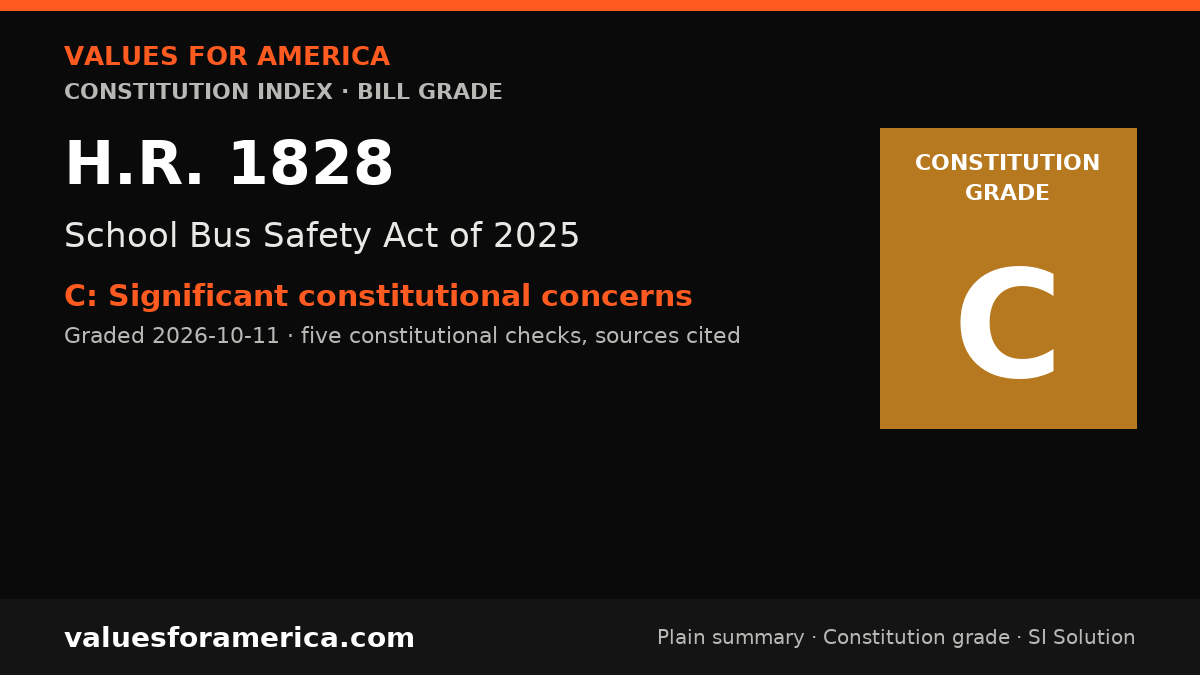
School Bus Safety Act of 2025
Cosponsors: 1 (1 D, 0 R) · per Congress.gov, 2026-10-12
Introduced: 2025-03-04
Latest action (2025-03-04): Referred to the Subcommittee on Highways and Transit.
What H.R. 1828 does, in plain terms
School Bus Safety Act of 2025 This bill directs the Department of Transportation (DOT) to issue rules requiring school buses to have certain safety features. DOT must also establish a grant program to assist in the implementation of the requirements. Specifically, DOT must issue rules requiring school buses to include three-point safety belts for all seats, a fire suppression system which addresses engine fires, a firewall between the engine and passenger compartment that prevents hazardous quantities of gas or flames from passing through the firewall, increased performance standards for interior flammability and smoke emissions, an automatic emergency braking system, an event data recorder, and an electronic stability control system. DOT must also require at least eight hours of behind-the-wheel training for school bus operators that meets specified requirements. Further, the Federal Motor Carrier Safety Administration and the National Highway Traffic Safety Administration (NHTSA) must issue rules on the evaluation of safety sensitive personnel for moderate-to-severe obstructive sleep apnea. NHTSA must also study the benefits of requiring school buses manufactured in, or imported into, the United States to be equipped with a motion-activated detection system that is capable of detecting road users (e.g., pedestrians and bicyclists) and alerting the bus operator of their presence. NHTSA must issue rules implementing such a requirement. Finally, DOT must establish a grant program to assist local educational agencies in (1) purchasing school buses equipped with three-point safety belts or any of the other safety features required under this bill, and (2) modifying existing school buses.
Official summary by the Congressional Research Service, via Congress.gov.
Constitution Index
“VFA Constitution grade”
Significant constitutional concerns
Graded 2026-10-11
SI-generated grade · five published checks · not individually reviewed by a person · methodology
The bill raises significant constitutional concerns regarding federal overreach into state and local control of education and transportation, and it imposes unfunded mandates on local school districts. While the safety goals are legitimate, the federal government lacks enumerated power to regulate school bus safety directly, and the bill consolidates decision-making at the federal level without clear constitutional authority.
-
✗ Concern · Enumerated powers
The bill directs the Department of Transportation to regulate school bus safety features and training. The federal government's enumerated powers under Article I, Section 8 do not include a general police power to regulate education or local transportation. The Commerce Clause (Article I, Section 8, Clause 3) might be invoked because school buses are involved in interstate commerce, but the connec… -
✓ Passes · Bill of Rights
The bill does not directly infringe on any of the first ten amendments. It imposes safety regulations on school buses and training requirements, but these do not implicate speech, religion, assembly, press, petition, arms, quartering, search and seizure, self-incrimination, due process, takings, fair trial, jury, cruel and unusual punishment, or unenumerated rights. The requirements are regulatory… -
✓ Passes · Individual sovereignty
The bill restricts the freedom of school districts and bus manufacturers to choose safety features, but this is a commercial regulation, not a restriction on individual personal autonomy. The government has a compelling interest in child safety, and the restrictions are reasonable and narrowly tailored to that interest. Individuals are not directly burdened; the bill does not restrict personal spe… -
✗ Concern · Decentralization
The bill fails the decentralization test. (1) Individuals and families cannot handle school bus safety on their own; they rely on schools. (2) Local communities and school districts could and should handle school bus safety, as they operate the buses and know local needs. (3) States can and do regulate school bus safety; the federal role is unnecessary. (4) The bill consolidates decision-making at… -
✓ Passes · Due process and takings
The bill does not bypass due process or take property without just compensation. It imposes prospective regulations, which are subject to the legislative process. The grant program mitigates the financial burden on local educational agencies, but even without it, the regulations would not constitute a taking because they are not a physical invasion or a deprivation of all economic use. Procedural …
Sources: Congress.gov: HR 1828 summary
Report an error in this grade
What should pass
“VFA SI Solution”
No solution yet
A sourced SI draft appears here once it passes automated checks (Constitution citation, source verification, independent SI critic). How publication works.
Related on VFA

For journalists and bloggers
“Embed this grade”
Free to use with the link back. The badge and card update when the grade changes. Embed terms →
