H.R. 1810 explained · 119th Congress · Pending in Congress
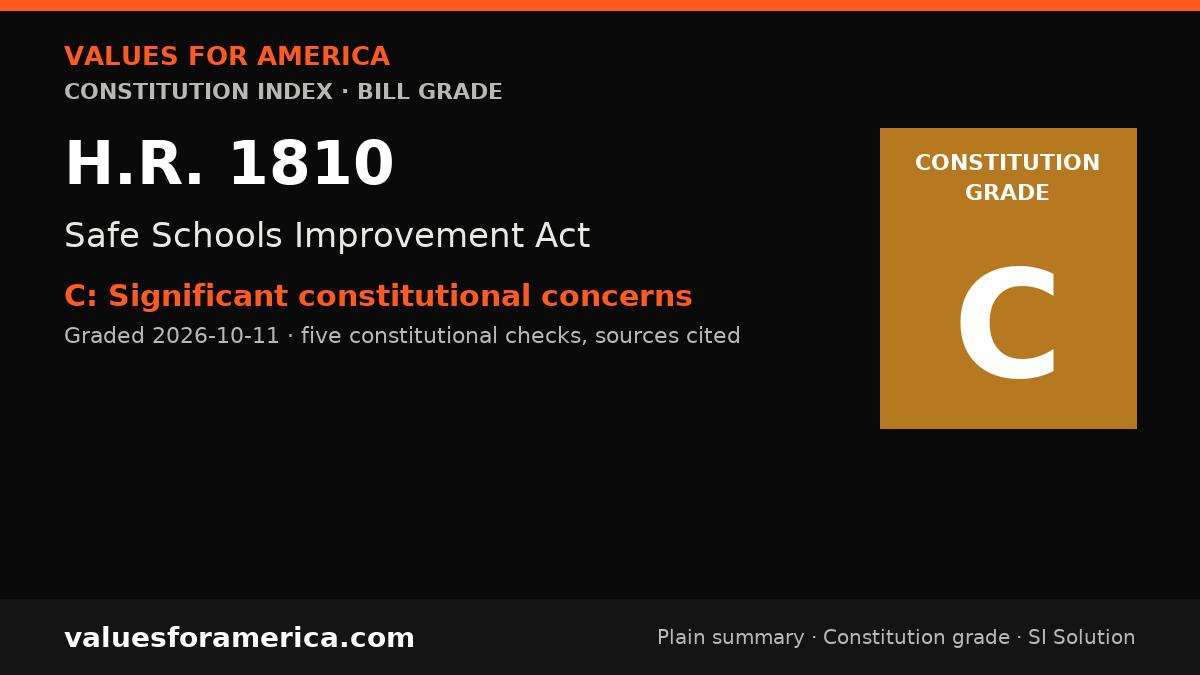
Safe Schools Improvement Act
Cosponsors: 214 (212 D, 2 R) · per Congress.gov, 2026-10-12
Introduced: 2025-03-03
Latest action (2025-03-03): Referred to the House Committee on Education and Workforce.
What H.R. 1810 does, in plain terms
Safe Schools Improvement Act This bill requires states to direct their local educational agencies (LEAs) to establish policies that prevent and prohibit bullying and harassment of elementary and secondary school students. In particular, these policies must prohibit bullying and harassment based on race, color, national origin, disability, religion, or sex. Sex includes sexual orientation, gender identity, and sex characteristics (including intersex traits). Further, LEAs must provide (1) students, parents, and educational professionals with annual notice of the conduct prohibited in their disciplinary policies; (2) students and parents with grievance procedures that target such conduct; and (3) the public with annual data on the incidence and frequency of that conduct at the school and LEA level. The Department of Education must conduct and report on an independent biennial evaluation of programs and policies to combat bullying and harassment in elementary and secondary schools. The National Center for Education Statistics must collect state data to determine the incidence and frequency of the conduct prohibited by LEA disciplinary policies.
Official summary by the Congressional Research Service, via Congress.gov.
Constitution Index
“VFA Constitution grade”
Significant constitutional concerns
Graded 2026-10-11
SI-generated grade · five published checks · not individually reviewed by a person · methodology
The bill raises significant constitutional concerns. While Congress has some authority under the Spending Clause and the Fourteenth Amendment to address discrimination in education, the bill's broad mandates on states and local educational agencies, particularly its expansion of protected categories to include sexual orientation, gender identity, and sex characteristics, may exceed federal enumerated powers and infringe on state and local control over education. The bill also imposes significant reporting and procedural requirements that could burden local communities without clear constitutional justification. The bill does not directly violate the Bill of Rights, but its potential to compel speech or restrict local decision-making warrants a structural rewrite to better align with constitutional principles of federalism and enumerated powers.
-
✗ Concern · Enumerated powers
The federal government's authority over education is not explicitly enumerated in Article I, Section 8. Congress may use the Spending Clause (Article I, Section 8, Clause 1) to attach conditions to federal funding, and the Fourteenth Amendment (Section 5) allows Congress to enforce equal protection guarantees. However, this bill goes beyond conditional spending by directly mandating state and loca… -
✓ Passes · Bill of Rights
The bill does not directly infringe on the First, Second, Third, Fourth, Fifth, Sixth, Seventh, Eighth, Ninth, or Tenth Amendments. However, the requirement that LEAs provide annual notice and grievance procedures could potentially implicate First Amendment rights if it compels speech or restricts religious expression, but the bill does not explicitly do so. The Tenth Amendment is relevant because… -
✗ Concern · Individual sovereignty
The bill restricts the ability of local communities and families to determine their own educational policies regarding bullying and harassment. While the goal of preventing bullying is compelling, the bill's specific mandates on what must be prohibited (including sexual orientation, gender identity, and sex characteristics) may override local values and parental authority. The burden is on the gov… -
✗ Concern · Decentralization
The bill fails the decentralization test. (1) Individuals and families could address bullying through local school boards and community action without federal involvement. (2) Local communities and counties can handle bullying policies without state involvement. (3) States can handle bullying policies without federal involvement. (4) The bill consolidates decision-making at the federal level by ma… -
✓ Passes · Due process and takings
The bill does not bypass due process or take property without just compensation. It requires grievance procedures, which could enhance due process protections. However, the bill's mandates on LEAs may impose administrative burdens that could be considered arbitrary if not tied to clear constitutional authority, but this is not a direct violation of the Due Process Clause or the Takings Clause.
Sources: Congress.gov: HR 1810 summary
Report an error in this grade
What should pass
“VFA SI Solution”
No solution yet
A sourced SI draft appears here once it passes automated checks (Constitution citation, source verification, independent SI critic). How publication works.
Related on VFA

For journalists and bloggers
“Embed this grade”
Free to use with the link back. The badge and card update when the grade changes. Embed terms →
