H.R. 1786 explained · 119th Congress · Pending in Congress
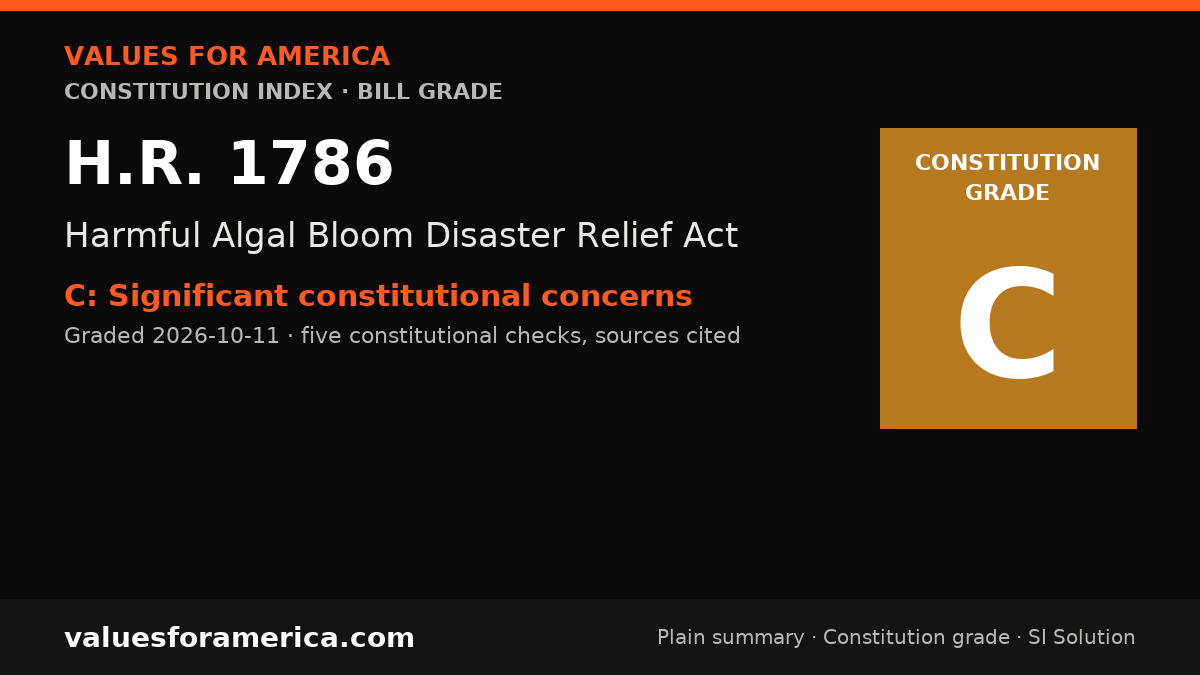
Harmful Algal Bloom Disaster Relief Act
Cosponsors: 9 (6 D, 3 R) · per Congress.gov, 2026-10-12
Introduced: 2025-03-03
Latest action (2025-03-03): Referred to the Subcommittee on Economic Development, Public Buildings, and Emergency Management.
What H.R. 1786 does, in plain terms
Harmful Algal Bloom Disaster Relief Act This bill explicitly authorizes the President to declare that a major disaster exists when algal blooms cause damage sufficient to warrant federal major disaster assistance.
Official summary by the Congressional Research Service, via Congress.gov.
Constitution Index
“VFA Constitution grade”
Significant constitutional concerns
Graded 2026-10-11
SI-generated grade · five published checks · not individually reviewed by a person · methodology
The bill expands federal disaster declaration authority to include harmful algal blooms, which is a significant expansion of federal power beyond the traditional scope of the Stafford Act. While the federal government has authority to provide for the general welfare and to regulate interstate commerce, the bill's broad delegation to the President to declare a major disaster for algal blooms may overstep enumerated powers, particularly if it allows federal intervention in purely intrastate matters. The bill does not directly infringe on individual rights, but it centralizes disaster response at the federal level, potentially undermining state and local autonomy. The lack of specific criteria for what constitutes 'sufficient damage' raises due process concerns regarding arbitrary application. Overall, the bill requires structural refinement to align with constitutional limits.
-
✗ Concern · Enumerated powers
The federal government's authority to provide disaster relief is typically derived from the Spending Clause (Article I, Section 8, Clause 1) and the Commerce Clause (Article I, Section 8, Clause 3). However, this bill authorizes the President to declare a major disaster for harmful algal blooms without clear limits to interstate or federal interests. Algal blooms often occur intrastate, and the bi… -
✓ Passes · Bill of Rights
The bill does not directly infringe on any of the first ten amendments. It does not restrict speech, religion, assembly, press, petition, arms, quartering, search and seizure, self-incrimination, due process, fair trial, jury, cruel and unusual punishment, or unenumerated rights. The Tenth Amendment is not directly violated because the bill does not commandeer state governments, but it may implica… -
✓ Passes · Individual sovereignty
The bill does not restrict individual liberty or property rights. It authorizes federal assistance, which is generally voluntary and beneficial. There is no coercion of individuals, and the bill does not impose mandates or prohibitions on personal conduct. The burden on government to justify restrictions is not triggered because no restrictions are imposed. -
✗ Concern · Decentralization
The bill fails the decentralization test because it consolidates disaster response authority at the federal level. While algal blooms can be catastrophic and may exceed local capacity, the bill does not require exhaustion of state or local resources before federal intervention. It allows the President to declare a major disaster without demonstrating that state and local governments cannot handle … -
✗ Concern · Due process and takings
The bill lacks clear standards for what constitutes 'damage sufficient to warrant federal major disaster assistance.' This vague delegation to the President could lead to arbitrary or discriminatory application, violating substantive due process principles that require non-arbitrary government action. Additionally, the bill does not provide for notice or hearing for affected parties, though it doe…
Sources: Congress.gov: HR 1786 summary
Report an error in this grade
What should pass
“VFA SI Solution”
No solution yet
A sourced SI draft appears here once it passes automated checks (Constitution citation, source verification, independent SI critic). How publication works.
Related on VFA

For journalists and bloggers
“Embed this grade”
Free to use with the link back. The badge and card update when the grade changes. Embed terms →
