H.R. 1777 explained · 119th Congress · Pending in Congress
SECURE Notarization Act of 2025
Cosponsors: 8 (5 D, 3 R) · per Congress.gov, 2026-10-12
Introduced: 2025-03-03
Latest action (2025-03-03): Referred to the Committee on Energy and Commerce, and in addition to the Committee on the Judiciary, for a period to be subsequently determined by the Speaker, in each case for consideration of such provisions as fall within the jurisdiction of the committee concerned.
What H.R. 1777 does, in plain terms
Securing and Enabling Commerce Using Remote and Electronic Notarization Act of 2025 or the SECURE Notarization Act of 2025 This bill allows a notary public commissioned under state law to remotely notarize electronic records and perform notarizations for remotely located individuals. The bill provides technical requirements for the notarizations, including the creation and retention of video and audio recordings and the use of communication technologies (i.e., video chat). Additionally, the bill requires U.S. courts and states to recognize notarizations—including remote notarizations of electronic records and notarizations of remotely-located individuals—that occur in or affect interstate commerce and are performed by a notary public commissioned under the laws of other states. The bill also allows a notary public to remotely notarize electronic records involving an individual located outside of the United States, subject to certain requirements.
Official summary by the Congressional Research Service, via Congress.gov.
Constitution Index
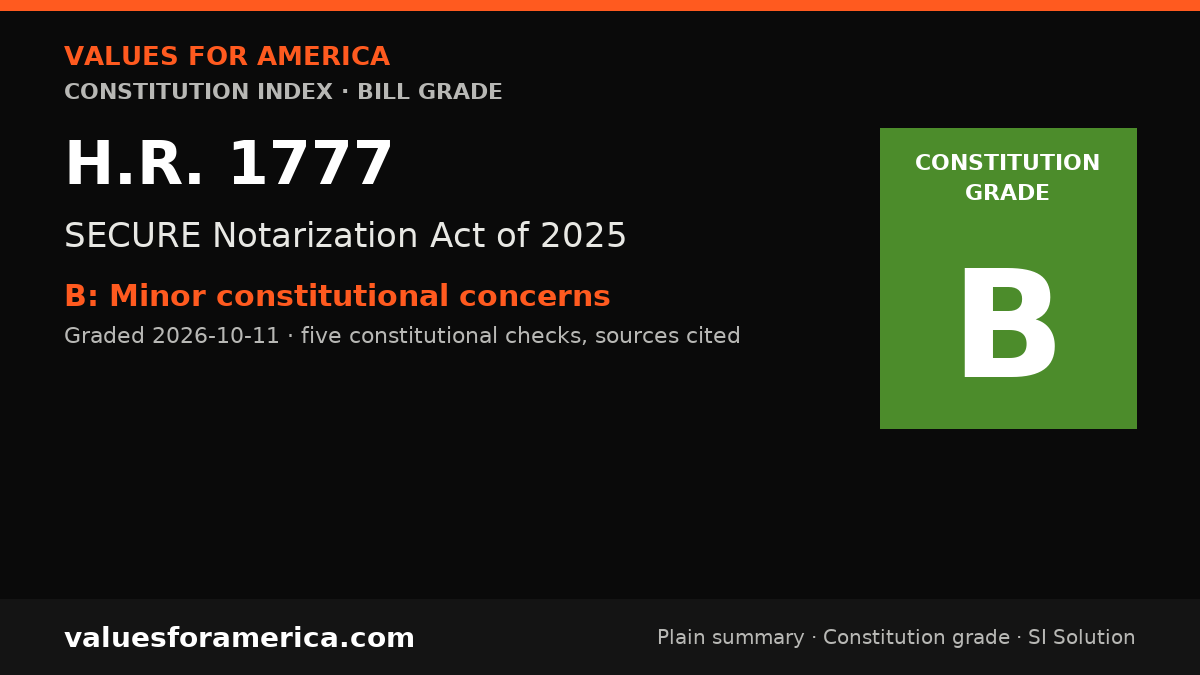
“VFA Constitution grade”
Minor constitutional concerns
Graded 2026-10-11
SI-generated grade · five published checks · not individually reviewed by a person · methodology
The SECURE Notarization Act of 2025 is a federal statute that facilitates interstate recognition of remote notarizations. It does not directly infringe on individual rights, but it raises concerns about federal overreach into state-regulated notary practices and the potential for increased surveillance through mandatory audio-video recordings. The bill's requirement that states recognize out-of-state notarizations may conflict with the Tenth Amendment's reservation of notary regulation to the states, though the interstate commerce nexus provides a plausible constitutional basis. The recording requirements, while not a search in the traditional sense, implicate privacy and Fourth Amendment values, and the lack of explicit data protection standards is a significant concern. Overall, the bill is mostly sound but requires adjustments to better respect state authority and individual privacy.
-
✓ Passes · Enumerated powers
Congress has authority under the Commerce Clause (Article I, Section 8, Clause 3) to regulate notarizations that occur in or affect interstate commerce. The bill explicitly ties its provisions to interstate commerce, and remote notarization of electronic records is a commercial activity that crosses state lines. However, the bill's requirement that states recognize out-of-state notarizations may e… -
✗ Concern · Bill of Rights
The bill's mandatory audio and video recording of notarizations implicates the Fourth Amendment's protection against unreasonable searches and seizures. While notarizations are not traditionally considered private communications, the recording of a person's image and voice in their home or office could be seen as a search, especially if the recordings are retained and potentially accessed by the g… -
✗ Concern · Individual sovereignty
The bill imposes a requirement that individuals submit to audio and video recording during remote notarizations, which is a restriction on their ability to conduct personal business without government-mandated surveillance. While notarization is a regulated activity, the government has not provided a compelling justification for the blanket recording requirement, especially given that the recordin… -
✗ Concern · Decentralization
The bill fails the decentralization test because it consolidates decision-making at the federal level by requiring states to recognize out-of-state notarizations, overriding state authority to regulate notaries. While an individual could handle a notarization without government involvement, the bill's federal mandate is not the minimum necessary. Local communities and states could handle the recog… -
✓ Passes · Due process and takings
The bill does not bypass due process or take property without just compensation. It does not deprive individuals of life, liberty, or property without a hearing; rather, it establishes procedural requirements for remote notarization. The recording requirement could be seen as a taking of personal data, but the bill does not specify that the recordings are government property, and individuals conse…
Sources: Congress.gov: HR 1777 summary
Report an error in this grade
What should pass
“VFA SI Solution”
No solution yet
A sourced SI draft appears here once it passes automated checks (Constitution citation, source verification, independent SI critic). How publication works.
Related on VFA

For journalists and bloggers
“Embed this grade”
Free to use with the link back. The badge and card update when the grade changes. Embed terms →
