H.R. 1771 explained · 119th Congress · Pending in Congress
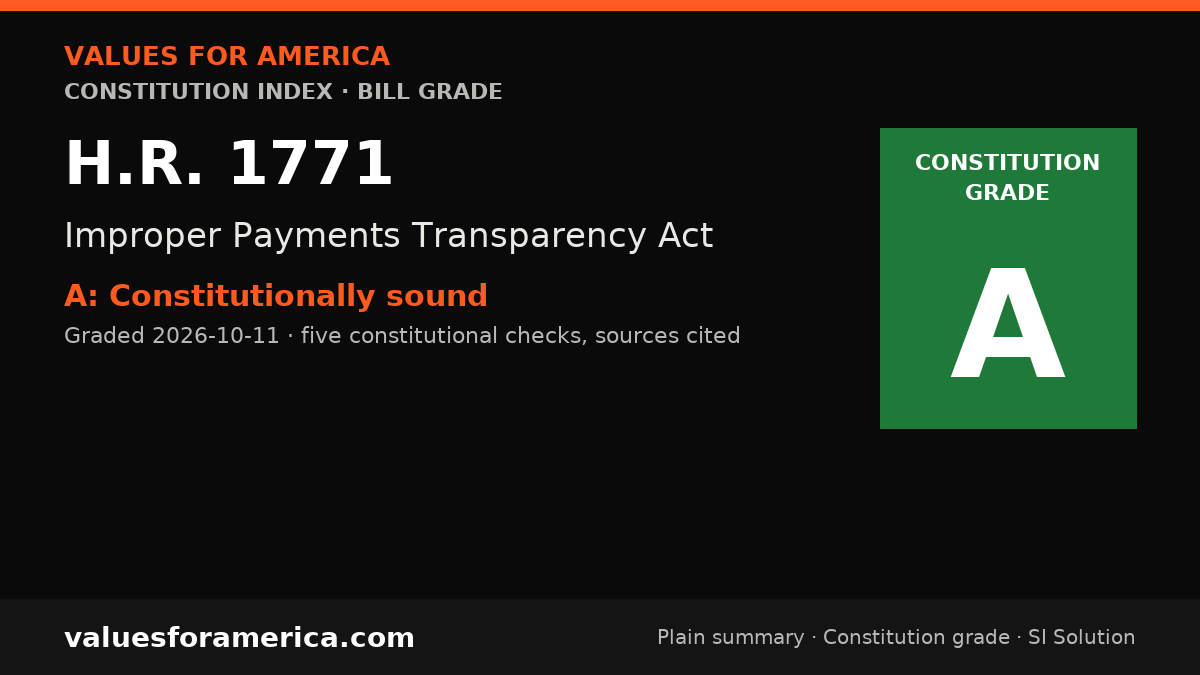
Improper Payments Transparency Act
Cosponsors: 7 (4 D, 3 R) · per Congress.gov, 2026-10-12
Introduced: 2025-03-03
Latest action (2025-03-03): Referred to the House Committee on the Budget.
What H.R. 1771 does, in plain terms
Improper Payments Transparency Act This bill requires the President's annual budget to include specified information regarding improper payment amounts and rates for programs and activities at certain federal agencies. (An improper payment is any payment that should not have been made or that was made in an incorrect amount, including an overpayment or underpayment, under a statutory, contractual, administrative, or other legally applicable requirement.) Specifically, the President's budget must include (1) a narrative description, including a detailed explanation of why any improper payment amounts and rates occurred and related trends for programs and activities; and (2) corrective actions and steps the agencies will take to address improper payment amount and rate issues.
Official summary by the Congressional Research Service, via Congress.gov.
Constitution Index
“VFA Constitution grade”
Constitutionally sound
Graded 2026-10-11
SI-generated grade · five published checks · not individually reviewed by a person · methodology
The Improper Payments Transparency Act is fully constitutional. It requires the President's annual budget to include narrative descriptions and corrective action plans regarding improper payments at federal agencies. This is a straightforward exercise of Congress's enumerated power over the federal purse under Article I, Section 8, Clause 1 (the Taxing and Spending Clause) and its oversight authority. The bill imposes no restrictions on individual rights, does not consolidate power upward beyond what is necessary for federal fiscal accountability, and respects due process by merely requiring transparency in existing spending. It passes all five constitutional checks with no violations.
-
✓ Passes · Enumerated powers
Congress has explicit constitutional authority under Article I, Section 8, Clause 1 to lay and collect taxes, pay debts, and provide for the common defense and general welfare. This includes the power to attach conditions to federal spending and to require transparency in how appropriated funds are used. Requiring the President's budget to include information on improper payments is a direct exerc… -
✓ Passes · Bill of Rights
The bill does not restrict speech, religion, assembly, press, petition, arms, quartering, search and seizure, self-incrimination, due process, takings, fair trial, jury, cruel and unusual punishment, or any other right protected by the first ten amendments. It imposes no criminal penalties, no searches, no seizures, and no restrictions on personal conduct. The Bill of Rights is not implicated. -
✓ Passes · Individual sovereignty
The bill does not restrict what any individual may do with their person, property, speech, labor, or belief. It imposes requirements only on the federal executive branch regarding budget reporting. No individual is compelled to act, refrain from acting, or surrender any right. The burden of justification does not arise because no individual liberty is restricted. -
✓ Passes · Decentralization
The bill passes all four questions of the decentralization test. (1) An individual or family cannot handle federal improper payment transparency because this concerns federal agency spending, which is inherently a federal function. (2) A local community or county cannot handle this because it involves federal programs and appropriations. (3) A state cannot handle this because it involves federal a… -
✓ Passes · Due process and takings
The bill does not deprive any person of life, liberty, or property without due process. It does not impose fines, penalties, or forfeitures. It does not take private property for public use without just compensation. The bill merely requires the executive branch to include narrative explanations and corrective action plans in the President's budget submission. This is a procedural requirement on g…
Sources: Congress.gov: HR 1771 summary
Report an error in this grade
What should pass
“VFA SI Solution”
No solution yet
A sourced SI draft appears here once it passes automated checks (Constitution citation, source verification, independent SI critic). How publication works.
Related on VFA

For journalists and bloggers
“Embed this grade”
Free to use with the link back. The badge and card update when the grade changes. Embed terms →
