H.R. 1770 explained · 119th Congress · Pending in Congress
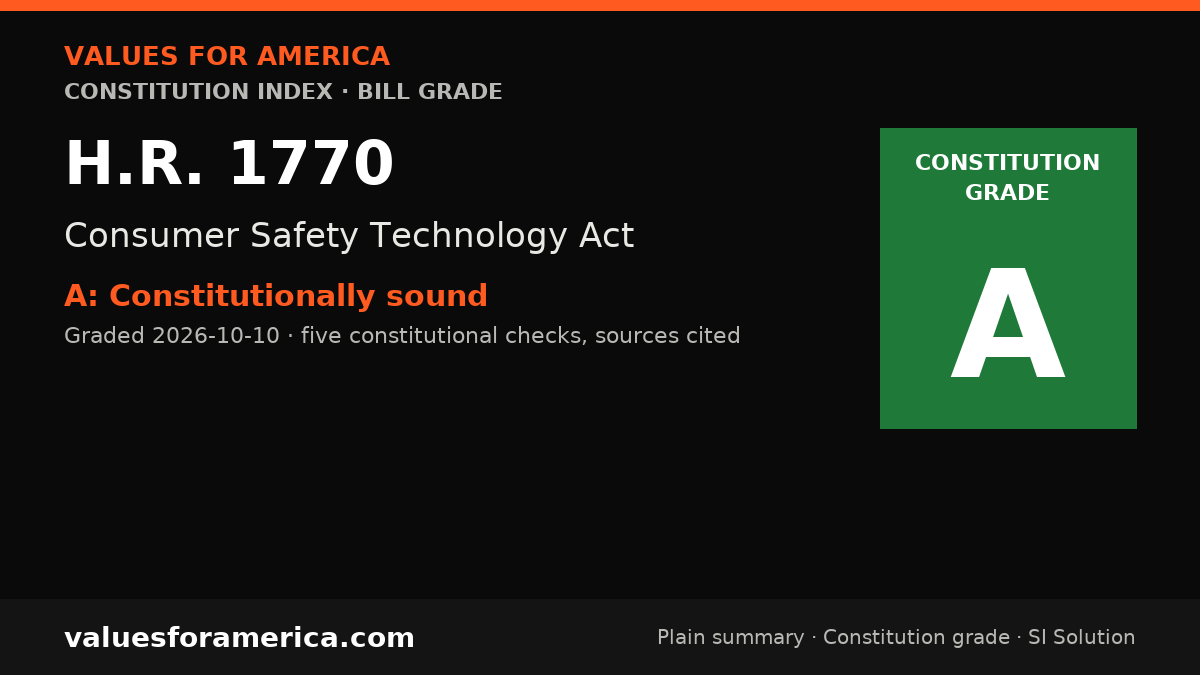
Consumer Safety Technology Act
Cosponsors: 3 (2 D, 1 R) · per Congress.gov, 2026-10-11
Introduced: 2025-03-03
Latest action (2025-07-15): Received in the Senate and Read twice and referred to the Committee on Commerce, Science, and Transportation.
What H.R. 1770 does, in plain terms
Consumer Safety Technology Act This bill (1) establishes a pilot program to explore the use of artificial intelligence to support the Consumer Product Safety Commission (CPSC), and (2) requires reports related to blockchain technology and digital tokens. Specifically, the CPSC must consult with relevant stakeholders, such as data scientists and product manufacturers, and use artificial intelligence for a least one of the following purposes: (1) tracking trends in injuries involving consumer products, (2) identifying consumer product hazards, (3) monitoring the sale of recalled consumer products, or (4) identifying consumer products that do not meet specified importation requirements related to product safety. The bill also requires (1) the Department of Commerce to report on existing and emerging uses of blockchain technology for consumer protection, and (2) the Federal Trade Commission to report on its efforts to prevent unfair or deceptive practices relating to digital tokens.
Official summary by the Congressional Research Service, via Congress.gov.
Constitution Index
“VFA Constitution grade”
Constitutionally sound
Graded 2026-10-10
SI-generated grade · five published checks · not individually reviewed by a person · methodology
The Consumer Safety Technology Act is constitutional. It operates within Congress's enumerated commerce power, does not infringe any Bill of Rights protections, respects individual sovereignty by imposing no restrictions on persons or property, passes all four decentralization questions, and provides full due process without any taking of property.
-
✓ Passes · Enumerated powers
Congress has authority under Article I, Section 8, Clause 3 (Commerce Clause) to regulate interstate commerce, including consumer product safety. The bill directs the CPSC, Department of Commerce, and FTC to study and report on technologies related to consumer protection, which falls within the scope of regulating interstate commerce in goods and preventing deceptive practices. No action exceeds e… -
✓ Passes · Bill of Rights
The bill imposes no restrictions on speech, religion, assembly, press, petition, arms, quartering, search and seizure, self-incrimination, due process, trial rights, jury rights, cruel and unusual punishment, or unenumerated rights. It merely authorizes studies, reports, and a pilot program using artificial intelligence to analyze consumer product data. No provision infringes any of the first ten … -
✓ Passes · Individual sovereignty
The bill does not restrict what any individual may do with their person, property, speech, labor, or belief. It imposes no mandates, prohibitions, or penalties on private citizens. The government bears no burden to justify a restriction because no restriction exists. The pilot program and reports involve only government agencies and their contractors, leaving individual freedom entirely untouched. -
✓ Passes · Decentralization
The bill passes all four questions. (1) Individuals and families cannot independently track nationwide consumer product injury trends or monitor recalled products across all import channels; some federal coordination is necessary for uniform safety data. (2) Local communities cannot effectively monitor interstate product safety without national data sharing. (3) States could theoretically handle s… -
✓ Passes · Due process and takings
The bill contains no provisions that bypass procedural or substantive due process. It does not create any presumption of guilt, impose fines, seize property, or deprive any person of life, liberty, or property. There is no taking of private property for public use; therefore, the Fifth Amendment Takings Clause is not implicated. All actions are informational and advisory only.
Sources: Congress.gov: HR 1770 summary
Report an error in this grade
What should pass
“VFA SI Solution”
No solution yet
A sourced SI draft appears here once it passes automated checks (Constitution citation, source verification, independent SI critic). How publication works.
Related on VFA

For journalists and bloggers
“Embed this grade”
Free to use with the link back. The badge and card update when the grade changes. Embed terms →
