H.R. 1768 explained · 119th Congress · Pending in Congress
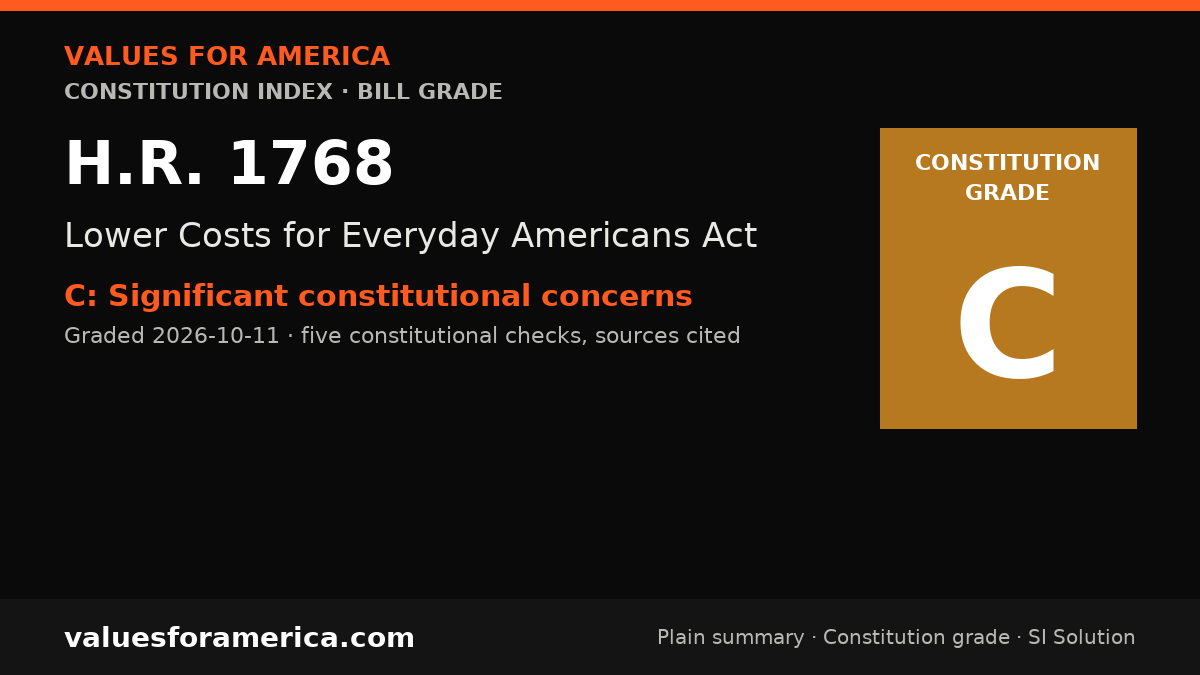
Lower Costs for Everyday Americans Act
Cosponsors: none · per Congress.gov, 2026-10-12
Introduced: 2025-03-03
Latest action (2025-03-03): Referred to the Committee on Energy and Commerce, and in addition to the Committees on Ways and Means, the Budget, the Judiciary, and Education and Workforce, for a period to be subsequently determined by the Speaker, in each case for consideration of such provisions as fall within the jurisdiction of the committee concerned.
What H.R. 1768 does, in plain terms
Lower Costs for Everyday Americans Act This bill reauthorizes and establishes programs and requirements regarding health, commerce, and the environment. The bill reauthorizes and expands programs for health care, including by allowing individuals age 65 and over with a medically improved disability to qualify for Medicaid; extending payment increases for certain providers under Medicare, including physicians and rural hospitals; extending Medicare coverage of certain telehealth services; requiring pharmacy benefit managers to remit 100% of rebates for prescription drugs to group health plans; reauthorizing programs supporting health care in underserved communities, including the National Health Service Corps; expanding and reauthorizing programs for public health emergency preparedness and response, including pandemic preparedness; expanding and reauthorizing programs for prevention and treatment of certain conditions, including substance use disorders, traumatic brain injuries, and sickle cell disease; and expanding the Food and Drug Administration’s authority regarding research on rare pediatric diseases. The bill also establishes requirements relating to commerce, including by prohibiting nonconsensual online publication of intimate visual depictions of individuals, requiring manufacturers of internet-connected devices to disclose whether the device has a camera or microphone prior to purchase, banning products containing 10% or more of sodium nitrite by weight, and requiring additional disclosures relating to the prices of concert tickets and hotel rooms. Additionally, the bill establishes and reauthorizes programs relating to the environment, including grants for community recycling systems, drinking water infrastructure, and reducing diesel emissions. It also allows gasoline that is blended with 10% to 15% ethanol to be sold year-round.
Official summary by the Congressional Research Service, via Congress.gov.
Constitution Index
“VFA Constitution grade”
Significant constitutional concerns
Graded 2026-10-11
SI-generated grade · five published checks · not individually reviewed by a person · methodology
This omnibus bill mixes constitutionally sound exercises of enumerated powers with significant overreach into areas reserved to the states and individuals. The health care and commerce provisions largely fall within Congress's spending and interstate commerce powers, but the blanket ban on sodium nitrite products and the forced disclosure of intimate images without a warrant or judicial process raise serious due process and First Amendment concerns. The bill also consolidates numerous policy areas at the federal level, failing the decentralization test on multiple counts.
-
✓ Passes · Enumerated powers
Congress has authority under Article I, Section 8 to tax and spend for the general welfare (Clause 1) and to regulate interstate commerce (Clause 3). Health care programs, Medicare/Medicaid expansions, and public health grants fall under the spending power. The commerce clause supports regulations on pharmacy benefit managers, internet-connected devices, and ticket pricing. However, the ban on sod… -
✗ Concern · Bill of Rights
The bill's prohibition on nonconsensual online publication of intimate visual depictions implicates the First Amendment's protection of speech. While the government can regulate obscenity and certain narrow categories of speech, a blanket prohibition on such images without a prior judicial determination or a clear definition of 'nonconsensual' could chill protected expression. The requirement for … -
✗ Concern · Individual sovereignty
The bill restricts individual freedom in several ways. The ban on products containing 10% or more sodium nitrite by weight restricts the ability of individuals to purchase and use a lawful substance, without a compelling justification that less restrictive means could not achieve. The prohibition on nonconsensual publication of intimate images, while aimed at protecting privacy, imposes a prior re… -
✗ Concern · Decentralization
The bill fails the decentralization test on multiple counts. (1) Individuals and families could handle many of these issues without federal involvement, such as choosing health plans or avoiding certain products. (2) Local communities and states can address issues like recycling, drinking water, and even some health care programs without federal mandates. (3) States can regulate intrastate commerc… -
✗ Concern · Due process and takings
The bill's prohibition on nonconsensual publication of intimate images lacks procedural due process safeguards. It does not provide for a hearing or judicial determination before the publication is banned, and it may impose liability without fair notice of what constitutes 'nonconsensual.' The sodium nitrite ban is a regulatory taking of property (the product) without just compensation, as it dest…
Sources: Congress.gov: HR 1768 summary
Report an error in this grade
What should pass
“VFA SI Solution”
No solution yet
A sourced SI draft appears here once it passes automated checks (Constitution citation, source verification, independent SI critic). How publication works.
Related on VFA

For journalists and bloggers
“Embed this grade”
Free to use with the link back. The badge and card update when the grade changes. Embed terms →
