H.R. 1737 explained · 119th Congress · Pending in Congress
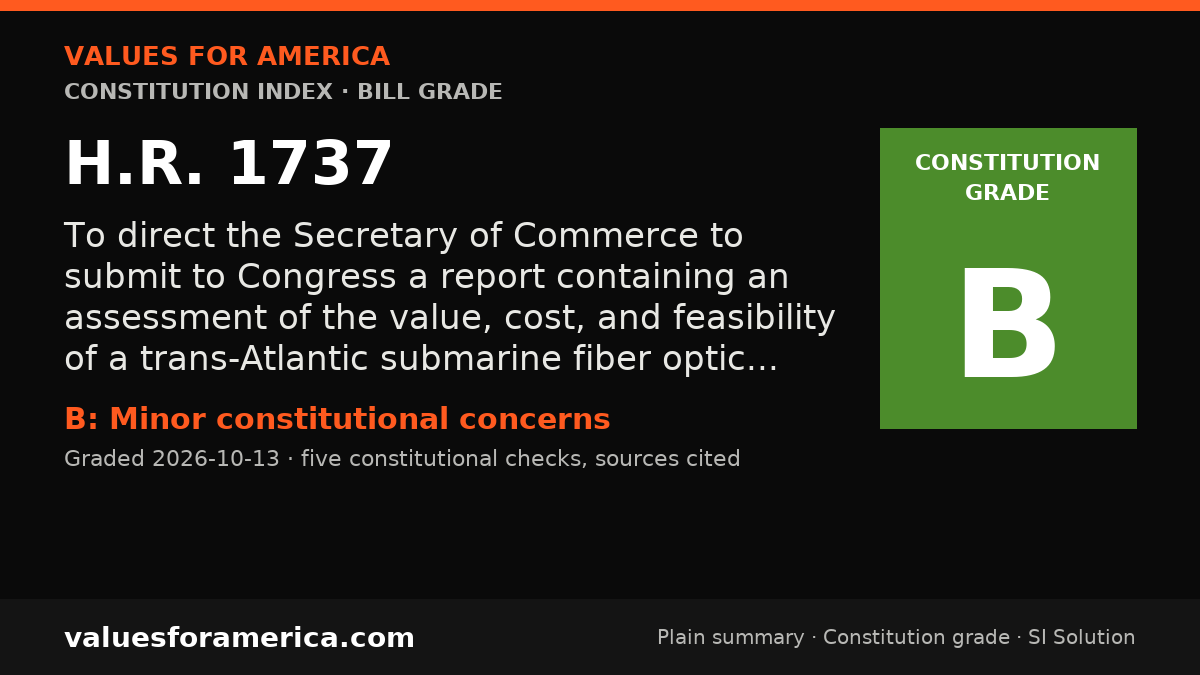
To direct the Secretary of Commerce to submit to Congress a report containing an assessment of the value, cost, and feasibility of a trans-Atlantic submarine fiber optic cable connecting the contiguous United States, the United States Virgin Islands, Ghana, and Nigeria.
Cosponsors: 1 (0 D, 1 R) · per Congress.gov, 2026-10-11
Introduced: 2025-02-27
Latest action (2025-06-24): Received in the Senate and Read twice and referred to the Committee on Commerce, Science, and Transportation.
What H.R. 1737 does, in plain terms
This bill requires the National Telecommunications and Information Administration to submit a report to Congress that assesses the feasibility, value, cost, and security implications of a submarine fiber optic cable to connect the contiguous United States, the U.S. Virgin Islands, Ghana, and Nigeria. The report must include, among other topics, an assessment of the potential establishment of a data center and high-security cloud services facility in the U.S. Virgin Islands for certain national security communications.
Official summary by the Congressional Research Service, via Congress.gov.
Constitution Index
“VFA Constitution grade”
Minor constitutional concerns
Graded 2026-10-13
SI-generated grade · five published checks · not individually reviewed by a person · methodology
This bill directs the Secretary of Commerce to produce a report assessing the feasibility of a trans-Atlantic submarine fiber optic cable. It does not authorize construction, spending, or any regulatory action. The primary constitutional concern is whether the federal government has enumerated power to commission such a study. The report's focus on national security communications and international commerce provides a plausible basis under the Commerce and Foreign Commerce Clauses, and the national security angle supports the federal role. The bill does not infringe on individual rights, and it does not consolidate decision-making upward in a problematic way—it merely gathers information for Congress. The only minor issue is that the report's scope touches on areas that could be handled by private industry or states, but the national security and international dimensions justify federal involvement. Overall, the bill is a modest exercise of federal power with no rights violations, earning a B for minor tension in the decentralization check.
-
✓ Passes · Enumerated powers
The bill directs a federal agency to study the feasibility of an international submarine cable. This falls within Congress's power to regulate commerce with foreign nations (Article I, Section 8, Clause 3) and to provide for the common defense (Article I, Section 8, Clause 1). The national security implications of the cable and the potential high-security cloud facility for national security commu… -
✓ Passes · Bill of Rights
The bill imposes no restrictions on speech, religion, assembly, press, petition, arms, quartering, search and seizure, self-incrimination, due process, takings, trial by jury, or cruel and unusual punishment. It is a reporting requirement only, with no impact on any enumerated right. -
✓ Passes · Individual sovereignty
The bill does not restrict any individual's use of their person, property, speech, labor, or belief. It merely requires a government report. There is no burden on individual liberty, and no compelling justification is needed because no restriction exists. -
✗ Concern · Decentralization
The bill fails one of the four questions: the study could arguably be conducted by private industry or individual states, but the international and national security dimensions make federal involvement appropriate. The bill does not consolidate decision-making upward; it only gathers information for Congress to consider future action. The national security aspect and the involvement of foreign nat… -
✓ Passes · Due process and takings
The bill does not deprive any person of life, liberty, or property, nor does it take private property for public use. It imposes no penalties and requires no hearing. There is no due process or takings issue.
Sources: Congress.gov: HR 1737 summary
Report an error in this grade
What should pass
“VFA SI Solution”
No solution yet
A sourced SI draft appears here once it passes automated checks (Constitution citation, source verification, independent SI critic). How publication works.
Related on VFA

For journalists and bloggers
“Embed this grade”
Free to use with the link back. The badge and card update when the grade changes. Embed terms →
