H.R. 1721 explained · 119th Congress · Pending in Congress
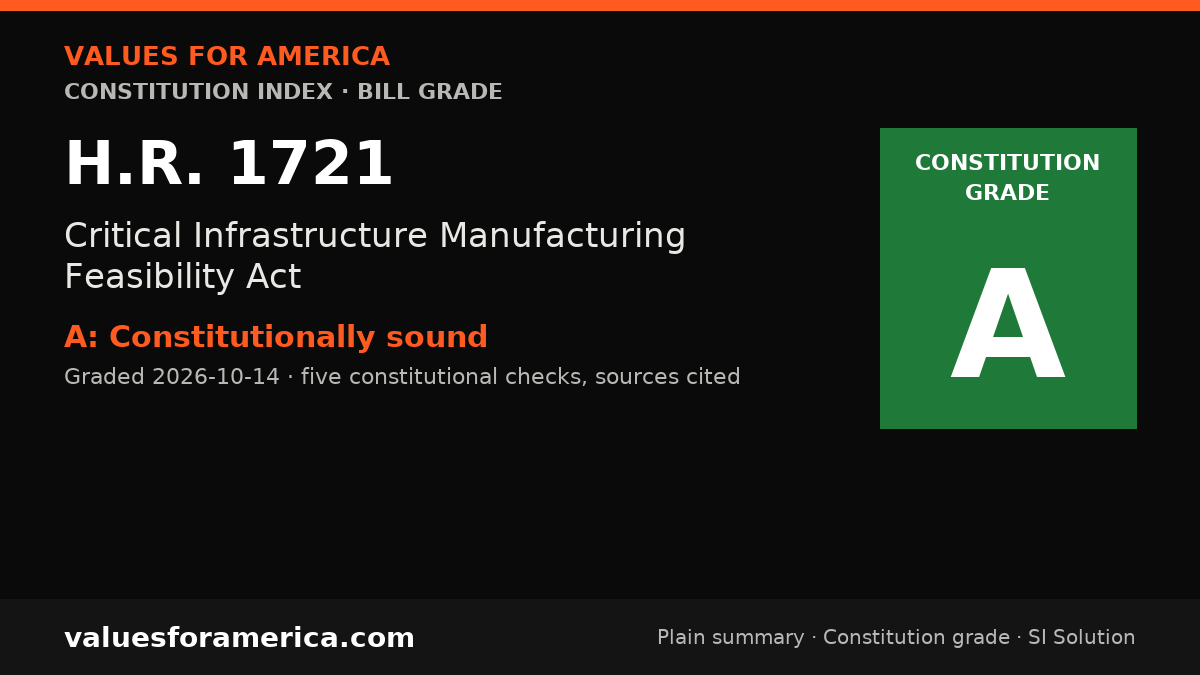
Critical Infrastructure Manufacturing Feasibility Act
Cosponsors: 2 (1 D, 1 R) · per Congress.gov, 2026-10-14
Introduced: 2025-02-27
Latest action (2026-09-24): Message on Senate action sent to the House.
What H.R. 1721 does, in plain terms
Critical Infrastructure Manufacturing Feasibility Act This bill requires the Department of Commerce to study and report on products that are in high demand across the critical infrastructure sectors. Critical infrastructure sectors are those whose assets, systems, and networks are vital to national security, the economy, public health or safety, or any combination of those matters. The study must (1) identify the products in high demand across those sectors that are being imported due to manufacturing, material, or supply chain constraints; and (2) analyze the costs, benefits, and feasibility of manufacturing those products in the United States.
Official summary by the Congressional Research Service, via Congress.gov.
Constitution Index
“VFA Constitution grade”
Constitutionally sound
Graded 2026-10-14
SI-generated grade · five published checks · not individually reviewed by a person · methodology
This bill directs the Department of Commerce to conduct a study and report on manufacturing feasibility for critical infrastructure products. It imposes no mandates, restrictions, or penalties on individuals, states, or private entities. It falls within Congress's enumerated power over interstate and foreign commerce, does not infringe any constitutional right, respects individual sovereignty, leaves all decision-making at the federal level only for a study (not regulation), and fully preserves due process and property rights.
-
✓ Passes · Enumerated powers
The bill authorizes a study and report on products in high demand across critical infrastructure sectors, focusing on imports and domestic manufacturing feasibility. This falls under Congress's power to regulate interstate and foreign commerce (Article I, Section 8, Clause 3) and to provide for the general welfare (Article I, Section 8, Clause 1). No regulatory or coercive action is taken; it is p… -
✓ Passes · Bill of Rights
The bill does not restrict speech, religion, assembly, press, petition, arms, quartering, search and seizure, self-incrimination, due process, takings, fair trial, jury, cruel and unusual punishment, or any other right protected by the first ten amendments. It imposes no obligations or prohibitions on individuals or entities. -
✓ Passes · Individual sovereignty
The bill does not restrict any person's control over their own person, property, speech, labor, or belief. It merely directs a federal agency to gather information and produce a report. No individual is compelled to act or refrain from acting. The burden on government to justify restrictions is not triggered because no restriction exists. -
✓ Passes · Decentralization
The bill passes all four questions of the decentralization test. (1) An individual or family could not handle a nationwide study of critical infrastructure manufacturing feasibility; this is inherently a national-scale informational task. (2) A local community or county could not conduct such a study across all sectors. (3) A state could not feasibly study national import patterns and manufacturin… -
✓ Passes · Due process and takings
The bill does not deprive any person of life, liberty, or property without due process, nor does it take private property for public use without just compensation. It imposes no penalties, fines, or seizures. Procedural and substantive due process are fully preserved.
Sources: Congress.gov: HR 1721 summary
Report an error in this grade
What should pass
“VFA SI Solution”
No solution yet
A sourced SI draft appears here once it passes automated checks (Constitution citation, source verification, independent SI critic). How publication works.
Related on VFA

For journalists and bloggers
“Embed this grade”
Free to use with the link back. The badge and card update when the grade changes. Embed terms →
