H.R. 1717 explained · 119th Congress · Pending in Congress
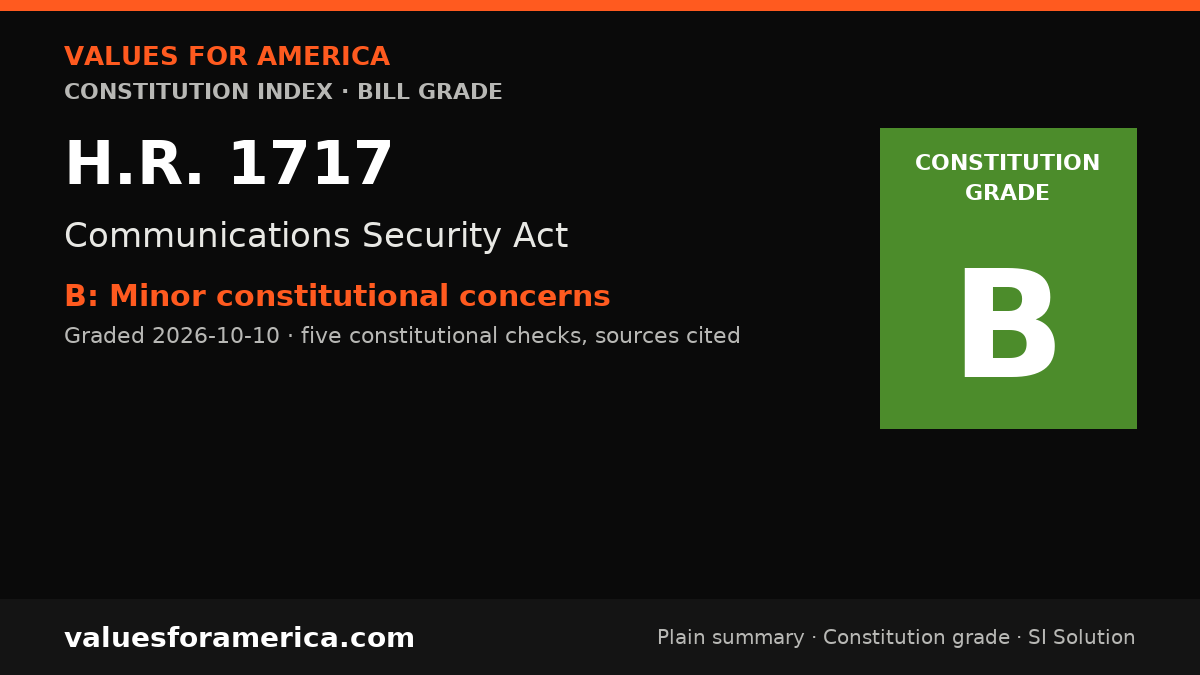
Communications Security Act
Cosponsors: 1 (0 D, 1 R) · per Congress.gov, 2026-10-11
Introduced: 2025-02-27
Latest action (2025-07-16): Received in the Senate and Read twice and referred to the Committee on Commerce, Science, and Transportation.
What H.R. 1717 does, in plain terms
Communications Security Act This bill provides statutory authority for a council established by the Federal Communications Commission (FCC) to provide advice regarding the security, reliability, and interoperability of communications networks. (This advice is currently provided by the FCC’s Communications Security, Reliability, and Interoperability Council.) The bill specifies that the FCC may designate an existing advisory committee to fulfill this role, provided the committee’s membership is modified, as necessary, to comply with membership requirements set forth in the bill. Specifically, the bill requires the council to include, to the extent practicable, representatives of companies in the communications industry; public interest organizations or academic institutions; and federal, state, tribal, and local governments (with at least one member representing each level of government). Members are to be selected by the FCC's chair and generally may not include representatives of entities owned or controlled by, or subject to the influence of, a foreign adversary, or otherwise deemed to pose a threat to U.S. national security. Under current law, federal advisory committees must generally terminate after two years unless they are renewed or a statute specifies a different termination date. However, the bill exempts the council from this requirement.
Official summary by the Congressional Research Service, via Congress.gov.
Constitution Index
“VFA Constitution grade”
Minor constitutional concerns
Graded 2026-10-10
SI-generated grade · five published checks · not individually reviewed by a person · methodology
The Communications Security Act is a modest, procedural bill that formalizes an existing FCC advisory council. It does not expand federal regulatory power over communications networks, but rather provides statutory authority for an advisory body that already exists. The bill raises minor concerns regarding the exclusion of foreign-influenced entities from council membership, which could implicate First Amendment associational rights, but these concerns are likely justified by national security interests and are limited to advisory roles. The bill also exempts the council from the two-year termination requirement, which is a minor deviation from standard administrative practice but does not violate the Constitution. Overall, the bill is mostly sound, with minor tensions that are fixable.
-
✓ Passes · Enumerated powers
The FCC operates under the Commerce Clause (Article I, Section 8, Clause 3) and the Necessary and Proper Clause (Article I, Section 8, Clause 18) to regulate interstate and foreign communications. Establishing an advisory council to advise on the security, reliability, and interoperability of communications networks falls squarely within the FCC's statutory mandate under the Communications Act of … -
✗ Concern · Bill of Rights
The bill's requirement that council members may not include representatives of entities owned or controlled by, or subject to the influence of, a foreign adversary, or otherwise deemed to pose a threat to U.S. national security, could implicate the First Amendment's freedom of association. However, this restriction applies only to membership on a federal advisory committee, not to general speech o… -
✓ Passes · Individual sovereignty
The bill does not restrict what individuals can do with their own person, property, speech, labor, or belief. It only sets membership criteria for a federal advisory committee. The exclusion of foreign-influenced entities from the council is a reasonable qualification for a government advisory role, not a restriction on individual liberty. The bill does not impose any mandates or prohibitions on p… -
✓ Passes · Decentralization
The bill does not consolidate decision-making at a higher level of government. It merely formalizes an existing FCC advisory council, which is an advisory body, not a regulatory authority. The council includes representatives from federal, state, tribal, and local governments, ensuring input from multiple levels. The bill does not shift power from states to the federal government; it simply provid… -
✓ Passes · Due process and takings
The bill does not deprive any person of life, liberty, or property without due process of law. It does not impose penalties or take property. The exclusion of foreign-influenced entities from council membership is not a deprivation of a protected interest; serving on an advisory committee is a privilege, not a right. The bill provides no hearing or notice requirements, but none are required becaus…
Sources: Congress.gov: HR 1717 summary
Report an error in this grade
What should pass
“VFA SI Solution”
No solution yet
A sourced SI draft appears here once it passes automated checks (Constitution citation, source verification, independent SI critic). How publication works.
Related on VFA

For journalists and bloggers
“Embed this grade”
Free to use with the link back. The badge and card update when the grade changes. Embed terms →
