H.R. 1709 explained · 119th Congress · Pending in Congress
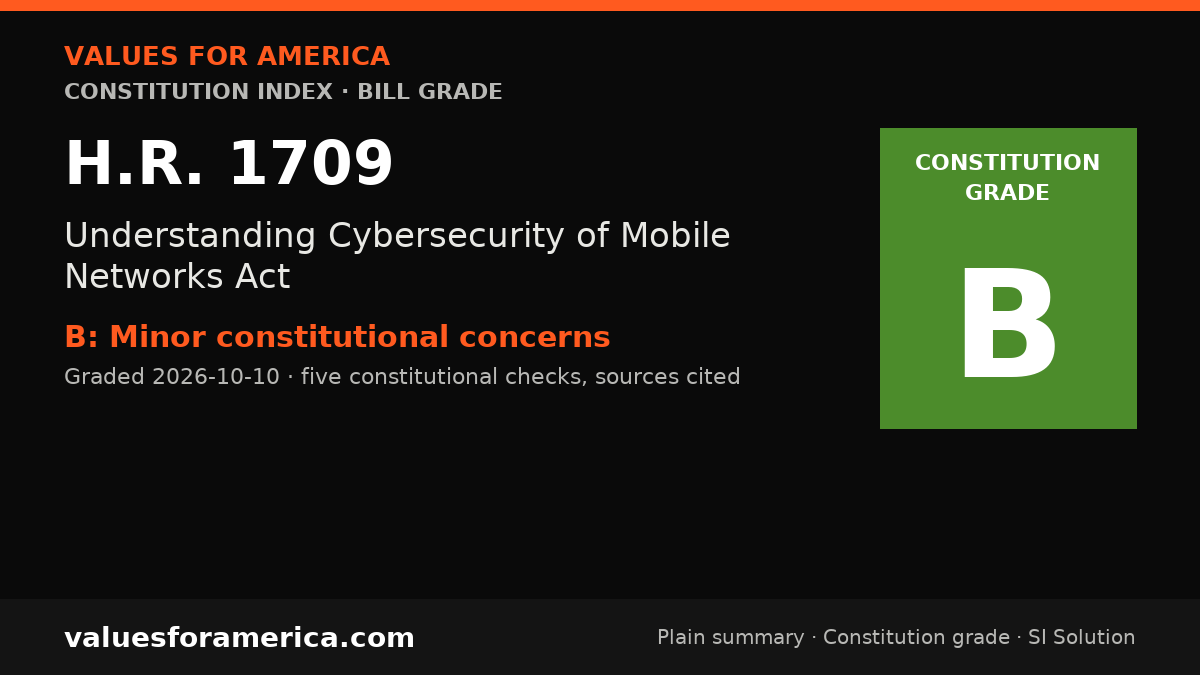
Understanding Cybersecurity of Mobile Networks Act
Cosponsors: 4 (0 D, 4 R) · per Congress.gov, 2026-10-11
Introduced: 2025-02-27
Latest action (2025-07-15): Received in the Senate and Read twice and referred to the Committee on Commerce, Science, and Transportation.
What H.R. 1709 does, in plain terms
Understanding Cybersecurity of Mobile Networks Act This bill requires the National Telecommunications and Information Administration to examine and report on the cybersecurity of mobile service networks and the vulnerability of these networks and mobile devices to cyberattacks and surveillance conducted by adversaries. The report must include, among other items, (1) an assessment of the degree to which mobile service providers have addressed certain cybersecurity vulnerabilities; (2) a discussion of the degree to which these providers have implemented cybersecurity best practices and risk assessment frameworks; and (3) an estimate of the prevalence and efficacy of encryption and authentication algorithms and techniques.
Official summary by the Congressional Research Service, via Congress.gov.
Constitution Index
“VFA Constitution grade”
Minor constitutional concerns
Graded 2026-10-10
SI-generated grade · five published checks · not individually reviewed by a person · methodology
This bill is a study-and-report measure that directs the National Telecommunications and Information Administration (NTIA) to examine cybersecurity vulnerabilities in mobile networks. It does not regulate conduct, restrict rights, or mandate private action. The primary constitutional concern is whether the federal government has enumerated authority to commission such a study. The Commerce Clause (Article I, Section 8, Clause 3) provides a reasonable basis, as mobile networks are instrumentalities of interstate and foreign commerce. The bill does not infringe on the Bill of Rights, individual sovereignty, or due process. It does, however, represent a minor upward consolidation of informational gathering, as states and private entities could conduct similar assessments, but the federal role is justified by the interstate nature of mobile networks. The grade is B because the bill is likely constitutional but raises a minor federalism tension.
-
✓ Passes · Enumerated powers
The federal government's authority to commission this study is grounded in the Commerce Clause (Article I, Section 8, Clause 3), which grants Congress power to regulate commerce among the several states. Mobile networks are inherently interstate and international in scope, and cybersecurity threats to these networks affect interstate commerce. The bill does not impose regulations but merely author… -
✓ Passes · Bill of Rights
The bill does not implicate any of the first ten amendments. It imposes no restrictions on speech, religion, assembly, press, petition, arms, quartering, search and seizure, self-incrimination, due process, takings, trial rights, or cruel and unusual punishment. It is purely informational and does not authorize surveillance or data collection from individuals. -
✓ Passes · Individual sovereignty
The bill does not restrict any individual's control over their person, property, speech, labor, or belief. It imposes no mandates on individuals or private entities. It merely directs a federal agency to study and report on cybersecurity issues. The burden of justification for any restriction is not triggered because no restriction exists. -
✗ Concern · Decentralization
The bill fails the decentralization test because it consolidates informational gathering at the federal level when states, private industry, or academic institutions could conduct similar assessments. However, the interstate nature of mobile networks and the need for a coordinated national perspective on cybersecurity justify federal involvement. The bill does not directly violate the Tenth Amendm… -
✓ Passes · Due process and takings
The bill does not deprive any person of life, liberty, or property, nor does it take private property for public use. It does not establish any adjudicative process or impose penalties. Therefore, procedural and substantive due process concerns are not implicated, and the Takings Clause of the Fifth Amendment is not triggered.
Sources: Congress.gov: HR 1709 summary
Report an error in this grade
What should pass
“VFA SI Solution”
No solution yet
A sourced SI draft appears here once it passes automated checks (Constitution citation, source verification, independent SI critic). How publication works.
Related on VFA

For journalists and bloggers
“Embed this grade”
Free to use with the link back. The badge and card update when the grade changes. Embed terms →
