H.R. 1703 explained · 119th Congress · Pending in Congress
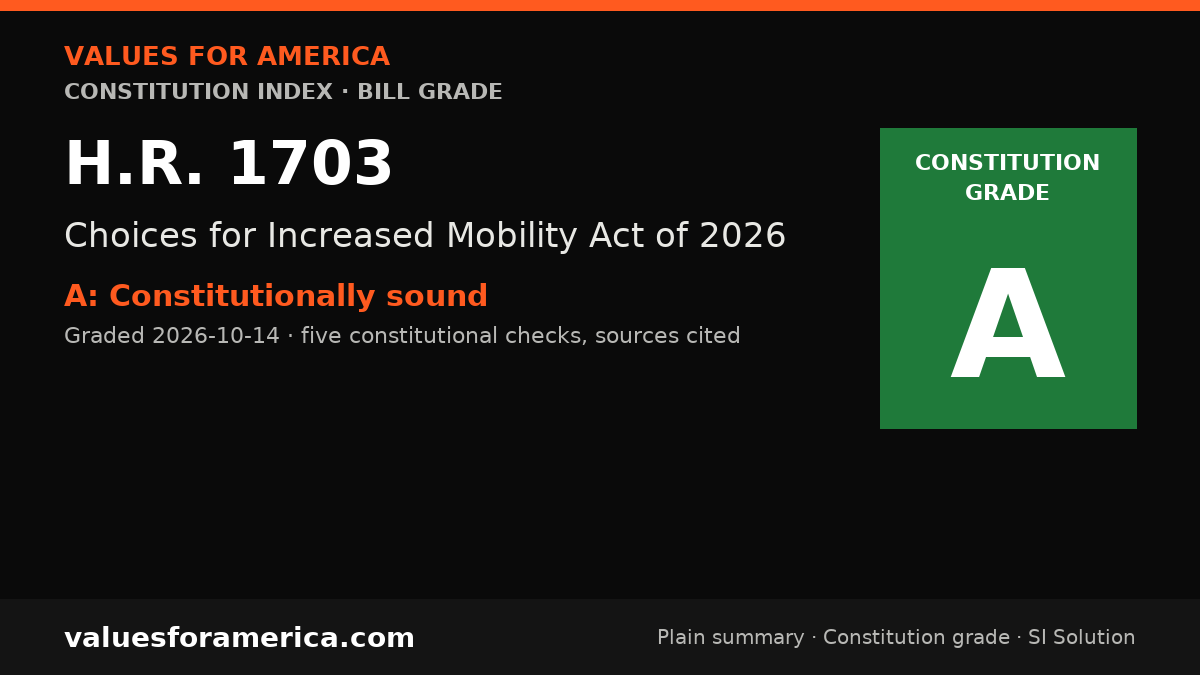
Choices for Increased Mobility Act of 2026
Cosponsors: 10 (4 D, 6 R) · per Congress.gov, 2026-10-14
Introduced: 2025-02-27
Latest action (2026-10-14): Message on Senate action sent to the House.
What H.R. 1703 does, in plain terms
Choices for Increased Mobility Act of 2025 This bill requires the Centers for Medicare & Medicaid Services (CMS) to establish specific billing codes under Medicare for certain materials used in ultralightweight manual wheelchairs. Specifically, the CMS must establish at least two billing codes for the base of the wheelchair, with at least one code for a base with titanium or carbon fiber construction material and at least one code for a base without these materials. Suppliers receive the same payment under Medicare for these wheelchairs as would otherwise apply, but may bill beneficiaries for any difference between the payment and the actual charge for the wheelchair. The CMS may require suppliers to inform beneficiaries of their potential financial liability in these cases.
Official summary by the Congressional Research Service, via Congress.gov.
Constitution Index
“VFA Constitution grade”
Constitutionally sound
Graded 2026-10-14
SI-generated grade · five published checks · not individually reviewed by a person · methodology
This bill is a narrow administrative measure that directs the Centers for Medicare & Medicaid Services to establish billing codes for certain wheelchair materials. It does not expand federal power beyond existing Medicare authority, does not infringe on any constitutional rights, and does not centralize decision-making beyond what is necessary for a federal insurance program. The provision allowing suppliers to bill beneficiaries for cost differences is a matter of contract and disclosure, not a taking or a denial of due process.
-
✓ Passes · Enumerated powers
The federal government has authority to administer Medicare under the Spending Clause (Article I, Section 8, Clause 1) and the Necessary and Proper Clause (Article I, Section 8, Clause 18). Establishing billing codes for Medicare-covered equipment is a routine exercise of that authority. -
✓ Passes · Bill of Rights
The bill does not implicate any of the first ten amendments. It does not restrict speech, religion, assembly, press, petition, arms, quartering, search and seizure, self-incrimination, due process, takings, trial rights, or cruel and unusual punishment. It merely adjusts administrative details of a voluntary federal insurance program. -
✓ Passes · Individual sovereignty
The bill does not restrict individual freedom. It creates optional billing codes and allows suppliers to inform beneficiaries of potential financial liability. Beneficiaries retain the freedom to choose their wheelchair and to accept or decline cost differences. The government is not compelling any individual to act against their will. -
✓ Passes · Decentralization
The bill concerns the administration of a federal program (Medicare) that is inherently national in scope. An individual or local community cannot administer Medicare billing codes. The federal government is the appropriate level for this action because Medicare is a federal program. The bill does not consolidate decision-making upward; it merely refines existing federal administration. -
✓ Passes · Due process and takings
The bill does not deprive anyone of property without due process. It does not take property for public use without just compensation. The provision allowing suppliers to bill beneficiaries for cost differences is a contractual arrangement, not a government taking. Beneficiaries are informed of potential liability, satisfying notice requirements.
Sources: Congress.gov: HR 1703 summary
Report an error in this grade
What should pass
“VFA SI Solution”
No solution yet
A sourced SI draft appears here once it passes automated checks (Constitution citation, source verification, independent SI critic). How publication works.
Related on VFA

For journalists and bloggers
“Embed this grade”
Free to use with the link back. The badge and card update when the grade changes. Embed terms →
