H.R. 1689 explained · 119th Congress · Pending in Congress
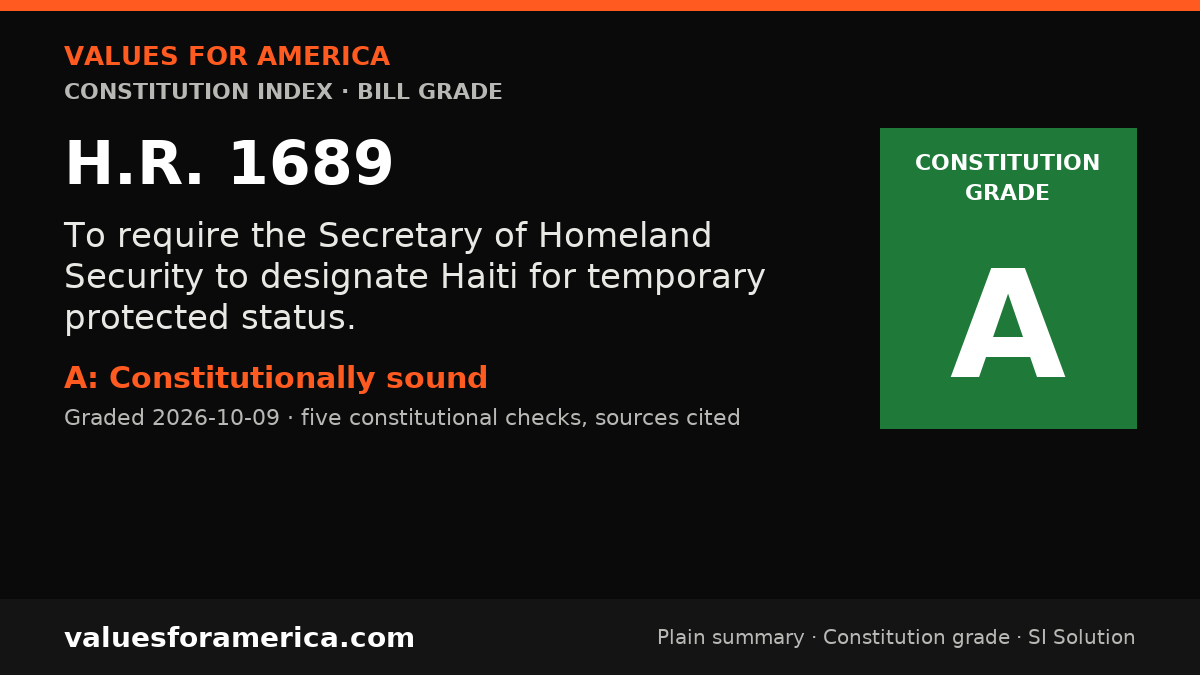
To require the Secretary of Homeland Security to designate Haiti for temporary protected status.
Cosponsors: 8 (7 D, 1 R) · per Congress.gov, 2026-10-08
Introduced: 2025-02-27
Latest action (2026-04-21): Read the second time. Placed on Senate Legislative Calendar under General Orders. Calendar No. 374.
What H.R. 1689 does, in plain terms
This bill directs the Department of Homeland Security to designate Haiti for temporary protected status (TPS) for 18 months beginning August 3, 2025. (Eligible nationals of a TPS-designated country may obtain employment authorization, may not be detained on the basis of their immigration status, and are not subject to removal while they retain TPS.)
Official summary by the Congressional Research Service, via Congress.gov.
Constitution Index
“VFA Constitution grade”
Constitutionally sound
Graded 2026-10-09
SI-generated grade · five published checks · not individually reviewed by a person · methodology
HR 1689 is constitutional. It exercises Congress's enumerated power over naturalization and immigration, does not infringe any Bill of Rights protections, respects individual sovereignty by providing relief from detention and removal, passes all four decentralization questions, and follows proper legislative due process.
-
✓ Passes · Enumerated powers
Congress has explicit constitutional authority over immigration and naturalization under Article I, Section 8, Clause 4, which grants Congress the power to 'establish an uniform Rule of Naturalization.' The Supreme Court has long recognized plenary federal power over immigration, including the authority to grant temporary protected status as a form of humanitarian relief. This bill falls squarely … -
✓ Passes · Bill of Rights
The bill does not infringe any of the first ten amendments. It grants employment authorization and protection from detention and removal to eligible Haitian nationals, which is a benefit, not a restriction. No speech, religion, press, assembly, petition, arms, quartering, search and seizure, self-incrimination, due process, trial, jury, cruel and unusual punishment, or reserved powers issues are i… -
✓ Passes · Individual sovereignty
The bill expands individual freedom by allowing eligible Haitian nationals to work lawfully and remain in the United States without fear of detention or removal. It does not restrict what any person can do with their own person, property, speech, labor, or belief. The government is providing a benefit, not imposing a restriction, so no compelling justification is required. -
✓ Passes · Decentralization
This action passes all four questions. (1) An individual or family cannot handle immigration status determinations on their own; this requires uniform national policy. (2) A local community or county cannot handle TPS designations; immigration is inherently federal. (3) A state cannot handle TPS designations; the Constitution assigns immigration to the federal government. (4) This does not consoli… -
✓ Passes · Due process and takings
The bill follows proper legislative procedure: it was introduced, passed by the House, read twice in the Senate, and placed on the legislative calendar. It does not bypass due process or take property without just compensation. TPS is a discretionary humanitarian designation, not a property right, so no Takings Clause issue arises under the Fifth Amendment.
Sources: Congress.gov: HR 1689 summary
Report an error in this grade
What should pass
“VFA SI Solution”
No solution yet
A sourced SI draft appears here once it passes automated checks (Constitution citation, source verification, independent SI critic). How publication works.
Related on VFA

For journalists and bloggers
“Embed this grade”
Free to use with the link back. The badge and card update when the grade changes. Embed terms →
